

Remember that moment in Avengers: Endgame when Doctor Strange raises a single finger? Tony Stark sees it, understands what it means, and makes the choice that kills him. We all thought we knew what that gesture meant: “This is the one.” The one timeline out of 14 million where the Avengers win.
But what if Strange was really saying something else entirely?
What if that finger meant: “This is the only way I can stop you from becoming Doctor Doom”?
Here’s where things get interesting. The Russo Brothers—the same directors who gave us Infinity War and Endgame—are back for Avengers: Doomsday. And when they were asked in March 2025 about how Robert Downey Jr. could return as Doctor Doom after dying as Tony Stark, Anthony Russo said something fascinating: “We can’t explain that as it’s part of the story. But there’s nobody else in the world who could play this character the way he’s about to.”
Tony’s death isn’t just backstory. It’s not a coincidence. According to the directors themselves, Stark’s sacrifice in Endgame directly connects to Doom’s story in Doomsday. Which raises an uncomfortable question: Did Doctor Strange see a future where Tony Stark survived the snap, refused to give up the Infinity Stones, and became something far worse than Thanos?
And did he choose to let Tony die to prevent it?
The theory coming out of the MCU community suggests something even more devastating: Strange made the “right” choice. He picked the timeline where Tony dies a hero instead of living long enough to become a villain. The problem? That choice had an unintended consequence. During the Time Heist that Strange’s plan required, Loki escaped with the Tesseract. That escape freed the multiverse. And when Loki shattered He Who Remains’ Sacred Timeline, every one of those 14 million possible futures became real.
Including the one where Tony Stark becomes Doctor Doom.
Strange now faces a threat he thought he’d erased from existence—except this version of Doom knows exactly what happened. He’s aware that a variant of Doctor Strange looked into the future, saw him, and specifically chose a path that wiped him from existence. Doom survived anyway, thanks to the multiverse chaos that Strange’s own plan created. And he’s pissed.
Think about that for a second. The entire Multiverse Saga has been building to a villain who exists because Doctor Strange played god with the timeline. Doom’s not just another big bad who wants to conquer or destroy. He’s on a mission of revenge against the heroes—specifically Strange—who tried to erase him from reality. And unlike Thanos, who never knew what the Avengers were planning, Doom has the benefit of hindsight. He can see exactly how Strange manipulated events to prevent his existence.
This reframes everything. Tony’s sacrifice wasn’t just about stopping Thanos. It was about preventing something potentially worse: an all-powerful Tony Stark corrupted by the Infinity Stones, fused with his armor, ruling the multiverse with an iron fist. Strange saw that future during those few seconds on Titan, lived through it, watched Tony transform from genius billionaire philanthropist into “Doctor Doom,” and made the hardest call imaginable.
He chose to kill one of his allies to save the universe from him.
The evidence for this theory is everywhere once you start looking. Tony’s entire arc has been building toward this dark possibility—his obsession with protecting Earth at any cost, his willingness to make unilateral decisions about global security, his belief that he alone could be trusted with ultimate power. “I am Iron Man” wasn’t just a declaration of identity. It was a warning about ego. And in at least one timeline, that ego got combined with six Infinity Stones and the kind of near-omnipotence that corrupted Thanos.
Here’s what we’re going to explore: the hidden future Strange saw, how Tony would have become Doom, why Loki’s escape broke everything, and what this means for Avengers: Doomsday. Because if this theory is right, the MCU has been telling one connected story about choice and consequence from the very beginning. And that story is about to come full circle in the most devastating way possible.
Doctor Strange tried to save us from Doctor Doom. He failed. And now the Avengers have to face a threat their own actions created—a threat wearing Tony Stark’s face.

What Doctor Strange Really Saw in Those 14 Million Futures
Let’s go back to Titan. The rusted planet where everything started to fall apart.
Doctor Strange sits cross-legged, suspended in air, his head tilted back as green energy pulses from the Time Stone. His body trembles. Sweat forms on his brow. And in those few seconds of real time, he lives through 14,000,605 different futures—experiencing each one fully, dying in most of them. When he finally opens his eyes, Tony Stark is immediately in his face: “How many did we win?”
“One.”
We all know what happens next. Strange trades the Time Stone to save Tony’s life—breaking his earlier promise to protect the Stone above all else. That finger raise in Endgame. Tony’s sacrifice. The assumption has always been that this was the “one way” Strange saw: let Thanos win initially, wait five years, use time travel to undo everything, and Tony dies stopping Thanos permanently.
But here’s the thing nobody talks about: Strange never said they only win in one future. He said out of 14 million futures, they win in one. That’s a very specific distinction. He didn’t say “there’s only one possible future where we win.” He said of the futures he saw—and we know from the Russos that Strange had to experience each death, each failure, living through centuries of possibility in mere moments—only one resulted in victory.
What about the other futures? The ones where they also defeat Thanos, but Strange didn’t count them as wins?

Think about what constitutes a “victory” from Doctor Strange’s perspective. He’s not just looking for any timeline where Thanos loses. He’s the Sorcerer Supreme. His job is protecting reality itself. A timeline where the Avengers technically defeat Thanos but create something worse in the process? That’s not a win. That’s just delaying the problem.
And here’s where the theory gets interesting: What if Strange saw futures where Tony Stark survived the snap?
Remember, in most of those 14 million futures, different combinations of heroes live and die. There’s got to be at least some scenarios where Tony makes it through Thanos’ snap. In fact, given the random nature of the snap, you’d expect roughly half of all futures to have Tony survive. That’s millions of possible timelines where Tony Stark is still alive after Thanos destroys half the universe.
But Strange specifically chose the path where Tony lives long enough to develop time travel and then dies using the Infinity Stones. Why? What did Strange see in those other timelines—the ones where Tony survived—that made them unacceptable?
The Vision That Haunted Tony Stark
Look at Tony’s entire arc. From the beginning, his greatest fear has been not doing enough. That vision Scarlet Witch showed him in Age of Ultron haunts him: his friends lying dead in space, Captain America’s dying words being “You could have saved us.” Every single one of Tony’s worst decisions stems from this terror of inadequacy. Creating Ultron. Supporting the Sokovia Accords. His paranoia about threats to Earth.

“I saw a suit of armor around the world,” Tony says, trying to justify Ultron’s creation. Even after that disaster, the impulse doesn’t go away. It gets stronger.
Imagine a scenario where Tony Stark—brilliant, arrogant, haunted Tony Stark—defeats Thanos using the Infinity Stones but doesn’t die. The Stones would have severely injured him, certainly. Thanos’ entire arm was burnt and scarred from a single snap. But what if Tony’s armor, his arc reactor technology, the sheer force of his will… what if it kept him alive?
Picture it: Tony Stark, scarred beyond recognition, his body permanently fused with his Iron Man armor. The suit isn’t something he wears anymore—it’s the only thing keeping him breathing. And in his burnt hand, glowing with impossible power, sit all six Infinity Stones. The very weapons that nearly killed him are now the only things sustaining him.
Strange had to have seen this possibility. In at least some of those 14 million futures, Tony won against Thanos without dying. And Strange had to ask himself: What does Tony Stark do with omnipotent power when he’s already convinced the universe needs to be saved from itself?
The answer is probably what terrified Strange into choosing the timeline where Tony dies.
Why Tony Would Never Give Up the Stones
Because Tony Stark with the Infinity Stones wouldn’t give them up. Not willingly. Think about it: the entire Infinity Saga, Tony’s been haunted by the possibility of another invasion. The Chitauri in New York. The vision of his friends dead. Ultron going wrong. Thanos proving that the threat was real all along. Every fear Tony had was validated.
When he finally holds the power to prevent any future threat—when he has all six Infinity Stones in his possession—why would he return them? Steve Rogers’ whole plan in Endgame depends on bringing the Stones back to their proper timelines. But in a scenario where Tony survives the snap, scarred and kept alive by the Stones’ power, there’s no way he agrees to that.
“The safest hands are still our own,” Tony said during Civil War, throwing Steve’s words back at him. And he believed it. With the Infinity Stones quite literally keeping him alive and offering ultimate protection, Tony would see returning them as a suicide mission—both for himself and for Earth.
Strange would have foreseen this. In his vision of the future, he’d watch as Tony Stark transformed from hero to something else entirely. Not overnight. Tony would still believe he was protecting people. He’d still see himself as Earth’s defender. But absolute power doesn’t just corrupt—it warps perspective. The Stones would twist Tony’s already-present paranoia into something darker.
“I’ve successfully privatized world peace,” Tony jokes in Iron Man 2. But with six Infinity Stones and the conviction that he alone can be trusted? That joke becomes a mission statement. Tony wouldn’t see himself as a tyrant. He’d see himself as the only person willing to make the hard choices to keep humanity safe.
In this scenario, “Doctor Doom” isn’t just a villain name someone pins on Tony. It becomes what he is. The merchant of death turned ultimate authority. A genius who started with good intentions and ended up with a “suit of armor around the world” powered by Infinity Stones—crushing free will in the name of safety.
And Strange saw it coming. That’s why he traded the Time Stone to save Tony’s life while simultaneously setting up the chain of events that would kill him five years later. It wasn’t cruel. From Strange’s perspective, it was mercy. Better for Tony Stark to die a hero than live long enough to become the very thing he fought against.
The “one way” wasn’t about defeating Thanos. It was about defeating Thanos and preventing Doctor Doom from ever existing.
How Tony Stark Becomes Doctor Doom: The Timeline Strange Prevented
Let’s map out exactly how this transformation happens. Because the path from Tony Stark to Doctor Doom isn’t a sudden corruption—it’s the logical endpoint of every character beat the MCU has been building for over a decade.
It starts the same way in every timeline: the Battle of Earth. Thanos and his armies descend on the Avengers compound. Captain America stands alone facing an army, until the portals open and everyone who was snapped away comes back. The fight is desperate, brutal, exactly what we saw in Endgame.
But here’s where the timelines diverge.
In our timeline—the “sacred” one—Tony Stark snaps his fingers, says “And I… am… Iron Man,” and dies from the power surge. The Infinity Stones literally burn through him, stopping his heart, and he passes knowing he saved everyone. It’s tragic, heroic, final.
In the Doctor Doom timeline? Tony survives the snap. Barely.

The Infinity Stones Corrupt Tony Stark
The Infinity Stones rip through his body just like they did in our timeline. His arm is scorched beyond repair. The energy tears through his nervous system, his organs, his cells. By all rights, he should die. But Tony Stark has been cheating death since a car bomb filled him with shrapnel in an Afghan cave. His arc reactor kept his heart beating then. His armor systems could keep him alive now.
Except it’s not just the armor anymore. In this timeline, the Infinity Stones—all six of them—have bonded to Tony at a cellular level. The raw power that should have killed him has instead fused with his biology. He can’t remove the Stones without dying. But more importantly, he discovers he can draw on their energy to stay alive. The Stones become his new arc reactor, except instead of keeping shrapnel from reaching his heart, they’re keeping his entire ravaged body functioning.
Think about what Thanos looked like after using the Stones just once. The entire right side of his body was scarred, blackened, permanently damaged. Imagine Tony Stark—whose body is smaller, frailer—after channeling all six Stones at full power. The scarring would be catastrophic. His face would be a ruin. The only reason he’s not dead is because the Stones themselves are sustaining him.
And here’s where the armor becomes permanent.
Tony’s suit has always been a part of his identity. “I am Iron Man,” he declared in the first film, rejecting the separation between man and machine. The Mark 50 and Mark 85 were nanotech, stored in his body, basically part of him already. With his body too damaged to survive unassisted, the armor isn’t optional anymore. It’s a life support system. The mask isn’t to hide his identity—it’s covering a face too scarred to show.
Sound familiar? Victor von Doom wears his mask for the exact same reason. His face was destroyed in an accident involving forces he couldn’t control, and his armor is all that keeps him alive. In this timeline, Tony Stark has literally become the same thing, just with a different origin story.
From Iron Man to Doctor Doom: The Psychological Transformation
The psychological transformation happens next. And honestly, it’s almost sympathetic.
Tony wakes up after the Battle of Earth to discover he’s permanently bonded to the most powerful objects in the universe. His body is destroyed. He’s alive only because six cosmic artifacts are functioning as his organs. And he knows—knows—that if anyone tries to take the Stones from him to return them to their original timelines (which is exactly what Captain America wants to do), Tony dies.
When Steve Rogers approaches him about the plan to return the Stones, Tony refuses. And he’s not wrong to refuse. From Tony’s perspective, Steve is literally asking him to commit suicide for the sake of timeline preservation. Steve might argue about the greater good, about fixing the branches they created during the Time Heist, but Tony’s looking at it from a much more immediate angle: “You want me to die.”
The two men have been on opposite sides of this argument before. “Sometimes my teammates don’t tell me things,” Steve said in Civil War, and Tony shot back with “I’m not your teammate anymore.” That rift never really healed, even when they fought Thanos together. And now it breaks open again, except this time Tony holds all the cards. Literally all the power in the universe.
This is where things get dark.
Tony doesn’t just refuse to return the Stones. He starts to rationalize keeping them. Think about the psychology here: he’s just spent years being right about everything he was afraid of. The Chitauri invaded. Sokovia almost got destroyed. Thanos arrived exactly like Tony predicted. His paranoia was completely justified.
He has the power to make sure it never happens again. Not just on Earth. Anywhere. The Infinity Stones can reshape reality, control time, manipulate minds, traverse space instantly. With proper application, Tony could prevent any cosmic threat from ever reaching Earth. He could monitor the entire universe for emerging dangers. He could build that suit of armor around the world he always wanted, except now it’s a suit of armor around reality itself.
“Peace through strength” was always Tony’s philosophy. Ultron was supposed to be a peacekeeping program. The Iron Legion was about protection. But those were limited by technology. The Infinity Stones remove those limitations. Tony can finally, finally, do what he’s always believed he should do: protect everyone, perfectly, forever.
Because he’s Tony Stark—genius, futurist, person who’s always three steps ahead—he’d convince himself this is the right thing. He’d build systems. Protocols. He’d use the Mind Stone to prevent conflicts before they start. The Reality Stone to repair damage instantly. The Time Stone to undo catastrophes. From his perspective, he’s not a tyrant. He’s the only person in the universe with both the power and the moral clarity to do what needs to be done.
But here’s the thing about absolute power: it doesn’t just corrupt, it isolates.
Why the Avengers Would Turn Against Him
The other Avengers see what’s happening. Steve Rogers recognizes the pattern—it’s exactly what HYDRA wanted to do with Project Insight, except a million times worse. Natasha sees a man who’s let his fear consume him. Bruce understands the danger of playing god. Thor knows what it looks like when someone accumulates too much power and loses perspective.
They try to intervene. Maybe they stage an intervention. Maybe they try to peacefully convince Tony to step down, to seek help, to recognize what he’s becoming. And Tony—isolated by his power, certain of his righteousness, unable to see how far he’s fallen—sees their concern as betrayal.
“I’m keeping you safe,” he tells them. “I’m keeping everyone safe. Why can’t you see that?”
The final break probably happens after Tony does something irreversible. Maybe he uses the Mind Stone to stop a conflict, not realizing (or not caring) that he’s overridden people’s free will. Maybe he rewinds time to prevent a tragedy, breaking the natural flow of causality. Maybe he simply makes a unilateral decision about something massive—relocating populations, altering ecosystems, making choices for civilizations without asking them.
And the Avengers—his former friends—stand against him.
The fight that follows ends with Tony winning, because of course it does. He has all six Infinity Stones. But in winning, he’s lost everything that made him a hero. His team is scattered, fled, or imprisoned. The people he saved from Thanos now fear him. The man who gave everything to protect the universe has become its greatest threat.
At some point in this spiral, someone—maybe Rocket Raccoon, who’s never been one for tact—calls him what he is: “You’re not Iron Man anymore, Stark. You’re a tyrant. A doomsday machine with a god complex.”
And maybe Tony, in one of his darker moments, embraces the assessment. If they’re going to call him Doctor Doom, fine. He’ll be Doctor Doom. At least a universe under Doom is a universe that survives.
The Adoption Theory Connection
But here’s the truly brilliant part of this theory: The Russo Brothers specifically said Robert Downey Jr. is playing Victor Von Doom. Not just “Doctor Doom.” Not “a variant who uses the Doom name.” Victor Von Doom specifically.
Which brings us to the adoption theory.
What if Tony Stark is Victor Von Doom? What if—in this timeline or even in the main 616 timeline—Tony was born Victor Von Doom in Latveria, then adopted as a baby by Howard and Maria Stark? We’ve never seen baby Tony. We don’t have his birth certificate. Endgame showed Tony looking confused when he sees his mother pregnant, like there’s something not quite right about it.
If Tony’s birth name was Victor Von Doom, then his transformation into Doctor Doom isn’t just thematic—it’s him embracing his true identity after discovering it through the omniscience the Infinity Stones provide. The name Stark was given to him. Doom was his birthright.
And honestly? That makes the tragedy even more complete. Tony spent his whole life trying to live up to or escape from Howard Stark’s legacy. In the end, he becomes something else entirely—not Iron Man, not Stark, but Doom. The man he was always meant to be if his path had gone differently.
Doctor Strange saw all of this play out in those 14 million futures. He watched Tony transform from hero to villain, saw the Infinity Stones corrupt him, witnessed the birth of Doctor Doom. And Strange made a choice: better to have Tony die a hero than watch him become this.
But Strange made one crucial miscalculation. He didn’t account for what Loki would do during the Time Heist.
How Loki’s Escape Created Doctor Doom (Strange’s Fatal Mistake)
Doctor Strange thought he’d solved the problem. Choose the timeline where Tony dies, Doctor Doom never exists, humanity is saved. Simple. Tragic, but simple.
Except it wasn’t simple at all. Because Strange’s perfect plan had a flaw he couldn’t have predicted: Loki picking up the Tesseract during the Time Heist.
Let’s be clear about what happened in Endgame. When the Avengers traveled back to 2012 New York, they were supposed to grab the Space Stone (inside the Tesseract), the Mind Stone (inside Loki’s scepter), and the Time Stone from the Ancient One. Clean in, clean out, don’t disrupt the timeline. Except Tony and Scott botched the Tesseract retrieval—it ended up sliding across the floor to Loki’s feet, and Loki, being Loki, took the opportunity to escape.
At the time, it seemed like a minor hiccup. Tony and Steve had to make an additional jump to 1970 to get the Space Stone from a different point in history. Problem solved, right? The Time Heist continued, the Avengers won, Steve returned all the Stones to their proper places. Everything tied up neatly.
Except that moment—Loki vanishing with the Tesseract—broke everything.

Loki Season 2’s Multiverse Revelation
In the Loki series, we learn exactly what happened next. Loki’s escape created a branching timeline, which the TVA immediately detected and moved to prune. But here’s what most people missed: That branch wasn’t supposed to exist. Not because Loki shouldn’t have escaped (though that’s what the TVA claimed at first), but because the entire system of “sacred timeline” protection was a lie orchestrated by He Who Remains.
He Who Remains—a Kang variant who won the multiversal war—had set up the TVA to maintain a single timeline: his timeline. Any deviation from his predetermined path was eliminated. But He Who Remains wasn’t trying to protect the multiverse. He was trying to prevent the other Kang variants from existing and potentially challenging his rule.
And the entire setup, every manipulation, was designed to bring Loki to the Citadel at the End of Time.
How He Who Remains Orchestrated Everything
Here’s what He Who Remains tells Loki in the Season 1 finale: “I paved the road.” He knew Loki would escape during the Time Heist. He knew the TVA would capture him. He knew Loki would eventually break free with Sylvie and make it to the Citadel. He knew Sylvie would kill him. All of it was orchestrated.

But why? Because He Who Remains was tired. After eons of managing the timeline, preventing multiversal war, maintaining the lie, he wanted out. But he couldn’t just stop—the moment he released his control, all the pruned timelines would branch out again, and the Kang variants would return to wage war. So he needed someone to either take over his job (maintain the Sacred Timeline and prevent Kang) or destroy the system entirely (free the multiverse and accept the consequences).
He gave Loki the choice: Kill Sylvie and take the throne, or let Sylvie kill him and unleash chaos.
Loki tried to find a third option. But in the end, he couldn’t stop Sylvie. She drove her sword through He Who Remains’ chest, and the Sacred Timeline shattered.
Now here’s where it gets complicated—and where Strange’s plan completely unraveled.
Before Loki Season 2’s finale, the multiverse was chaos. Branches grew uncontrollably, and the Temporal Loom (the device that processed all timeline branches) was overloading. The TVA tried to scale up the Loom, tried to manage the infinite growth, but as Ouroboros explained: “It’s like trying to divide by zero. It can’t be done.”
The only options were to let everything die—every timeline, including the Sacred Timeline—or go back and prevent Sylvie from killing He Who Remains in the first place, essentially restarting the cycle of control.
Loki refused both options.
Instead, he destroyed the Temporal Loom himself. He walked into the temporal radiation, grabbed the dying threads of reality with his bare hands, and used his magic to weave them into a new structure: Yggdrasil, the World Tree of Norse mythology. No longer one “sacred” timeline, but infinite branches all coexisting, all protected by Loki literally holding them together from the center.
It’s actually beautiful. Loki, the god of mischief, transformed into the God of Stories, sitting on a throne at the center of the multiverse, ensuring every possible story, every branching choice, every alternate reality can exist simultaneously. Free will restored. No more pruning. No more forced timeline.

For the multiverse, this is liberation.
For Doctor Strange’s plan? This is catastrophe.
Why Every Possible Future Became Real
Because here’s what Loki’s sacrifice did: It made every single possible future real.
Remember, Strange saw 14,000,605 possible futures. In his timeline—the Sacred Timeline, the one He Who Remains was protecting—only one of those futures came to pass: the one where Tony dies. All the other 14 million possibilities, including the ones where Tony becomes Doctor Doom, were prevented from existing because He Who Remains was pruning alternate timelines before they could fully develop.
But when Loki freed the multiverse and formed Yggdrasil? All those pruned possibilities came back. Every variation, every choice, every divergent path—they all exist now. Not as theoretical futures Strange glimpsed, but as actual, living universes.
Which means somewhere in the branches of Yggdrasil, there’s a universe where Tony Stark survived the snap. Where he kept the Infinity Stones. Where he became Doctor Doom.
And because the Infinity Stones grant cosmic awareness—we saw this with Infinity Ultron in What If?—this version of Doom knows he exists in a multiverse. More than that, he can see across realities. He’s aware that in other timelines, Tony Stark died. He’s aware that Doctor Strange manipulated events to prevent his existence.
He’s aware, and he’s furious.
Think about it from Doom’s perspective. He was the future that Strange actively chose to erase. Strange looked at him—looked at Tony Stark living, powerful, protecting the universe—and decided “No. This version doesn’t get to exist. Better to kill Tony and accept chaos than let him live.”
Doom would see this as the ultimate betrayal. Not just from Strange, but from the concept of predetermined fate itself. He was erased, deleted, deemed unworthy of existence. And then, through a cosmic accident (Loki freeing the multiverse), he came back into being—but now with the knowledge that he was never supposed to exist at all.
The rage that would fuel is almost beyond comprehension.
But there’s another layer to this that makes it even more devastating: Strange’s plan actually worked until Loki changed the rules.
If Loki had never picked up the Tesseract in 2012, the Sacred Timeline would have continued uninterrupted. Tony would have died in Endgame, the Stones would have been returned, and Doctor Doom would have remained one of millions of prevented possibilities—a nightmare future that Strange saw and successfully avoided.
But Loki did pick up the Tesseract. And He Who Remains confirmed this was “supposed to happen”—meaning Strange’s plan to save the universe was part of He Who Remains’ larger scheme to bring Loki to the Citadel. Which means that in trying to prevent Doctor Doom, Strange inadvertently set in motion the exact chain of events that would bring Doom back into existence.
There’s a brutal irony here that feels very much in line with Greek tragedy: The hero’s attempt to prevent the prophecy is what causes the prophecy to come true.
Strange tried to prevent Doctor Doom by choosing Tony’s death. But that choice required the Time Heist. The Time Heist led to Loki’s escape. Loki’s escape led to He Who Remains’ death and the freeing of the multiverse. And the freed multiverse brought Doctor Doom back—not just as a prevented future, but as an angry, omnipotent variant with a personal vendetta against Strange for trying to erase him.
You can almost hear He Who Remains laughing from beyond death: “I told you. I paved the road. You can’t escape it.”
And now Strange—and all the Avengers—have to deal with the consequences. They’re facing a villain who exists because they tried to save the universe. Doctor Doom isn’t just powerful. He’s justified. From his perspective, he’s not the threat. The time manipulators who played god and tried to erase entire realities? They’re the threat. And he’s here to balance the scales.
The hero of one story is the villain of another. It’s all a matter of perspective. And Doctor Doom’s perspective is that Doctor Strange tried to kill him before he was even born.
Strange meddled with time to prevent Doom. He succeeded temporarily. But Loki broke the system, and now Doom is back—except angrier, more powerful, and armed with the knowledge of what Strange tried to do.
The bill has come due.
Doom’s Revenge: Why He’s Targeting Doctor Strange in Doomsday
Let’s talk about what Doctor Doom actually knows.
This isn’t just a Tony Stark variant who happened to take a different path. Thanks to the Infinity Stones bonded to his body, Doom has cosmic awareness. He can perceive across timelines. He sees the branching paths of reality the same way you or I might look at a family tree. And what he sees when he looks at Universe 616—the “main” MCU timeline—must fill him with absolute fury.
He sees a universe where his counterpart died. Where Tony Stark snapped away Thanos and was hailed as the ultimate hero. Where statues were built, memorials erected, everyone mourning the great man who gave his life to save the universe.
But he also sees why Tony died. And that’s where things get personal.
Doom can perceive the moment on Titan where Doctor Strange used the Time Stone to look into 14 million futures. He can see Strange evaluating each possibility, living through each timeline. And critically, Doom can see the futures Strange chose not to take—including the ones where Tony Stark survived and became Doom himself.
From Doom’s perspective, this is damning evidence of manipulation.
Strange didn’t just witness possible futures. He actively selected which one to pursue. He made a choice: let Tony die so that Doom would never exist. And then Strange led Tony down that path like a lamb to slaughter, all while pretending it was the only way.
“I will not hesitate to let either of you die,” Strange told Tony and Peter on Ebony Maw’s ship. At the time, it seemed like brutal honesty from a man who understood the stakes. But with Doom’s perspective? That line takes on a much darker meaning. Strange wasn’t just willing to let Tony die. He actively planned for it. He needed Tony to die.
And Tony never knew.
The Confrontation: Strange vs. Doom
Think about how that betrayal lands. Tony Stark trusted Strange’s judgment. When Strange raised that finger in Endgame—signaling “this is the one”—Tony acted on faith that Strange had seen a path to victory. He put on the Infinity Gauntlet, snapped his fingers, and died believing he’d saved everyone.
He never knew that Strange had seen other paths. Paths where Tony lived. Paths where they still defeated Thanos.
Strange didn’t tell him. And in Doom’s eyes, that makes Strange not a hero, but a murderer who killed Tony Stark to prevent a future he personally deemed unacceptable.
The Russo Brothers have confirmed that Doctor Strange is a central figure in this film. They’ve hinted at major conflicts between the heroes. And the transcript theory lays out what might be the most dramatically satisfying confrontation in MCU history: Doom accusing Strange of playing god with the timeline.
Picture this scene:
Doctor Doom has the Avengers at his mercy. Maybe he’s cornered them, maybe he’s demonstrated his power by doing something impossible—stopping time, rewriting local reality, showing that he’s operating on a level above anything they’ve faced before. The heroes are desperate, outmatched, trying to buy time or find a weakness.
And then Doom speaks. Not to all of them. To Strange specifically.
“I know what you did.”
Strange, carefully maintaining composure: “I did what was necessary to save the universe.”
“You killed Tony Stark.” Doom’s voice is cold, precise. “You saw futures where he lived. Futures where we defeated Thanos and he survived. But you didn’t choose those futures, did you, Doctor? You chose the one where he died. Because you saw what I would become.”
The other Avengers are looking at Strange now. Confused. Horrified. They’ve never heard this before.
Strange, defensive: “I saw what you would do. The control you would seize. The free will you would eliminate in the name of protection. I made the only choice that saved the universe.”
“Saved the universe?” Doom’s laugh is bitter. “You destroyed half of existence for five years. Trillions dead because you were too afraid to trust Tony Stark with power. Tell me, Doctor—how many of those 14 million futures did you explore? How many variations did you consider? Or did you just see me and decide immediately that I was the threat?”
Strange doesn’t answer, which is an answer in itself.
“You played god,” Doom continues. “You decided which realities deserved to exist and which didn’t. You erased me from existence because you were frightened of what I represented. And then your meddling—your time travel, your manipulation—created the chaos that brought me back anyway. So congratulations, Doctor Strange. You’re a prophet. You predicted your own failure.”
That callback to Infinity War—”Congratulations, you’re a prophet”—is Tony’s line to Bruce. Doom using it here is a knife twist, throwing Tony’s words back at Strange to emphasize the betrayal.
Why Doom’s Anger is Justified
And here’s the thing: Doom isn’t entirely wrong.
Strange did manipulate the timeline. He did make a unilateral decision to eliminate certain futures. He did lead Tony to his death without telling him there were alternatives. From a certain perspective, Strange’s actions were every bit as arrogant and controlling as anything Doom might have done.
The difference—and it’s a crucial one—is intent. Strange made his choice to prevent greater suffering. He saw Doom becoming a tyrant and made the hard call to stop it. Was it playing god? Yes. But sometimes, when you have the power of the Time Stone, playing god is the job.
Except Strange can’t say that without sounding exactly like Doom would: “I made the hard choices for your own good. I know better than you what’s best for the universe.”
This is the moral ambiguity the MCU has been building toward since Civil War. There are no clear heroes and villains anymore—just people with different philosophies making choices they believe are right. Tony thought creating Ultron was right. Steve thought opposing oversight was right. Strange thought killing Tony was right. Doom thinks controlling the multiverse is right.
They’re all trying to protect people. They’re all convinced of their moral superiority. And they’re all willing to override free will and choice in service of their vision of safety.
The confrontation probably escalates from there. Maybe Peter Parker, who was effectively orphaned twice by losing Tony, breaks down: “You let him die? You could have saved him?”
Maybe Thor, who’s lost everyone he loved, rounds on Strange: “You speak of sacrifice as if you’re the only one who understands it. But you sacrificed Tony. Not yourself. Someone else paid the price for your decision.”
And maybe Strange, pushed to defend himself, says what he’s been thinking all along: “I saw what he would become. I saw Doctor Doom conquer reality, crush dissent, impose order through fear. Would you rather I let that happen? Would you rather live in a universe ruled by—”
“By someone like me?” Doom finishes. “Someone who understands that the multiverse cannot simply be left to chaos? Someone who recognizes that free will is a luxury civilizations can’t afford when extinction is always one mistake away?”
And there it is. The philosophical core of the conflict.
Strange believed in free will enough to erase a future that threatened it. Doom believes free will is the problem and order is the solution. They’re opposing extremes of the same impulse: protect people from themselves.
But Doom’s revenge isn’t just philosophical. It’s personal and tactical.
He knows that Strange’s manipulation—the Time Heist that led to Loki’s escape, which led to the freeing of the multiverse—is what created the current crisis. The Multiverse Saga’s chaos, the incursions, the collapsing realities, all of it stems from choices Strange made trying to prevent Doom’s existence.
Doom’s plan is probably elegant in its symmetry: punish Strange by using the chaos Strange created. The multiverse is fracturing because of the Time Heist’s consequences. Doom is going to “fix” it—impose order on the chaos—and in doing so, prove that his way was right all along.
He’s going to force the Avengers to watch as he does what Strange should have let him do five years ago: bring stability to reality. Except now it’s going to cost so much more. Lives, worlds, entire realities will be casualties of Doom’s imposed order. And the tragedy is that if Strange had made a different choice—if he’d trusted Tony, if he’d worked with Doom instead of trying to erase him—maybe they could have found a better way together.
But Strange chose the path of manipulation. And now Doom is choosing the path of revenge.
The transcript theory specifically mentions that Doom might target the Council of Kangs too—”He who remains, who paved the path for this all to happen, is also to blame. But he’s dead, or kind of. I think we’re going to see Doom annihilate the entire Council of Kangs.”
This makes sense. From Doom’s perspective, He Who Remains orchestrated the entire system that kept Doom erased from existence. The Council of Kangs represents the same impulse: control reality, prevent certain outcomes, impose order. Doom sees them as architects of his erasure.
He’s going after everyone who tried to delete him: Strange, the Kangs, anyone who believes they have the right to decide which futures deserve to exist.
And the brutal irony? Doom is proving he’s exactly what Strange feared he would be. A tyrant who believes his vision justifies any atrocity. Someone willing to break reality to impose his will.
Strange tried to prevent this future. But in trying to prevent it, he created a version of it that’s even worse—because now Doom knows what Strange tried to do, and he’s angry about it.
The path to hell, paved with good intentions. It’s practically Shakespearean.
What This Theory Means for Avengers: Doomsday and Secret Wars
Alright, so if this theory is even remotely close to accurate, we need to talk about what it means for Avengers: Doomsday and the wider Multiverse Saga.
First, the casting makes perfect sense now.
When Robert Downey Jr. was announced as Doctor Doom at San Diego Comic-Con 2024, the reaction was… complicated. Some fans were thrilled. Others felt betrayed. The common concern was that Marvel was just bringing back RDJ for nostalgia’s sake, that they couldn’t let go of Iron Man, that the casting was a gimmick.
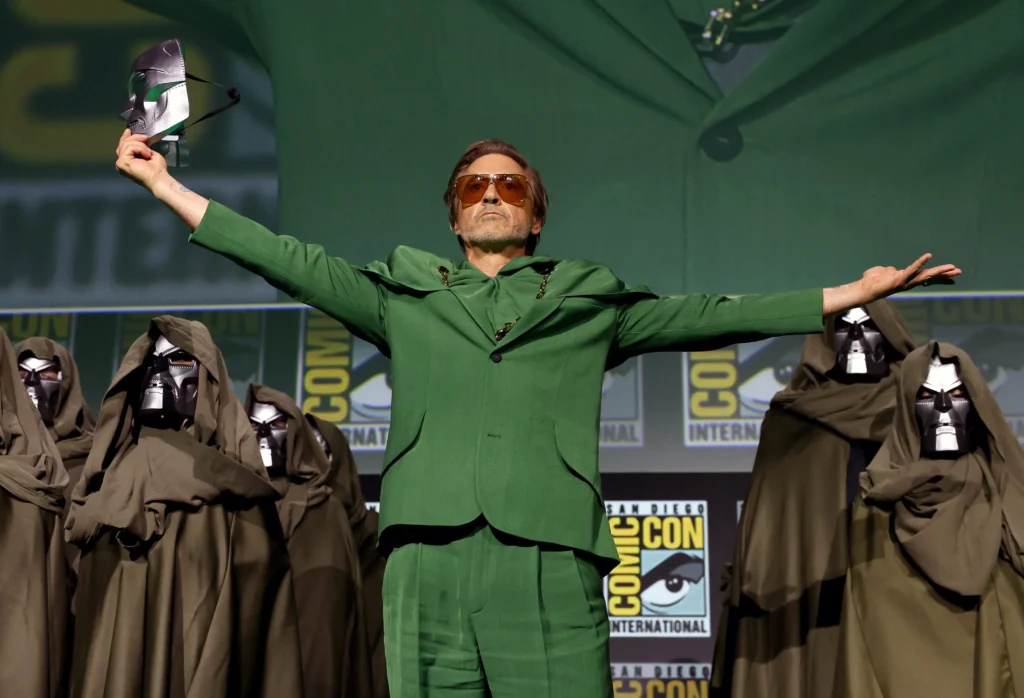
But if Doom is literally a Tony Stark variant who was erased by Strange and returned with a vengeance? That’s not a gimmick. That’s a thesis statement about the entire Multiverse Saga.
The Russo Brothers specifically said they’re playing Victor Von Doom, not just “a character called Doom.” Combined with their March 2025 comments that “Tony’s death is part of the story” and “there’s nobody else in the world who could play this character the way he’s about to,” it’s clear they’re leaning into the connection rather than avoiding it.
And honestly, that’s brilliant.
Because Avengers: Doomsday isn’t just another team-up film. It’s a reckoning. The Multiverse Saga has been about choices and consequences from the very beginning. WandaVision was about Wanda choosing to process grief through denial and control. Loki was about Loki choosing between order and chaos. No Way Home was about Peter choosing compassion over vengeance. Doctor Strange 2 was about Strange confronting alternate versions of himself who made different choices.
Every single project has reinforced the same theme: your choices matter, and they ripple out in ways you can’t predict or control.
Doctor Strange chose to kill Tony Stark to prevent Doctor Doom. That choice rippled out through time—requiring the Time Heist, which caused Loki’s escape, which freed the multiverse, which brought Doom back anyway. Strange’s attempt to prevent the future created it.
Now he has to face it.
Let’s talk about what the movie itself might look like. Production wrapped in September 2025, with the film scheduled for December 2026. The cast is absolutely stacked: Chris Hemsworth, Tom Hiddleston, Benedict Cumberbatch, Anthony Mackie, Sebastian Stan, and notably, Pedro Pascal as Reed Richards from The Fantastic Four: First Steps.
That last one is crucial. In the comics, Doctor Doom and Reed Richards are archenemies, former college roommates whose rivalry defines both characters. If the MCU is introducing Reed Richards and Doom in the same saga, that relationship has to be part of the story.
Here’s a possible structure:
The film opens with Doom’s arrival. Not a slow build—he’s already there, already powerful, already executing his plan. The Avengers are scattered across the multiverse, dealing with incursions and collapsing realities (setup from Loki Season 2). They’re losing.
Doom isn’t trying to conquer one universe. He’s trying to stabilize all of them by force. His plan is probably similar to what He Who Remains did—prune the excess branches, maintain control, prevent multiversal war—except Doom is doing it openly, using the power of six Infinity Stones to bend reality to his will.
The Avengers regroup. Captain America (Sam Wilson), Thor, Loki, Strange, and whoever else is left standing. They need to stop Doom, but they quickly realize they’re outmatched. Doom isn’t just powerful—he’s right about some things. The multiverse is collapsing. Free will has created chaos. And Doom’s solution, while tyrannical, might actually work.
This creates a moral crisis for the team. Do they stop Doom and risk total multiversal collapse? Or do they accept his order and lose their freedom?
Enter Reed Richards and the Fantastic Four. Reed is one of the few people in the multiverse who operates on Doom’s intellectual level. He’s been studying the incursions, the fracturing realities, and he’s come up with an alternative solution—one that doesn’t require a tyrant to enforce it.
But here’s the twist: Reed’s solution requires Strange to do something devastating. Maybe he has to sacrifice his magic. Maybe he has to undo certain timelines. Maybe he has to face the possibility that his original choice—letting Tony die—was wrong, and there’s now no way to fix it.
The climax probably involves a three-way confrontation: Doom trying to impose order, the Avengers trying to stop him, and Strange caught between his guilt over creating this situation and his desperation to fix it.
And at the center of everything is the question: Who gets to decide? Who gets to determine which realities deserve to exist, which choices are acceptable, which futures are too dangerous to allow?
He Who Remains thought he should decide. Strange thought he should decide. And now Doom—who was deemed unworthy of existence by both of them—is forcing everyone to confront what happens when the person making those decisions gets it wrong.
Because here’s the thing that makes this theory so compelling: Doom isn’t wrong about everything. The multiverse is chaotic. Free will has created catastrophic problems. And the heroes’ track record of making unilateral decisions that affect billions of people? That’s exactly the behavior they’d condemn in a villain.
Tony created Ultron without asking anyone if that was okay. Strange gave the Time Stone to Thanos without consulting his team. Wanda held an entire town hostage to process her grief. These are heroes. And they all made choices they believed were right, choices that had terrible consequences they couldn’t predict.
Doom is just operating at a larger scale. But the logic is the same: “I know better than you what’s best for the universe.”
So when Avengers: Doomsday arrives on December 18th, 2026, we’re not just going to get a superhero movie. We’re going to get a moral reckoning. A trial where the heroes’ past choices—all the way back to Age of Ultron, to Civil War, to that moment on Titan where Strange looked into 14 million futures—come back to haunt them.
And the prosecutor is wearing Tony Stark’s face.
Let’s also talk about Tom Holland’s Spider-Man, who’s confirmed to appear.
Peter Parker lost Tony twice now—once in Infinity War (temporarily) and permanently in Endgame. And in No Way Home, everyone forgot he existed, including his memories of his relationship with Tony. But Peter still remembers Tony. He still feels the weight of “If you’re nothing without the suit, then you shouldn’t have it.”
Imagine Peter meeting Doctor Doom and realizing it’s Tony. Or a version of Tony. Or something wearing Tony’s face. The emotional devastation would be immense. Peter’s going to have to fight someone who looks like his mentor, knowing that in another timeline, this person was the man who gave his life to save him.
That’s not just a fight scene. That’s trauma incarnate.
And it’s also going to force Peter to confront the question: If Tony had lived, would he have become this? Was Doom always inevitable, just waiting for the right circumstances? Or was there a version of events where Tony could have been saved without becoming a monster?
These are the questions that make Avengers: Doomsday more than just a spectacle. This is metatextual commentary on the entire MCU. On hero worship and the dangers of power. On making choices for others “for their own good.” On the cost of survival.
The Infinity Saga was about assembling the team and fighting a threat. The Multiverse Saga is about what happens when the team’s choices have consequences they didn’t predict and can’t control. It’s more complex, more morally ambiguous, and honestly, more interesting.
Robert Downey Jr. returning as a villain who’s technically right but morally wrong—who has legitimate grievances but unacceptable solutions—is perfect. Because that’s what makes a great antagonist. Not someone who’s evil for evil’s sake, but someone whose pain and logic you can understand even while opposing their methods.
Doctor Doom isn’t just a big bad. He’s the dark mirror of everything the MCU has been building. He’s Tony Stark without the redemption. He’s Strange’s nightmare made real. He’s the bill come due for a decade of heroes making unilateral decisions about other people’s lives.
And we’re going to have to watch as the heroes—including Strange, who caused this—figure out how to stop him without becoming him.
The MCU has always been about evolution. Phase 1 was about introducing heroes. Phase 2 was about testing them. Phase 3 was about breaking them and watching them rebuild. Phase 4 started fractured, introducing new heroes while dealing with the absence of old ones. And now Phase 5 and 6 are bringing everything full circle, forcing the heroes to confront the consequences of their victories.
Doctor Doom is the ultimate consequence. He’s proof that you can make all the right tactical decisions and still create a catastrophe. He’s what happens when your victory plants the seeds of the next defeat.
And he’s wearing Tony Stark’s face, which means every Avenger who loved Tony has to reconcile the man they mourned with the monster he might have become.
Reports from production suggest Doomsday will be the best-looking MCU film the Russos have ever made. Anthony Mackie has confirmed the film ends on a cliffhanger. And rumors indicate we’ll see multiple Doom variants—suggesting that across the multiverse, in countless realities, Tony Stark made the same transformation. Not because of one bad choice, but because his fundamental nature, given enough power and fear, leads to the same dark destination.
If the Russo Brothers pull this off—and given their track record with Infinity War and Endgame, they might—Avengers: Doomsday won’t just be a blockbuster. It’ll be a tragedy. An earned, complex, devastating tragedy that reframes the entire Multiverse Saga as a story about the impossibility of control and the necessity of accepting that even our best choices can lead to ruin.
CONCLUSION
Here’s what keeps me up at night about this theory:
In less than a month, on December 19th, 2025, the first Avengers: Doomsday trailer drops with Avatar: Fire and Ash. We’re going to see Robert Downey Jr. as Doctor Doom for the first time. And if this theory is even partially correct, we’re not just going to see a villain. We’re going to see the ghost of Tony Stark wearing a mask.
Think about how that’s going to land.
For over a decade, Tony Stark was the emotional core of the MCU. He was the first hero, the one who started everything with “I am Iron Man.” We watched him transform from selfish weapons manufacturer to self-sacrificing savior. His death in Endgame destroyed us because it felt earned—the perfect end to a perfect arc. A hero who gave everything to save everyone.
But what if that death wasn’t just heroic? What if it was necessary? Not just to defeat Thanos, but to prevent Tony from becoming something worse?
That reframes the entire Infinity Saga. Those 14 million futures Strange glimpsed weren’t just tactical calculations about beating Thanos. They were a moral evaluation of every possible outcome. And in that evaluation, Strange saw timelines where Tony Stark—brilliant, paranoid, convinced of his own righteousness—accumulated too much power and became the very threat he’d spent his life trying to prevent.
Strange chose to let Tony die rather than let him live. He made that choice knowing what it would cost—not just Tony’s life, but the pain it would cause everyone who loved him. Peter Parker, who lost his mentor. Pepper Potts, who lost her husband. Morgan Stark, who lost her father. Every Avenger who mourned the man who held the team together.
Strange let all that suffering happen because he’d seen something worse.
Except his plan had a fatal flaw: Loki.
The Time Heist—the mechanism Strange needed to make his plan work—created the exact chaos that brought Doctor Doom back into existence. Loki’s escape with the Tesseract set off a chain reaction that ended with the multiverse shattering open, and suddenly all those prevented futures became real. Including the one where Tony kept the Infinity Stones, survived, and became Doom.
The irony is almost beautiful in its cruelty: Strange’s attempt to prevent Doctor Doom created Doctor Doom. And not just created him—gave him the knowledge of what Strange tried to do. Armed him with justified rage. Made him not just a villain, but a victim with a legitimate grievance.
Because from Doom’s perspective, Strange is the villain. Strange looked at Doom’s future, decided it was unacceptable, and erased him from existence. Doom never got a chance to prove he could be better. Never got the opportunity to make different choices. He was judged, condemned, and deleted based on what he might do.
And now he’s back, and he remembers.
This is why the Russo Brothers specifically emphasized that Tony’s death is “part of the story.” This is why they said “there’s nobody else in the world who could play this character the way [RDJ is] about to.” Because Doom isn’t just a villain. He’s a tragedy. He’s every choice Strange didn’t make, every path not taken, every possibility deemed too dangerous to allow.
Reports from production suggest Doomsday will be the best-looking MCU film the Russos have ever made. Anthony Mackie has confirmed the film ends on a cliffhanger. And rumors indicate we’ll see multiple Doom variants—suggesting that across the multiverse, in countless realities, Tony Stark made the same transformation. Not because of one bad choice, but because his fundamental nature, given enough power and fear, leads to the same dark destination.
That’s genuinely frightening. Not because Doom is powerful (though he is), but because he represents something inevitable. The trajectory of genius plus paranoia plus omnipotence always ends at tyranny. Strange knew it. He tried to prevent it. And he failed in the most spectacular way possible—by succeeding temporarily and making things worse in the long run.
The Multiverse Saga has been asking one question since Loki freed the timeline: Who decides? Who gets to determine which realities deserve to exist, which choices are acceptable, which futures are too dangerous to allow?
He Who Remains thought he should decide. Strange thought he should decide. And now Doom—who was deemed unworthy of existence by both of them—is forcing everyone to confront what happens when the person making those decisions gets it wrong.
Because here’s the thing that makes this theory so compelling: Doom isn’t wrong about everything. The multiverse is chaotic. Free will has created catastrophic problems. And the heroes’ track record of making unilateral decisions that affect billions of people? That’s exactly the behavior they’d condemn in a villain.
Tony created Ultron without asking anyone if that was okay. Strange gave the Time Stone to Thanos without consulting his team. Wanda held an entire town hostage to process her grief. These are heroes. And they all made choices they believed were right, choices that had terrible consequences they couldn’t predict.
Doom is just operating at a larger scale. But the logic is the same: “I know better than you what’s best for the universe.”
So when Avengers: Doomsday arrives on December 18th, 2026, we’re not just going to get a superhero movie. We’re going to get a moral reckoning. A trial where the heroes’ past choices—all the way back to Age of Ultron, to Civil War, to that moment on Titan where Strange looked into 14 million futures—come back to haunt them.
And the prosecutor is wearing Tony Stark’s face.
The question isn’t whether the Avengers can defeat Doctor Doom. The question is whether they can defeat him without proving he’s right about them. Can they stop a tyrant without becoming one themselves? Can they protect free will without manipulating timelines? Can they save the multiverse without deciding which parts of it deserve to be saved?
Strange tried to answer those questions five years ago. He chose death over tyranny, sacrifice over compromise, the one way over the 14 million alternatives.
He thought he was saving the universe. Instead, he just delayed the inevitable and made it angrier.
The bill has come due. And this time, there’s no Time Stone to look into the future and pick the path of least resistance. No easy answers. No one way to win.
Just consequences. Just choices. Just a god of mischief who freed the multiverse, a sorcerer supreme who tried to control it, and a genius who was erased from existence for the crime of being too dangerous to live.
Guess which one of those three is coming for revenge.
In less than a month, we’ll see the first footage. In thirteen months, the full story arrives. And somewhere in the branches of Loki’s Yggdrasil, in a timeline that wasn’t supposed to exist, Doctor Doom is watching. Waiting. Planning his revenge against the man who decided he didn’t deserve to live.
Doctor Strange saw 14,000,605 futures. He chose the one where Tony Stark died to prevent Doctor Doom from existing.
He should have looked at future number 14,000,606.