

The popular story about Kang the Conqueror is that Jonathan Majors happened. That without the arrest, the conviction, the firing, we’d be watching Avengers: The Kang Dynasty right now instead of Avengers: Doomsday. And maybe that’s true. But it’s also the most convenient possible explanation — the one that lets Marvel completely off the hook for a structural mistake that was already buried in the foundation before a single frame of Quantumania was shot.
Kang didn’t fail because of who played him. He failed because Marvel fundamentally misidentified what kind of villain he is. In sixty years of comics, Kang the Conqueror has been many things — pharaoh, warlord, tragic lover, reluctant hero — but he has always, always been a time villain. A man who understood that the most terrifying weapon in existence isn’t a gauntlet full of stones. It’s the ability to reach back into your past and change what already happened.
The MCU turned that into a multiverse story. And that’s where everything went wrong.
Kang the Conqueror failed in the MCU not because of casting or a weak film, but because Marvel made a category error: they turned a time-travel villain into a multiverse concept. In the comics, Kang derives his power from the permanence of time — every choice echoes forever. The multiverse inverts that entirely. When nothing is permanent, no villain can feel threatening. That mistake is fixable. Post-Secret Wars, it’s correctable.

Who Kang Actually Is — And Why That Matters
Here’s something that gets lost in every MCU post-mortem: Kang the Conqueror didn’t start life as a multiverse character. He started as a time villain. Those are not the same thing.
His first appearance — Fantastic Four #19 in 1963, by Stan Lee and Jack Kirby — has him posing as Rama-Tut, a self-installed pharaoh in ancient Egypt who used future technology to rule the past. He wasn’t hopping between parallel dimensions. He was moving up and down a single timeline, planting himself in history like a flag. When Jack Kirby gave him his definitive design in Avengers #8 the following year — the green armour, the distinctive helmet, the casual contempt for Earth’s mightiest heroes — the character’s identity was already fully formed. Kang the Conqueror doesn’t want infinite worlds. He wants this world. All of it. At every point in its history.
The best Kang stories never forgot that. Kurt Busiek and Alan Davis’s Kang Dynasty arc — running from Avengers #41 through #55 and the 2001 Annual — is still the definitive Kang story, and it works precisely because it features one Kang with one plan attacking one timeline. No variants. No Council. Just a man from the 31st century who’s done being patient, wielding future technology to devastate Washington D.C. and force the Wasp to sign Earth’s formal surrender. He wins. The Avengers have to claw it back from a position of total defeat. The stakes feel real because the consequences are real — there’s no alternate timeline where everything is fine.
The Iron Lad arc in the 2005 Young Avengers series, created by Allan Heinberg and Jim Cheung, adds the emotional dimension that makes Kang genuinely interesting: a teenage Nathaniel Richards who steals his future self’s armour and flees to the present to stop himself from becoming the monster he’s destined to be. That’s a human story. A boy versus his own future. And it only works if time is linear and fate is actually possible — if there’s one timeline that can be altered or preserved, not infinite branches where every version of you already exists.
Kang is, at his core, a villain whose power comes from the weight of history. The MCU took that away before they even started.
What the MCU Got Right — And Then Immediately Squandered
Let’s be fair about this, because it matters for the argument. The MCU didn’t completely misfire on Kang. The first version we saw — He Who Remains in the Loki Season 1 finale — was genuinely compelling. Jonathan Majors played him as a man who had tried everything, seen every outcome, and concluded that his own eternal imprisonment was the only way to keep the multiverse from destroying itself. That’s a fascinating villain. A man who wins and loses simultaneously, who sentences himself to isolation at the end of time for the good of everyone who’ll never know he exists.

The specific tragedy of that character — that he can’t save Ravonna Renslayer, the woman he loved, despite having mastered time itself — landed. It gave him a wound. Wounds are what make villains three-dimensional rather than obstacles.
And even in Quantumania, the bones were there. The scene where Kang says “I am Kang” — quietly, not performing it — communicated exactly the right thing. This is a man who knows his own legend and has gotten bored of it. Majors gave the character a physical menace and a cold intelligence that the screenplay never quite deserved.
Then he lost to ants.
That single story decision — routing Kang’s first major defeat through Ant-Man, one of the franchise’s least threatening heroes, aided by a defecting MODOK and Hank Pym’s insect army — communicated something irreversible to the audience. Not that Kang could be beaten by clever thinking. That he wasn’t actually that dangerous. You can survive losing to Captain America. You can survive losing to Thor. You cannot survive losing in a way that makes the audience wonder whether you’d have beaten Spider-Man.
And here’s the part that gets overlooked: the Quantumania defeat didn’t just hurt that specific Kang. It hurt the concept. Because Marvel had already invested in the variant framing — if one Kang falls, hundreds more step forward. Which means each individual Kang’s defeat doesn’t matter. Which means they never managed to build the dread they needed before Majors’ situation made the whole project moot — and this Kang failure was one symptom of the broader creative problems that plagued the Multiverse Saga.
The Category Error That Actually Killed Kang
Time travel and the multiverse are not interchangeable story settings. They produce opposite emotional experiences. And Marvel, in building their Thanos replacement, chose the one that makes it structurally impossible to care.
Think about what time travel stories actually do to an audience. They create weight. Every choice the hero makes ripples forward. Every death is permanent — not because death can’t be reversed, but because the cost of reversing it is always something else, something worse. Back to the Future, Terminator, even Avengers: Endgame‘s best moments — they all work because time travel stories are fundamentally about consequence. About the terrible, irreversible gravity of the things we do. Tony Stark inventing time travel and then choosing not to use it to bring Natasha back — that silence at the end of Endgame hits because we understand that this timeline is the only one that matters. His restraint is devastating precisely because there’s no alternative version where he makes a different choice.
Now think about what the multiverse does. The multiverse says: there are infinite versions of everyone, infinite timelines where every possible decision was made, infinite worlds where your dead loved ones are still alive. It’s philosophically fascinating. It is narratively catastrophic. Because if every death has a parallel-universe correction, death means nothing. If every failure branches into a timeline where you succeeded, failure means nothing. If there are infinite Kangs — and Quantumania‘s post-credits scene literally showed us hundreds of them — then no individual Kang means anything either.
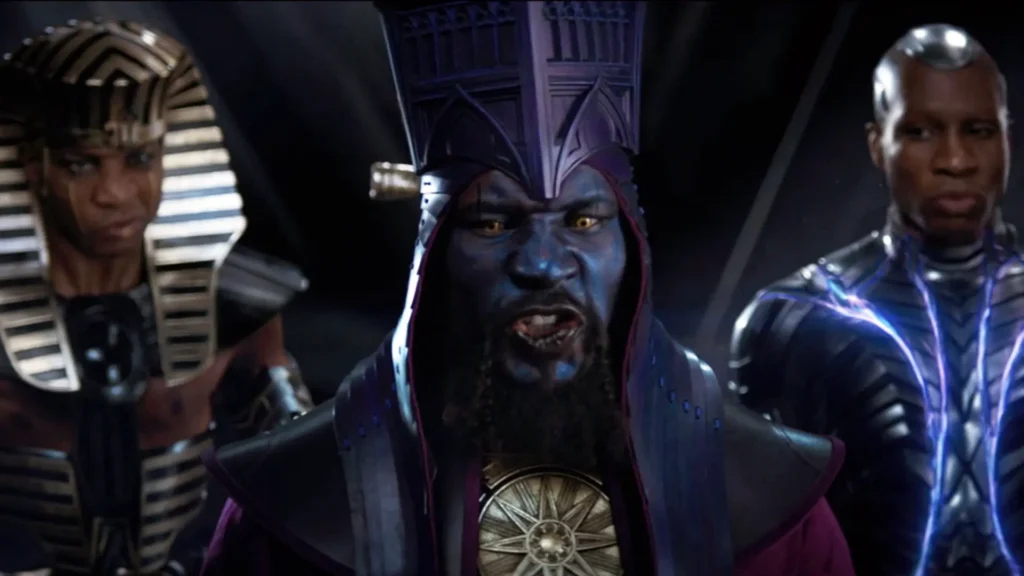
Marvel built a villain whose menace was explicitly rooted in his replaceability. An infinite army of himself. Which sounds powerful until you ask the question they needed audiences to never ask: if you kill this one, why does it matter?
Thanos worked for exactly the opposite reason — and it’s worth understanding how Kang’s shadow over Avengers: Doomsday reaches further than most fans realise, even now that Doom has taken centre stage. There was one of him. One vision, one wound — the death of his homeworld, the obsession born from watching a civilization consume itself. When he snapped his fingers, it wasn’t a multiverse event. It was an act of will by a single man with a single terrible idea about mercy. You could argue with his logic. You could even understand it. That’s what made him terrifying rather than just threatening.
The leaked details about the original Kang Dynasty plan — an Avengers film built around multiple Kang variants facing off against Earth’s heroes simultaneously — would have compounded the error catastrophically. The screenplay was reportedly near-impossible to crack, and you can see why. How do you make an audience invest in a character when the script requires you to immediately undercut his individuality by replacing him with copies? Every attempt to make the variants feel distinct would have worked against the unity of threat that makes a great villain. Every attempt to unify them into a single menace would have made the multiverse framing pointless.
This is why Kang’s failure isn’t fundamentally a casting problem or a quality-of-execution problem. It’s a story engine problem. And story engine problems don’t get solved by finding a better actor or a stronger director. They get solved by going back to what the character actually is.
In the comics, the moments where Kang becomes genuinely frightening aren’t the moments when he produces more of himself. They’re the moments when a single Kang — this specific man, with this specific knowledge of your past and future — tells you that he’s already been here. That he’s already seen how this ends. That the battle you’re about to fight, he’s fought before. And lost. And learned. And came back.
That’s not a multiverse story. That’s a ghost story. The most terrifying kind.
What a Real Kang Story Looks Like — And Why Phase 7 Isn’t Too Late
The question, then, is what you do with a ghost. The post-Secret Wars MCU — whatever shape it takes after 2027 — almost certainly simplifies what came before. That’s the point of a Secret Wars reset: clear the board, collapse the branches, give the franchise room to breathe. And that reset, frustrating as it may be for fans invested in current storylines, is the exact circumstance that makes a properly constructed Kang possible for the first time. You can read more about what the Secret Wars reset means for the MCU’s surviving characters — but the short version is that the structural conditions Kang always needed may finally exist.
Because if the multiverse is gone, or at least contained, Kang loses his most damaging feature. He stops being a concept and starts being a person again.

Here’s what that looks like in practice. Post-Secret Wars, the rules of time travel change. In the MCU as we’ve understood it, altering the past doesn’t rewrite your present — it just creates a diverging branch. That limitation is why Endgame‘s time heist felt bittersweet rather than triumphant. But a recast Kang, rebuilt from the ground up as a pure time villain, could operate under different physics entirely: technology that actually rewrites the timeline rather than branching it. Suddenly the stakes are what they always should have been. He doesn’t threaten infinite worlds. He threatens this one. Your history. The choices that already happened.
That framing also solves the origin problem elegantly. In the comics, Kang is Nathaniel Richards — a descendant of Reed Richards, who found a time machine and let his worst impulses run unchecked because the 31st century gave him unlimited power and no one who could challenge him. The MCU equivalent writes itself. Tony Stark invented time travel in Endgame. Some version of that technology, passed down across generations, eventually produces a man who inherits Stark’s genius and his ego but none of the human connections that kept Tony from becoming a monster. The new Avengers don’t just fight Kang. They fight the consequence of their predecessors’ greatest victory. That’s a sins-of-the-father story with actual weight.
The emotional spine, though, is Iron Lad. A teenage Nathaniel Richards, horrified by the vision of what he’s destined to become, stealing his future self’s armour and running to the present to find the Avengers — that character arc is the most human story in Kang’s entire mythology, and the MCU has never touched it. You give Iron Lad the film’s moral centre. He’s the one who knows exactly what Kang can do, exactly which ancestors Kang cannot harm without erasing his own existence, and exactly how thin the line is between who he is now and who he’ll become. Watch him make the same compromises, under pressure, across the course of one film. Watch the heroes see it happening and try to stop it. That’s your climax, and it’s more emotionally devastating than anything the Infinity Saga produced in its final act.
There’s another payload hiding in this structure that Marvel would be foolish to ignore. Kang’s history is littered with X-Men connection points. As Rama-Tut, he ruled ancient Egypt — the same territory where En Sabah Nur, the mutant who would become Apocalypse, was born and shaped. In the comics, Apocalypse’s transformation from mortal to godlike conqueror was catalysed by contact with alien technology. In a Kang film that visits ancient Egypt, that technology becomes Kang’s abandoned gear, and suddenly the X-Men’s most enduring villain has an MCU origin that connects directly to the new Avengers’ greatest threat. It’s a move that connects directly to the X-Men’s complicated role in the post-Doomsday MCU — and the implications run deeper than most fans have considered. You’ve seeded a mutant saga that the audience already knows is coming — and crucially, they now know how it ends, which means when the X-Men finally form in the present day, the urgency is already there. We’ve seen their dystopian future. We know what they’re fighting against.
The pieces exist. The character has the history. The post-Secret Wars reset creates the exact structural conditions that a time-travel Kang requires. Phase 7 isn’t too late. It might actually be the right time.
The only question is whether Marvel understands what they got wrong the first time.
Doctor Doom is the right villain for Avengers: Doomsday. That’s not a consolation take — Doom is extraordinary, and Robert Downey Jr. playing him is genuinely one of the more exciting things the MCU has done in years. But Doom doesn’t make Kang obsolete. He just buys Marvel time to get it right.
Post-Secret Wars, the conditions are finally correct. A simplified timeline. A villain rebuilt as a pure time conqueror. A teenage boy in stolen armour trying to outrun his own future. An X-Men saga seeded through ancient Egypt. The story that should have followed Endgame can still be told — it just needed the multiverse to collapse first before a time villain could mean something again.
The Kang who should have scared us is still out there in the 31st century. Waiting. Patient. He’s got nothing but time.
Frequently Asked Questions
Will Kang the Conqueror return to the MCU?
Marvel has officially shelved Kang as of early 2026, with no announced plans for the character’s return. However, the post-Secret Wars reset creates conditions where a recast, time-travel-focused Kang could be introduced in Phase 7 without carrying the baggage of the Multiverse Saga version. Nothing is confirmed, but the door isn’t closed.
What was Avengers: The Kang Dynasty supposed to be about?
Avengers: The Kang Dynasty was the original title for what became Avengers: Doomsday. According to leaked development details, it would have featured the Avengers facing multiple Kang variants simultaneously — a concept that proved structurally difficult to execute and was scrapped entirely after Jonathan Majors’ firing in late 2023.
What is the Kang Dynasty in Marvel Comics?
The Kang Dynasty is a landmark Avengers storyline by writer Kurt Busiek and artist Alan Davis, running across Avengers #41–55 and the 2001 Annual. In it, a single Kang the Conqueror actually conquers Earth — the first Marvel villain to achieve physical planetary domination — before the Avengers claw back a victory from a position of total defeat.
Who is Iron Lad and how is he connected to Kang?
Iron Lad is a teenage version of Nathaniel Richards — the man who becomes Kang the Conqueror — who travels back to the present day after seeing his monstrous future self. He founded the Young Avengers in the 2005 series by Allan Heinberg and Jim Cheung, trying to prevent his own transformation into Kang. In every version of the story, the attempt ultimately fails.