
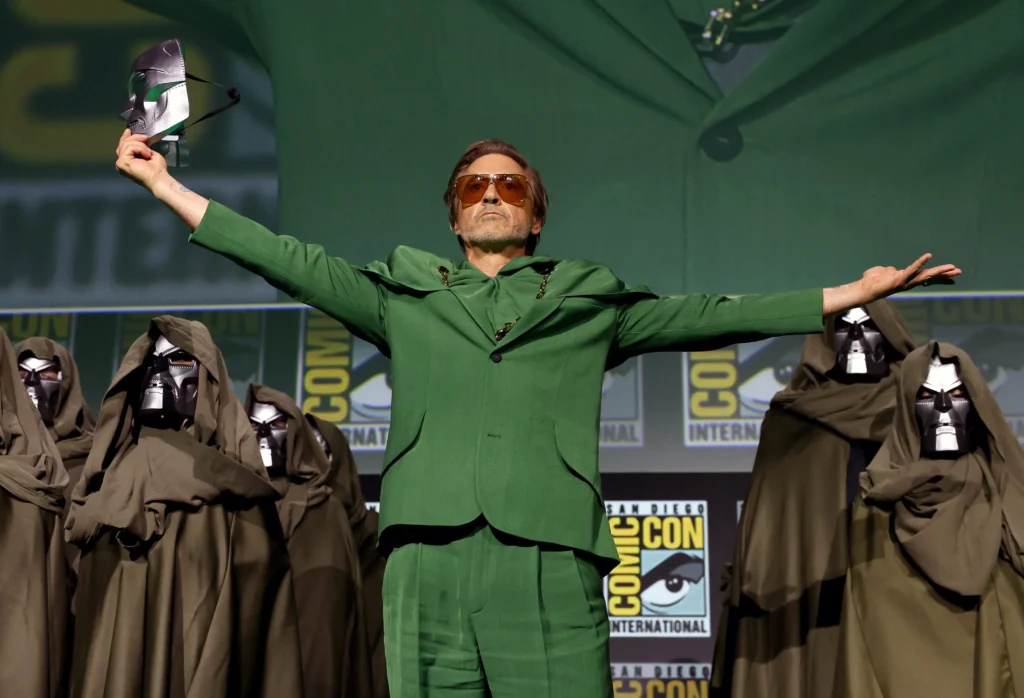
When Kevin Feige walked Robert Downey Jr. and his wife Susan into a pitch meeting about returning to the MCU, he didn’t say “we want to bring Tony Stark back.” He said: let’s get Dr. Doom right.
That’s the version of events confirmed by the Russo brothers themselves. And yet somehow, from the moment Downey took the stage at San Diego Comic-Con in July 2024 — armored up, delivering that “new mask, same task” line — the entire fan conversation collapsed into a single assumption: he has to be a Tony Stark variant. He must be evil Tony from a broken timeline. The question wasn’t whether Doom was Tony, it was when Tony broke bad.
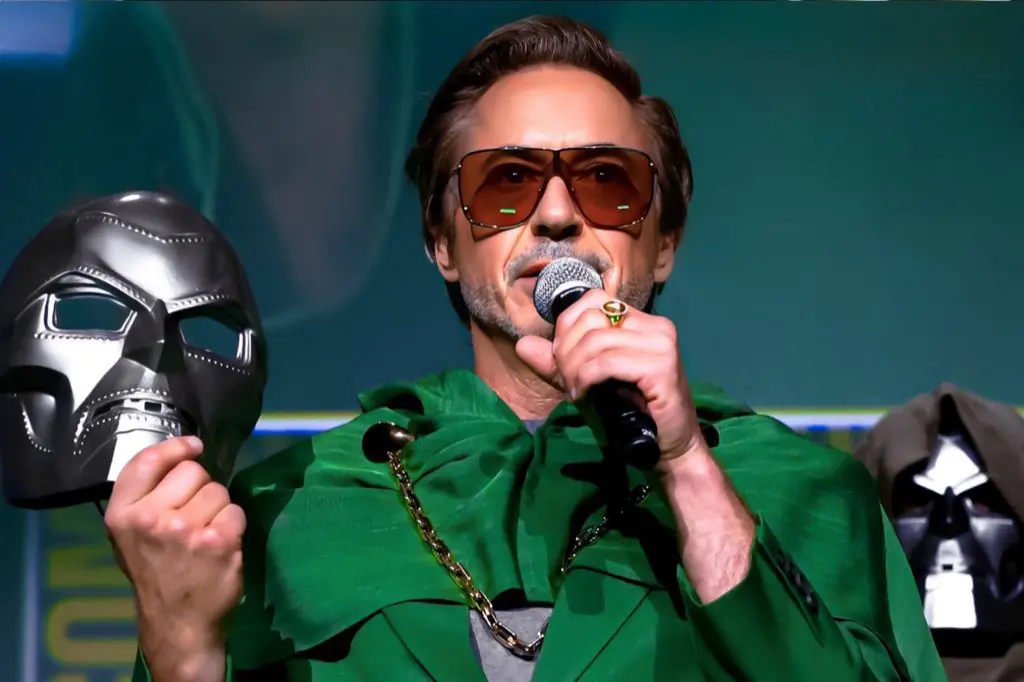
It’s a seductive theory. This is the Multiverse Saga, after all. The whole architecture of Phases Four through Six is built around the idea that our choices shape who we become across infinite realities. An evil Tony Stark as the final villain feels thematically tidy. It lets Downey play against himself. It gives Iron Man one last chapter.
But the evidence that’s been accumulating — from the filmmakers, from reliable leakers, from what we actually saw in The Fantastic Four: First Steps — keeps pointing somewhere else entirely. Somewhere more interesting.
Victor Von Doom is not a Tony Stark who went wrong. He never was.
The Assumption That’s Been Driving This Whole Debate
The variant theory has real logic behind it, and it’s worth giving it a fair hearing before dismantling it — because the people who’ve been running with it aren’t wrong to have gotten there.
The setup is almost too clean. The Multiverse Saga’s entire thematic engine is the idea that choices define us — that across infinite realities, the same person can become a hero or a monster depending on what happens to them. Kang the Conqueror was built on this premise: dozens of variants, each one a different answer to the question of what one man becomes when he gains access to time. Sylvie. Immortus. Rama-Tut. The whole point of the Multiverse Saga is that identity is contingent.
And then Marvel brings back Robert Downey Jr. — the actor who built the MCU from the ground up, whose Tony Stark is arguably the most beloved superhero in film history — and puts him in a suit of armor as the next great villain. The narrative logic writes itself. Of course he’s a variant. Of course this is the story of Tony Stark taken to a dark extreme. What else could it be?
From there, the fan theories got genuinely interesting. A Tony Stark where the snap went wrong and he lost everyone. A Tony who survived Endgame but watched the world fracture anyway. A Tony whose genius and need for control kept compounding long after there was no one left to check him. Each version has its own emotional resonance, its own tragic logic. The variant theory didn’t persist because fans were being lazy. It persisted because it felt like exactly the kind of story the Multiverse Saga was building toward.
But “feels like it fits” isn’t the same thing as “is what’s happening.” And the actual evidence — from the people making the film — has been quietly pointing somewhere else the entire time.
What the People Making This Movie Have Actually Said
Start with Feige’s pitch. When Kevin Feige approached Downey about returning to the MCU, the framing wasn’t “we want to bring Tony back through the multiverse.” According to the Russo brothers, confirmed in their interview with The Playlist, Feige’s pitch was explicit: let’s get Dr. Doom right. That’s the goal. Not let’s give Tony one more chapter. Not let’s use the multiverse to bring back the character you retired. Let’s finally do justice to Victor Von Doom.
Then there’s the announcement itself. Joe Russo, introducing Downey at San Diego Comic-Con 2024, didn’t say “an evil version of our favorite hero” or “a variant you won’t see coming.” He said: “We give you the one person who could play Victor Von Doom.” Later in the same appearance, he used the full name again. Twice. Unprompted. These are filmmakers who understand the weight of every public word — they don’t reach for “Victor Von Doom” twice by accident.
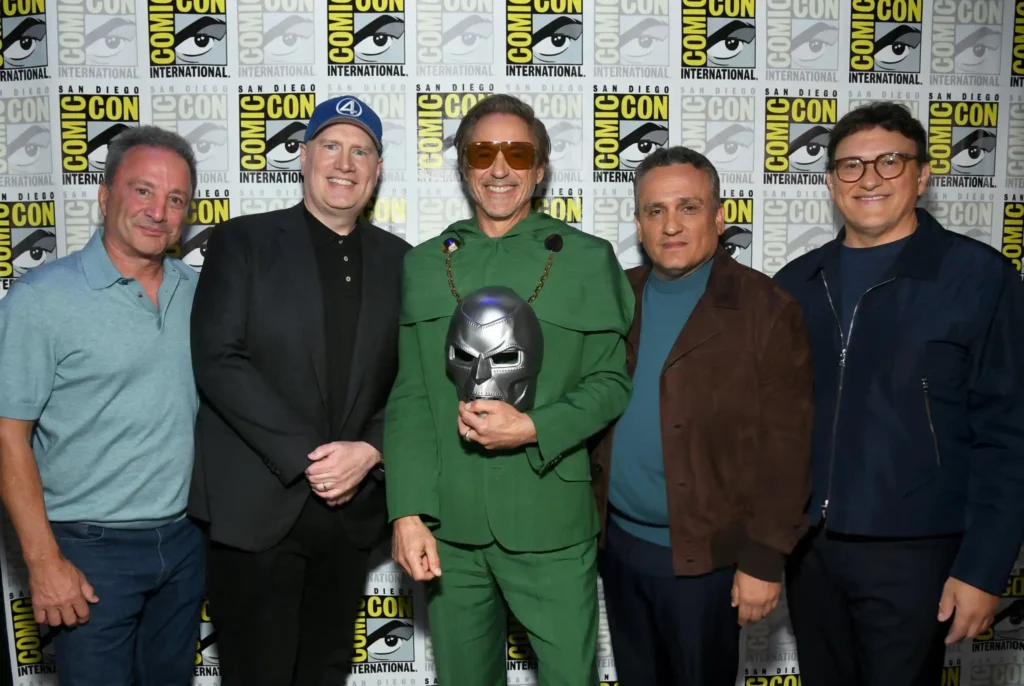
The Russo brothers have also been notably careful in every interview since. They’ve described Doom as a three-dimensional villain who believes he’s the hero of his own story. They’ve talked about their love for complex antagonists. What they haven’t done — in any interview, at any point — is confirm that Doom and Tony share more than a face. When asked directly about the resemblance, they said they couldn’t explain it because it’s part of the story, while adding that there’s nobody else in the world who could play this character the way Downey is about to. Which sounds, on the surface, like a confirmation of the variant theory — of course only Downey can play evil Tony, he is Tony.
But consider the other reading. Tony Stark appeared in eleven MCU films across twelve years. Downey built one of the most complete character arcs in blockbuster history — a selfish genius who becomes a father figure and then a martyr. He made a billionaire arms dealer genuinely sympathetic. He made an audience root for someone trying to beat up Captain America. That’s a remarkable, specific skill set. Maybe the reason only Downey can play Victor Von Doom isn’t because Doom is Tony — it’s because Doom requires exactly the kind of layered, charismatic, morally complicated performance that Downey has spent over a decade perfecting.
Reliable leaker Alex Perez, responding to a fan theory about Doom being a tortured Tony Stark variant, put it plainly: in the same way Chris Evans can play two different characters in the MCU with the same face, so can Robert Downey Jr. play Victor Von Doom. Perez added that just as the MCU now has Joseph Quinn as its definitive Johnny Storm, we’ll eventually have another actor playing Victor Von Doom in the main universe. That last part is the tell. If Doom were simply a Tony Stark variant, there’d be no need for a “main universe” version of the character down the road. The implication is that RDJ’s Doom is Doom — from the Fantastic Four’s universe, where he’s always existed — and the MCU’s broader continuity will eventually introduce a separate Victor Von Doom once this chapter closes.
Three separate threads. All pointing the same direction.
None of this is a signed confession. But taken together, it’s a pattern. The filmmakers keep calling him Victor Von Doom. The leakers say he’s not a variant. The casting rationale points to Downey’s skills as an actor, not his history as Tony. And Feige’s stated goal from day one was to get Dr. Doom right.
That means making him Dr. Doom.
Victor Von Doom Is Not Evil Tony Stark — A Character That Took 60 Years to Build
Victor Von Doom made his first full appearance in Fantastic Four #5 in 1962. Stan Lee and Jack Kirby had introduced him two issues earlier, but #5 is where they showed their hand — this wasn’t going to be a standard supervillain with a gimmick and a grudge. In his very first proper outing, Doom trapped the Fantastic Four in a time machine and sent them back to the age of pirates to steal Blackbeard’s treasure for him. He was already scheming at a level most Marvel villains never reach. Fully formed, geopolitically dangerous, and completely convinced of his own righteousness. Sixty-two years of stories since, and writers keep finding more to work with.
That’s because Doom was built on a foundation that has almost nothing in common with Tony Stark’s.
Victor Von Doom was born into a Romani tribe in the fictional Eastern European nation of Latveria — persecuted, stateless, poor. His mother Cynthia made a bargain with the demon Mephisto in exchange for power to protect her people, and it destroyed her. Her soul was dragged to Hell. Victor grew up brilliant, angry, and shaped by a grief he couldn’t resolve through any ordinary means. When he eventually made it to State University in New York on the strength of his genius alone, he built a machine not out of ambition or ego but out of love — he was trying to reach his mother’s soul and bring her back from Mephisto’s realm.
The experiment exploded. Victor’s face was scarred.
Here’s the part that matters: Reed Richards — his classmate, his intellectual rival — had looked over Victor’s calculations beforehand and spotted a math error. Victor dismissed him. The explosion happened. And Victor, rather than accept that his own arrogance caused the accident, blamed Reed Richards for the scar. He left university, traveled to Tibet, found a monastery of monks, and commissioned them to forge him a suit of iron armor. Then — because he couldn’t wait for his wounds to heal, because the idea of existing for one more day with an imperfect face was intolerable — he put the still-hot mask on before it had cooled, burning his features far worse than the original explosion ever had.
That detail is everything. Doom’s defining wound is self-inflicted. He knows it, on some level, and has spent his entire life building a mythology that buries that knowledge under layers of armor, sorcery, and absolute authority. He rules Latveria with genuine competence — his people are among the best cared-for in the Marvel universe, by almost any measure — because if he can prove that his judgment is perfect everywhere else, maybe the original error doesn’t count. He cannot improve because he cannot admit he was ever flawed. That’s the psychological engine of the character, and it’s been running consistently since 1962.
Tony Stark’s engine runs on the exact opposite fuel. Tony’s origin is the moment he’s forced to see the consequences of his own choices — the weapons he built, the people they killed, the man looking back at him in the mirror. His entire arc is the story of someone trying to be better. Trying and failing and trying again. He puts on the armor to make amends, not to avoid them.
Doom puts on the armor to never have to make amends at all.
And the armor is only half of it. The part that almost never gets mentioned in current MCU discourse — the part that’s going to matter enormously in Doomsday and Secret Wars — is that Victor Von Doom is the second most powerful sorcerer in the Marvel universe. The iron suit and the mystic arts aren’t separate aspects of the character. They’re the same compulsion expressed in two different languages: total mastery, over the physical world and the metaphysical one alike. Doom studied under the Aged Genghis, has gone toe-to-toe with Doctor Strange, and has wielded mystic power that rivals the Sorcerer Supreme. His armor combines Latverian robotics, force field technology, and enchantments that most Marvel heroes don’t even know how to counter. He has stolen the Power Cosmic from the Silver Surfer. He has held the Infinity Gauntlet. In Jonathan Hickman’s Secret Wars (2015), he absorbed the near-omnipotent power of the Beyonders and remade the universe in his own image — ruling a patchwork Battleworld as God Emperor Doom, with a Thor as his sheriff and the laws of reality itself bending to his will.
When Doom finally had infinite power, the first thing he did was fix his face.
That’s not Tony Stark taken to a dark extreme. That’s a completely different kind of human being — one whose tragedy runs deeper, whose ambitions are more total, and whose potential as a long-term MCU antagonist is virtually unlimited. The variant theory collapses all of that into a footnote. And there’s one relationship in particular it destroys completely — one that nobody seems to be accounting for.
The Reed Richards Problem Nobody Is Talking About
If Victor Von Doom is a Tony Stark variant from another universe, Reed Richards becomes irrelevant to his own villain’s origin story.
Think about what the Doom-Reed relationship actually is. These two men knew each other as young students. Reed saw the flaw in Victor’s experiment. Victor refused to listen. The explosion happened. And Victor Von Doom has spent the rest of his life directing the full force of his intellect, his sorcery, and the resources of an entire nation toward proving that Reed Richards is wrong — that Victor’s judgment is superior, that the accident was Reed’s fault, that the smartest man in the world isn’t Reed Richards, it’s him. Every scheme Doom has ever run against the Fantastic Four carries that wound at its center. He doesn’t just want to defeat them. He needs Reed to know he lost.
That’s one of the richest antagonist dynamics in Marvel Comics history. Two brilliantly intelligent men, one driven by the need to be right and one maddened by the need to prove it. Lee and Kirby built it in the early 1960s, and writers from John Byrne to Mark Waid to Jonathan Hickman have deepened it across decades. Hickman in particular — whose FF and Fantastic Four runs from 2009 to 2012 are among the best Marvel Comics of the last twenty years — understood that the Reed-Doom dynamic isn’t just personal. It’s philosophical. Reed believes intelligence serves humanity. Doom believes intelligence earns dominion over it. They are genuinely two sides of a single coin, and neither one can fully exist without the other.
Now consider what happens to all of that if Doom is a Tony Stark variant.
Pedro Pascal’s Reed Richards shows up in Avengers: Doomsday as a supporting character in someone else’s Iron Man story. His history with Doom — the experiment, the scar, the lifelong wound — is irrelevant, because this Doom was never his classmate. Their relationship becomes a coincidence rather than a foundation. Reed gets to stand in the background looking worried while the Avengers deal with an evil version of their friend Tony. That’s not a supporting role. That’s a cameo with good posture.
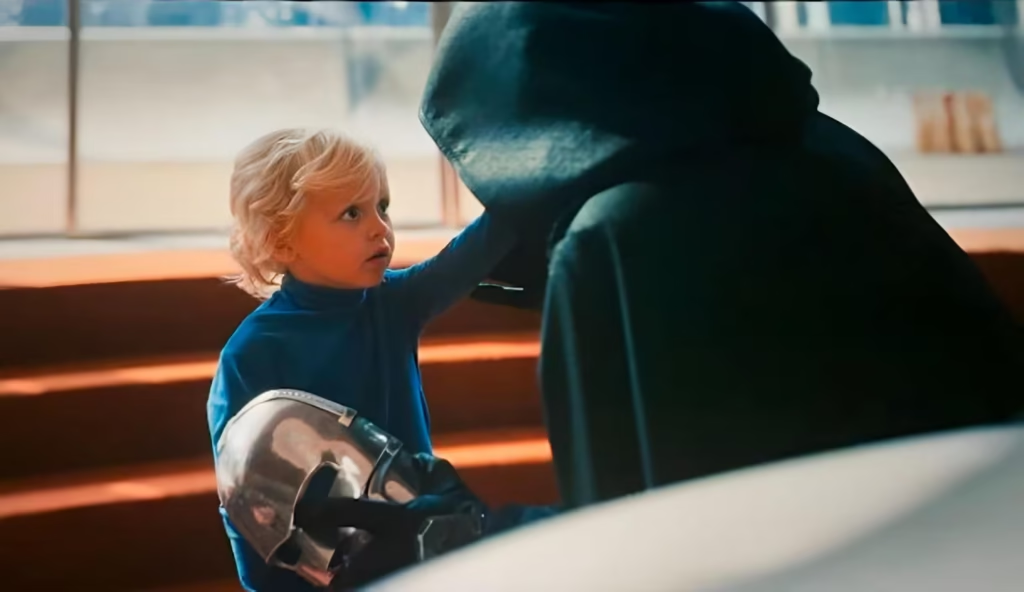
There’s evidence the film is setting up something better than that. In The Fantastic Four: First Steps, a Latverian flag appears at the Future Foundation gathering — conspicuously unmanned, no representative present. In the comics, Doom rules Latveria as its absolute monarch. That empty seat implies that in this universe, a Victor Von Doom already exists, already knows about the broader world, and has already decided he has better things to do than join a club Reed Richards built. Director Matt Shakman confirmed in a podcast interview that yes, that is Robert Downey Jr.’s Doom in the end credits of the film. He’s already there. He’s already watching. He’s from this universe.
If that’s the case — and the evidence increasingly suggests it is — then Reed Richards walks into Avengers: Doomsday as the one person who has known Victor Von Doom the longest. Who understands better than anyone what he’s capable of and what drives him. Who carries a specific, complicated guilt about a math error he pointed out decades ago that Doom turned into a scar and a mythology. Reed can be the film’s Cassandra — the person desperately trying to make the other heroes understand that this isn’t a villain they can reason with or outfight, because this villain has been preparing for exactly this moment since before most of them were born.
That’s the version of Reed Richards worth having in this film. And it only works if Doom is Doom.
The “Same Face, Different Man” Device — And What It’s Actually For
The variant theory has always rested on one question that genuinely doesn’t have a clean answer yet: if Doom isn’t Tony, why does he have Tony’s face? It’s a fair question, and anyone making the case that RDJ is playing a wholly separate character owes the reader an honest attempt at it.
The MCU has already told us — explicitly, in the text of Deadpool & Wolverine — that face-sharing across universes isn’t a plot device. It’s just how the multiverse works. Different people, same face. When Wade Wilson encountered a version of the Human Torch played by Ryan Reynolds, the joke was right on the surface: yes, they look identical, no, they are not the same person, move on. The film didn’t try to explain it because there’s nothing to explain. The multiverse contains infinite people and a finite number of faces. Chris Evans played Steve Rogers in the MCU and Johnny Storm in Fox’s Fantastic Four films, and the MCU has never once suggested those characters share a soul. They share a jawline. That’s it.
So the mechanical answer to “why does Doom look like Tony” is: the same reason the Human Torch looked like Deadpool. Coincidence with narrative utility.
But the narrative utility is where it gets interesting. Because the MCU isn’t going to cast Robert Downey Jr. — the most expensive and emotionally loaded casting decision in the history of this franchise — just to shrug and say “multiverse, what can you do.” The face-sharing is going to mean something. The question is what.
Alex Perez’s reporting suggests Doom doesn’t remove his mask in Doomsday — that the unmasking is being held for Secret Wars. Which makes sense on multiple levels. Doom’s mask is his identity. He hasn’t willingly shown his face to another living person since the accident in Latveria. The mask is the character. Keeping it on through the first film preserves both the mystery and the integrity of the characterization.
But when the mask comes off — when the heroes finally see what’s underneath — they’re going to see Tony Stark’s face. And that moment has the potential to be one of the most psychologically destabilizing beats in the MCU’s history. These are people who watched Tony Stark die. Who carried that loss. And now the man who has been systematically dismantling their world, who may have already reshaped reality in his own image, is wearing the face of the person they loved most. The grief and the threat collapse into each other simultaneously.
There’s a version of this where Doom is entirely aware of what his face does to them and uses it deliberately — a living psychological weapon. Doom in the comics is nothing if not someone who weaponizes every advantage available to him, including the intangible ones. And there’s a version where it’s simply a wound the heroes have to fight through, the cruelest possible context in which to finally let Tony Stark go.
Either way, it only works if Doom is genuinely someone else. The face needs to be a mask within a mask — the iron one hiding the scarred one hiding the fact that the man underneath is not who they think he is. If Doom actually is a Tony variant, the reveal isn’t devastating. It’s just confirmation of what everyone already suspected. The dramatic power of that moment requires the truth underneath to be a stranger.
Why Getting Doom Right Matters More Than the Tony Farewell Tour
There’s a version of the MCU’s future where Victor Von Doom is the connective tissue for the next fifteen years of storytelling — the same way Tony Stark was the connective tissue for the first fifteen. Doom and the X-Men. Doom and Galactus — and if Marvel is smart, eventually Doom: The Emperor Returns. Doom and the Silver Surfer. Doom and Doctor Strange. Triumph and Torment, the 1989 Roger Stern and Mike Mignola graphic novel where Doom descends into Hell itself to rescue his mother’s soul from Mephisto, is one of the greatest single Marvel stories ever told and it hasn’t been touched yet. A Doom solo film built around that story would be unlike anything the MCU has produced. There’s also Doom as reluctant hero — Emperor Doom, Infamous Iron Man, the runs where circumstance forces him into something resembling the right side — and those stories only carry weight because you already understand how far he has to travel to get there.
All of that potential exists only if Doom is allowed to be himself from the beginning.
The moment you define Victor Von Doom as a Tony Stark variant, you’ve capped his ceiling. He becomes a dark mirror, a what-if, a tributary of someone else’s river. Every story you tell with him afterward carries the asterisk: but he’s really just Tony gone wrong. You can’t do Triumph and Torment with that version of the character because the emotional core of that story — Doom’s love for his mother, his willingness to face Hell itself for her, the specific tragedy of a man who is monstrous in every direction except one — belongs to Victor Von Doom and nobody else.
The MCU is genuinely at a crossroads right now. The Infinity Saga worked because it had a clear architectural spine: Tony Stark’s journey from selfish genius to selfless father, anchored by Feige’s decade-long vision. The Multiverse Saga has struggled in part because that spine has been missing — too many threads, not enough weight on any single one. What it needs isn’t another chapter of Tony’s story delivered through a backdoor. It needs a new center of gravity.
A comic-faithful Victor Von Doom — brilliant, tragic, terrifying, utterly convinced of his own righteousness — is exactly that. A villain with the psychological complexity to carry two films without losing definition. A character whose defeat, when it finally comes, means something independent of Iron Man’s legacy. A foundation for the next era of Marvel storytelling that doesn’t require constantly looking backward to justify itself.
Feige said he wanted to get Dr. Doom right. The evidence suggests that’s exactly what they’re doing. And if the man in the iron mask turns out to be Victor Von Doom all the way down — born in Latveria, scarred by his own arrogance, convinced he is the only one capable of saving a universe he intends to rule — then the MCU will have its next great villain.
Not a version of Tony Stark.
The real thing. Finally.