
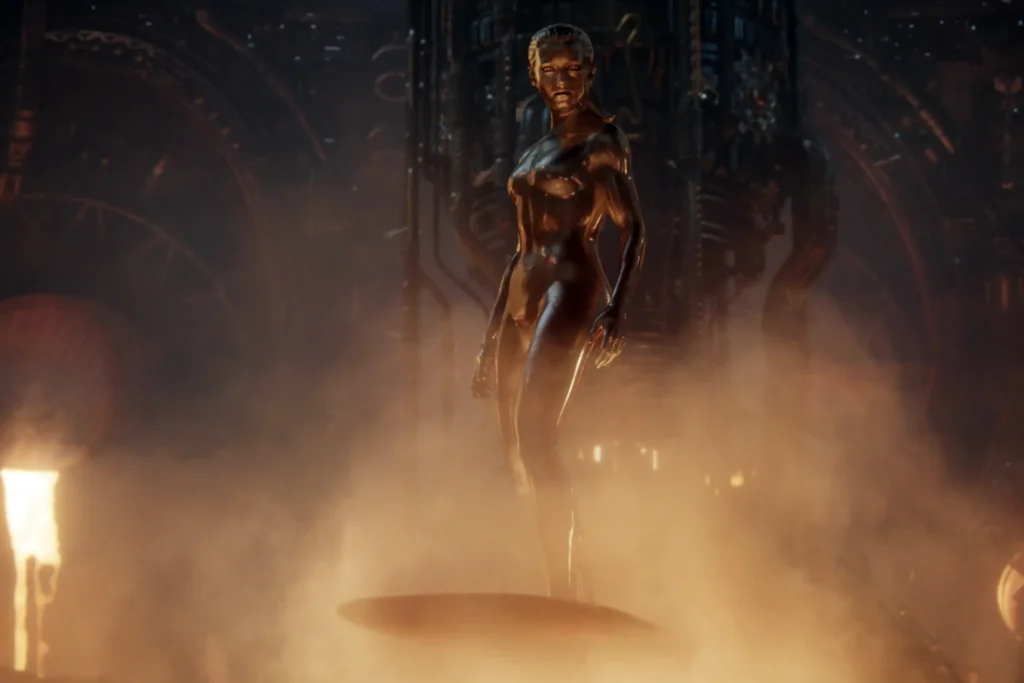
Jack Kirby added the Silver Surfer to Fantastic Four #48 without telling Stan Lee. The script called for Galactus to arrive at Earth alone. Kirby decided that a god needed a herald, sketched a gleaming figure on a surfboard because surfing was in the news that week, and handed the pages in. Lee’s first reaction, according to Kirby, was: “What’s this?” His second reaction was to realize it was the best thing in the issue. That accidental creation — an unplanned character drawn because Kirby thought Galactus needed company — has spent nearly six decades as Marvel’s most philosophically serious figure. That tells you something.
The Silver Surfer is Norrin Radd — an astronomer from the utopian planet Zenn-La who bargained with the planet-devourer Galactus to save his world, becoming his cosmic herald in return. The Power Cosmic grants him near-invulnerability, energy projection strong enough to destroy planets, faster-than-light travel, matter manipulation, and cosmic awareness spanning the universe. In the MCU’s The Fantastic Four: First Steps (2025), the mantle belongs to Shalla-Bal, portrayed by Julia Garner.
Who Is the Silver Surfer? (And Why the Answer Is Complicated)
The easy answer: Norrin Radd, alien astronomer from the planet Zenn-La, transformed into a silver-skinned cosmic being by Galactus, the Devourer of Worlds. Herald, wanderer, occasional defender of Earth. Created by Jack Kirby and Stan Lee, first appeared in Fantastic Four #48, March 1966. One of Marvel’s most powerful characters. That’s the answer.
The honest answer is messier.
For the first century of his existence as the Silver Surfer, Norrin Radd guided Galactus to inhabited worlds and watched them die. Not because he wanted to. Because Galactus had suppressed his memories and emotions to make him a willing instrument — a fact Norrin only understood after the Fantastic Four helped him rediscover who he’d been. The guilt of those centuries has driven nearly every significant Silver Surfer story since. He’s not a villain. He’s not exactly a hero, either. He’s a man trying to atone for damage he didn’t fully choose to cause, using powers he didn’t ask for, in a body that isn’t his original one.
That moral complexity is precisely what makes him interesting — and precisely what makes the MCU’s decision to reimagine the herald as Shalla-Bal in The Fantastic Four: First Steps (2025) more meaningful than most people initially gave it credit for. Shalla-Bal isn’t a gender-swapped Norrin Radd. She’s a completely separate character from Marvel Comics lore, a scientist and mother from Zenn-La who made the same bargain with Galactus for entirely different reasons. Same silver skin. Same Power Cosmic. Same impossible weight. We’ll get to her fully — but the short version is that the Silver Surfer has always been about what sacrifice costs the person who makes it, and that theme survives the character change intact.
The comics version of Norrin Radd is the focus of most of this piece. But understanding who the Silver Surfer is means understanding that the mantle has always been bigger than any single person wearing it.
Silver Surfer’s First Appearance: The Accidental Creation Jack Kirby Snuck into Marvel
The Silver Surfer wasn’t supposed to exist.
Stan Lee’s plot for Fantastic Four #48 (March 1966) called for Galactus to arrive at Earth as a solo threat. No herald. Just the planet-devourer and the Fantastic Four. Jack Kirby, illustrating the story through the Marvel Method — where artists drew from plot outlines before dialogue was added — looked at that premise and decided a cosmic god needed an emissary. He sketched a gleaming, bald figure riding a silver surfboard across the stars, added him to the pages without consultation, and handed them in.
Lee’s documented first response was, essentially: what is this?
His second response was to realize it was the best character in the issue.
Kirby’s explanation for the surfboard, in a later interview, was characteristically blunt: surfing had just hit the mainstream news, California kids were doing it, and he couldn’t put an ordinary teenager on a surfboard so he put a man from outer space on one instead. The cosmic herald who would become one of Marvel’s most philosophically rich characters originated, in part, from a newspaper article about beach culture.
Fantastic Four #48-50 — the arc now called the Galactus Trilogy — introduced both Galactus and the Silver Surfer in three issues that permanently expanded Marvel’s cosmic scope. Before this storyline, the Marvel universe was largely Earth-bound. After it, the cosmos was populated with planet-consuming entities, cosmic heralds, and the Power Cosmic. The Silver Surfer’s betrayal of Galactus at the trilogy’s end — turning against his master after Alicia Masters, the Thing’s blind girlfriend, reached the humanity buried inside him — established the character’s defining tension immediately: a being of immense cosmic power undone by something as simple as genuine human compassion.
Stan Lee became so attached to the character that he asked other writers not to use him as a general rule. The Silver Surfer became, effectively, Lee’s personal creative project within Marvel — the character he used to explore ideas about morality, loneliness, and humanity’s potential that didn’t fit cleanly into the Avengers or the X-Men.
The accident Jack Kirby committed on a Tuesday afternoon in 1965 is still generating stories in 2025. The question is who Kirby actually created — because the origin story Galactus gave Norrin Radd is stranger and more costly than anything in the comics synopsis.
The Origin of Norrin Radd: From Zenn-La to Herald of Galactus
Zenn-La was perfect. That was the problem.
By the time Norrin Radd was born, his homeworld had solved everything. War, crime, illness — eliminated. Poverty, hunger, suffering — gone. The civilization of Zenn-La had achieved what most species only dreamed about, and in doing so had quietly destroyed the one thing that made life feel worth living: the need to strive for something. As Norrin reflected in The Silver Surfer #1 (August 1968), his people had “lost the spirit of high adventure, the thrill of exploration, the longing to see beyond the veil of knowledge.” They’d even automated walking — conveyor belt streets meant no one had to exert themselves to get anywhere. Utopia had become a very comfortable cage.
Norrin was the only one who seemed to notice.
Shalla-Bal — the woman he loved, the daughter of Zenn-La’s imperial household, who would later become Empress of her world — recognized his restlessness before he could fully articulate it. “Too long have I sensed the hunger gnawing at your breast,” she told him, “a hunger for that which I could never give you.” She understood that what Norrin needed couldn’t be found on Zenn-La. She just didn’t know it would take a planet-devourer to give it to him.
When Galactus arrived — the first alarm Zenn-La had sounded in a millennium — the civilization’s centuries of peaceful complacency became a tactical catastrophe. No space fleet. No weapons. No warriors. They deployed their “weapon supreme,” a device so devastating it hurled neighboring planets from orbit and reduced Zenn-La itself to smoldering rubble in the process of firing. Galactus absorbed it without pausing.
Norrin Radd walked to the Council of Scientists, asked them to build him a spaceship, and flew directly into the threat.
What he found wasn’t a monster in any conventional sense. Galactus explained his nature plainly: he required planetary energy to survive, the same way a human requires food, and the moral weight of consuming inhabited worlds registered to him roughly the way stepping on an anthill registers to a person in a hurry. He wasn’t evil. He was simply operating at a scale that made individual civilizations invisible. That framing — the indifference of cosmic scale rather than the malice of a villain — is part of what gave the Galactus Trilogy its philosophical weight and why it still holds up nearly sixty years later.
Norrin seized the one opening available. Galactus needed a herald to scout uninhabited worlds ahead of his arrival. Norrin offered himself: “Let me probe the heavens, scan the starways, roam the endless cosmos for you. All this will I do if you will but spare my people.”
Galactus accepted. Then he warned Norrin that the mantle of herald was permanent. Norrin accepted anyway: “My fate is of little consequence if I can save the world that gave me birth.”
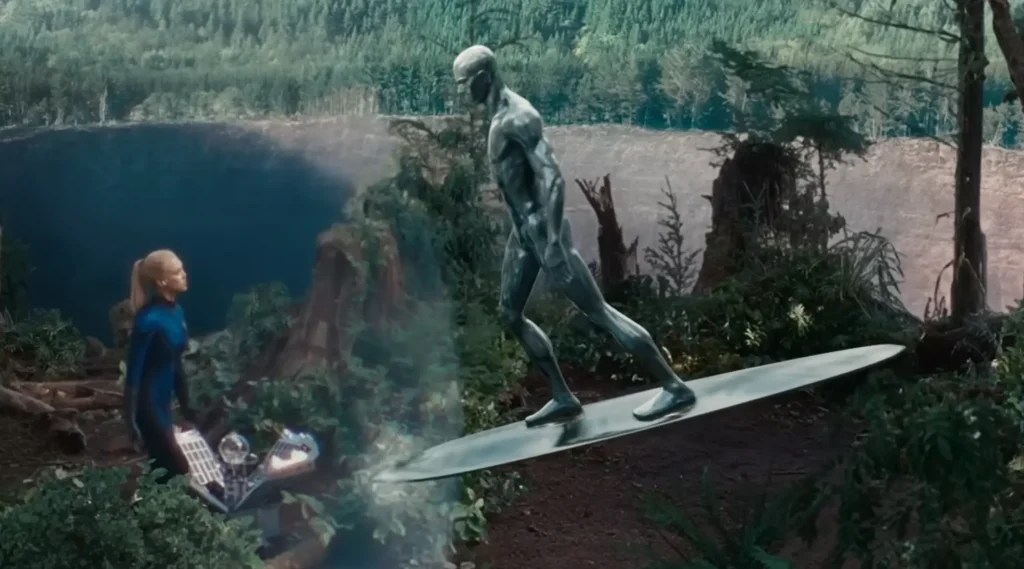
The transformation was literal death and rebirth. Galactus killed Norrin Radd and rebuilt him — encasing his body in a nearly indestructible silvery substance of cosmic design, linking his mind to a surfboard capable of faster-than-light travel, and imbuing him with a fraction of the Power Cosmic. Then, critically, Galactus did something the comics would reveal gradually over subsequent decades: he suppressed Norrin’s memories and emotions to ensure his herald would guide him to inhabited worlds without moral hesitation.
The Silver Surfer served Galactus for close to a century. In that time, billions died on the worlds he found. He didn’t know. He couldn’t know. When the Fantastic Four helped him break through that suppression during the Galactus Trilogy, what returned wasn’t just his identity — it was the full weight of everything he’d done while his identity was missing.
That’s the wound that never fully healed. That’s the character.
Silver Surfer’s Powers Explained: What the Power Cosmic Actually Does
The Power Cosmic is not a list of abilities. That’s the mistake most breakdowns make — treating it like a superpower menu when it’s actually something closer to a fundamental relationship with the universe’s underlying physics.
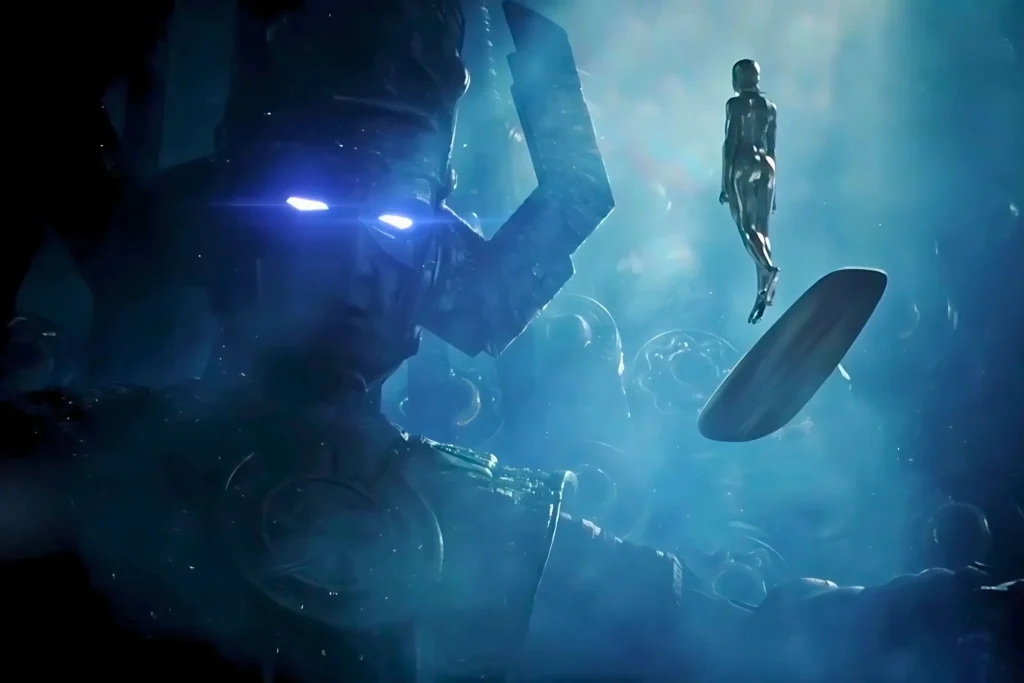
Galactus is the Power Cosmic’s source and primary wielder. What Norrin Radd received was a fraction of that — enough to make him one of the most powerful beings in Marvel’s cosmos, not enough to threaten his master. That foundation — control over the four fundamental forces of nature: gravity, electromagnetism, the strong nuclear force, and the weak nuclear force — is what makes the individual abilities make sense rather than feel arbitrary. Everything else flows from that.
The Silver Surfer’s physical power operates at a level that puts him in genuine contention with Thor and the Hulk. In Tales to Astonish #93 (1967, Stan Lee and Marie Severin), the Surfer and Hulk clash directly — the Surfer holds his own and uses the Power Cosmic to temporarily neutralize the Hulk’s gamma radiation, a demonstration that his power works as much through matter manipulation as raw force. His silvery skin is effectively indestructible under most conditions — he’s survived direct immersion in stars, the crushing pressure of black holes, and in Silver Surfer: Black #1 (2019) by Donny Cates and Tradd Moore, being hurled through a black hole billions of years into the past with enough capacity left to ignite the universe’s first star.
Energy projection is what the Surfer uses most visibly in combat. His blasts at full output are capable of planetary destruction — not theoretical, documented across multiple storylines. He can redirect incoming energy attacks, absorb energy from stars and other cosmic sources to replenish himself, and create force fields capable of stopping nuclear detonations. He can also manipulate energy at the subatomic level, which is how he stripped the Hulk’s gamma radiation in Tales to Astonish #93 — one of the more creative power applications in his history.
Speed, in the Silver Surfer’s case, is almost a philosophical category. He travels faster than light aboard his surfboard — measurably, not metaphorically. In Silver Surfer Vol. 3 (the 1987-1998 series that ran 146 issues), he demonstrates the ability to break the time barrier through sheer velocity, traveling through time as a byproduct of speed rather than any distinct temporal power.
Matter manipulation is where the Power Cosmic starts to approach genuine godhood. Galactus can reshape reality at will; Norrin’s fraction of that power still allows him to transmute elements, reconstruct or deconstruct physical objects at the molecular level, and rearrange matter on a cosmic scale. In Silver Surfer #11 (2016, Dan Slott and Michael Allred), he creates a massive portal that teleports three billion ships to safety simultaneously. That’s not a combat power. That’s a consequence of understanding matter well enough to bend it.
Cosmic awareness is the power that separates the Silver Surfer from characters who are merely physically powerful. The Power Cosmic grants perception across the universe — energy concentrations, approaching threats, and the life-force of beings from light-years away. He sensed Galactus rising 93 million miles from Earth’s sun. He perceived Johnny Storm’s death from halfway across the universe while stripped of most of his power. It functions like a cosmic-scale spider-sense, calibrated to the entire cosmos rather than immediate physical danger.
The Silver Surfer is also a high-level telepath — not widely discussed, but consistently demonstrated. He’s cut through the Hulk’s rage-split psyche, resisted the Puppet Master’s control, and in Silver Surfer Vol. 3 outmaneuvered Mephisto on the astral plane. His healing factor regenerates from dismemberment, and in rare instances he’s extended that healing to others.
For all of this, the Power Cosmic has one genuine vulnerability: it can be drained. Beings operating at Galactus’s power level — and weapons specifically designed to disrupt cosmic energy — can strip or diminish the Surfer’s abilities. Galactus himself imprisoned Norrin on Earth by severing his connection to the wider cosmos through his surfboard. The board isn’t decorative; it’s the physical anchor of his space-time traveling capacity, and when Galactus linked the exile barrier to it, the most powerful being on Earth couldn’t leave.
The Power Cosmic makes Norrin Radd nearly a god. It doesn’t make him free. That distinction is what every good Silver Surfer story is actually about.
The Greatest Silver Surfer Stories: Essential Comic Arcs
Six decades of comics produce a lot of noise. These are the stories that actually define the character — the ones that shaped how writers, artists, and readers understand what the Silver Surfer is for.
The Galactus Trilogy — Fantastic Four #48-50 (1966)
Start here. Always start here. Stan Lee and Jack Kirby’s three-issue arc introduced both Galactus and the Silver Surfer to the Marvel universe and did something no superhero comic had seriously attempted before: it treated a cosmic threat as philosophically serious rather than just physically large. Galactus doesn’t want to conquer Earth. He wants to eat it because he’ll die otherwise. The Silver Surfer doesn’t turn against him out of strategic calculation — he turns because Alicia Masters, a blind sculptor who has never met him, treats him like he might be worth something. That’s the hinge. The most powerful being on Earth is reached not by matching his power but by assuming his dignity.
Issue #48 establishes the threat. Issue #49 delivers the turn — the Surfer’s awakening when Alicia tells him every living thing matters, that humans have hearts and souls even if they’re not powerful. Issue #50 resolves it with Reed Richards wielding the Ultimate Nullifier against Galactus — one of the few weapons in the Marvel universe capable of destroying galaxies — and Galactus backing down. The price is the Silver Surfer’s exile on Earth. It’s a deeply satisfying trade narratively, and it set up two decades of stories about a cosmic being trapped on a world that feared and misunderstood him.
Silver Surfer: Parable (1988)
Stan Lee returned to the character twenty-two years later for this two-issue arc, illustrated by Jean Giraud — better known as Moebius — through Marvel’s Epic Comics imprint. The pairing of Lee’s philosophical ambitions and Moebius’s otherworldly visual language produced something unlike anything else in the Silver Surfer’s publishing history. Moebius drew Galactus as genuinely alien rather than merely large, and the result is still visually arresting nearly forty years later.
The story is an allegory about false gods and the human appetite for submission. Galactus arrives on Earth not as a destroyer but as a proclaimed savior, offering humanity freedom from guilt and moral law — declaring there is no sin, pleasure is all, follow me. The immediate result is societal collapse: cults form, violence spreads, civilization fractures within days. The Silver Surfer emerges as the counter-voice, arguing that meaning requires struggle, that a god who removes responsibility removes everything worth having. Galactus, bored by the chaos once humans turn against him, departs and frees the Surfer as an afterthought.
It’s a sharper piece of work than its premise suggests, and Moebius’s art elevates it into something that operates more like a fable than a superhero story. If Parable is the Silver Surfer at his most allegorical — ideas wearing a costume — Requiem is the one that drops the allegory entirely and asks what’s left underneath.
Silver Surfer: Requiem (2007)
J. Michael Straczynski’s four-issue miniseries is the most emotionally direct Silver Surfer story ever told, and it earns that distinction by going somewhere most superhero comics actively avoid: it lets the hero die.
The premise is that the Silver Surfer is dying — his cosmic body deteriorating in ways even the Power Cosmic can’t reverse — and rather than fight it, he embarks on a farewell tour of the universe. He visits civilizations he touched during his centuries as Galactus’s herald. He has a quiet conversation with Spider-Man on a rooftop in New York. He reflects on humanity’s capacity for both extraordinary cruelty and extraordinary grace without resolving the contradiction, because the contradiction is the point.
His final act is flying into a star — not as destruction, but as transformation, his dying body fueling new light across the cosmos. The Watcher’s eulogy is one of the most earned moments in the character’s publishing history: “His name was Norrin Radd, once the Silver Surfer, herald of Galactus. His actions saved the lives of billions. He was my friend, and he shall be missed.”
If you’ve never read a Silver Surfer comic and want to understand what the character is actually capable of emotionally, start here.
Silver Surfer: Black (2019)
Donny Cates and Tradd Moore’s five-issue series is the modern classic, operating at a level of visual and conceptual ambition that most Marvel comics don’t attempt. The premise: the Silver Surfer is sucked into a black hole during the Absolute Carnage crossover and hurled billions of years into the past, to the universe’s earliest moments — where he encounters Knull, the god of the symbiotes, a primordial entity of pure void who predates the Marvel universe itself.
Knull infects the Surfer with darkness, turning him black and establishing a visual metaphor the series earns rather than just announces. The arc builds toward the Surfer achieving what fans call “god mode” — channeling all his remaining inner light to ignite the first star in the universe’s history, an act that literally creates the light the cosmos will know for billions of years to come. Tradd Moore’s artwork throughout is extraordinary: abstract, kinetic, psychedelic in the best possible sense, treating cosmic scale as a visual problem to be solved rather than just implied.
It also retroactively reframes the Silver Surfer’s entire history. If Norrin Radd is the being who lit the first star, everything that follows — the civilizations that grew under that light, Galactus consuming them, Norrin’s guilt — takes on a different weight.
Death of the Silver Surfer (2025)
The most recent significant arc, written by Greg Pak with art by Sumit Kumar, confronts something the character’s history had been building toward for decades: what happens when Norrin Radd is genuinely done?
Facing the end of his life, the Surfer chooses to pass the Power Cosmic to Kelly Koh — a young, deeply xenophobic human woman who has made clear she doesn’t trust aliens, doesn’t want cosmic power, and is arguably the worst possible candidate for the mantle. Pak’s point is deliberately uncomfortable: Norrin doesn’t choose the most qualified or the most worthy. He chooses someone who might be changed by the responsibility, the way he was changed. Whether that’s wisdom or arrogance is the question the series leaves open.
Kelly Koh formally takes the Silver Surfer mantle in Death of the Silver Surfer #5 (October 2025), teaming up with Norrin against a Galactus-powered threat in the series’ climax. She’s the current Silver Surfer in the comics as of early 2026 — which means there are now three active versions of the character across media: Norrin Radd’s legacy in the books, Shalla-Bal in the MCU, and Kelly Koh carrying the Power Cosmic forward in current continuity.
The MCU Silver Surfer: Why Shalla-Bal Is a Different Character (Not a Gender Swap)
When The Fantastic Four: First Steps was announced with Julia Garner as the Silver Surfer, the online reaction divided quickly. Fans who knew the character primarily from the 2007 Fantastic Four: Rise of the Silver Surfer — or from the classic comics — read “female Silver Surfer” as a gender-swap of Norrin Radd. That’s not what happened. Understanding why requires knowing who Shalla-Bal actually is.
Her comics history
Shalla-Bal first appeared in The Silver Surfer #1 (August 1968), created by Stan Lee and artist John Buscema. In the original comics, she’s Norrin Radd’s great love — the daughter of Zenn-La’s imperial household, later crowned Empress of Zenn-La after Norrin’s transformation separated them permanently. She’s not a passive figure waiting for his return. She’s a ruler navigating the political fallout of a civilization whose most famous son became a cosmic herald, dealing with Mephisto’s manipulation, Galactus’s destruction of Zenn-La’s ecosystem, and the impossible position of being the person Norrin sacrificed everything to protect while he was out protecting everyone else.
In the Earth X limited series — a late-1990s alternate continuity by Jim Krueger and Alex Ross — Shalla-Bal becomes a Silver Surfer herself, serving alongside Norrin as twin heralds of a second Galactus (who, in that continuity, is Franklin Richards). The MCU’s choice wasn’t invented from nothing. The comics had already imagined Shalla-Bal in the role.
What the MCU changed and why it works
The MCU’s The Fantastic Four: First Steps is set on Earth-828, an alternate universe — not the Earth-616 of the main MCU timeline. That framing matters because it’s not revising established MCU canon; it’s building a separate continuity where the Silver Surfer’s origin takes a different shape.
In this version, Shalla-Bal is a scientist and mother from Zenn-La who made Norrin Radd’s bargain for entirely different reasons. Norrin sacrificed himself to save Shalla-Bal and their world — romantic love as the driver. Shalla-Bal sacrifices herself to save her daughter and her world — parental love. It’s a shift in emotional register that makes her a direct foil to Sue Storm, who is pregnant throughout the film and makes every choice she makes through the same lens: what does a parent owe the world versus what does a parent owe their child?
There’s a moment in the film where Sue Storm, exhausted and overextended, pushes Galactus toward the portal with everything she has — and dies doing it. Shalla-Bal watches that happen and finishes the job. One mother protecting her child by refusing to surrender him. Another mother protecting someone else’s child because she already surrendered hers. That parallel isn’t subtle, but it’s earned.

Julia Garner described the character as having “mysterious energy” that slowly resolves — someone whose allegiance genuinely isn’t clear until she makes it clear. That ambiguity is harder to achieve with Norrin Radd, whose nobility is typically announced immediately. Making the herald Shalla-Bal bought the film a slower, more genuinely uncertain character arc.
What it means for Norrin Radd
Nothing, necessarily. Earth-828 is a separate universe. Earth-616 — where the main MCU timeline operates — has no Silver Surfer yet. The road is entirely clear for Norrin Radd to appear in a future MCU film as the comics-accurate herald, potentially with Shalla-Bal as the Empress of Zenn-La in his backstory, exactly as in the source material. The Fantastic Four: First Steps choice doesn’t close that door. If anything, it opens a more interesting one: a version of Norrin Radd who exists in the MCU knowing that Shalla-Bal already paid a price he was supposed to pay.
What happened to Shalla-Bal after pushing Galactus through the portal remains unknown. The film leaves it deliberately open. Whether she survived — and whether she’ll appear in future MCU projects — is one of the more genuinely interesting unresolved threads in the current Marvel slate.
Silver Surfer in the MCU: What Comes Next After Fantastic Four: First Steps
The MCU’s cosmic roadmap for Phase 6 is still being assembled, but the Silver Surfer’s position in it is already more complex than it looks.
Shalla-Bal’s fate at the end of The Fantastic Four: First Steps is technically unresolved. She pushed Galactus through the interdimensional portal and disappeared into it alongside him. The film doesn’t confirm her death — deliberately. Marvel rarely wastes Julia Garner. The more interesting question is what her survival would mean: a Silver Surfer without a master, finally free of the bargain that made her, operating in a universe she spent years systematically marking for destruction. That’s not a supporting character arc. That’s a protagonist arc, and Avengers: Doomsday — currently scheduled for May 2026 — is precisely the kind of cosmic-scale event where a free Shalla-Bal could surface. (Editor’s note: Update this section following the Avengers: Doomsday release.)
On the Earth-616 side, Norrin Radd doesn’t exist in the main MCU timeline yet. That gap is notable. With Galactus now established as a confirmed MCU threat via Earth-828, the question of whether Earth-616 has its own version of Galactus — and its own herald — is live. The Annihilation cosmic event — a 2006 storyline widely considered the blueprint for Marvel’s modern cosmic publishing — features the Silver Surfer prominently alongside Nova and the Guardians of the Galaxy, and has been circling as a long-term MCU possibility for years. A Norrin Radd introduction as part of that framework would allow Marvel to have both versions active simultaneously: Shalla-Bal as the MCU’s established Silver Surfer from the Fantastic Four’s corner of the multiverse, Norrin Radd as the comics-accurate herald when the main timeline’s cosmic mythology demands it.
In the comics, as of early 2026, Kelly Koh holds the Power Cosmic following the events of Death of the Silver Surfer #5. Whether the MCU ever adapts that storyline is speculative — but the pattern of Marvel Studios mining recent comics for Phase 6 material makes it worth noting. Three versions of the Silver Surfer are currently active across Marvel’s output. That’s not a coincidence. It’s a character whose mythology has enough room in it for multiple people to inhabit the mantle, each time revealing something different about what the Power Cosmic costs.
Frequently Asked Questions About Silver Surfer
How did the Silver Surfer get his powers?
Norrin Radd received his powers from Galactus, the planet-devourer, through a bargain: Norrin agreed to serve as Galactus’s cosmic herald — scouting the universe for planets to consume — in exchange for Galactus sparing his homeworld of Zenn-La. Galactus transformed Norrin’s body, encasing him in a near-indestructible silvery material and imbuing him with a fraction of the Power Cosmic, the fundamental energy source that grants Galactus his own near-limitless abilities.
Is Silver Surfer a hero or a villain in the comics?
Neither cleanly. Norrin Radd began as Galactus’s herald, unknowingly guiding his master to inhabited worlds while his memories and emotions were suppressed. After the Fantastic Four helped him break through that suppression, he turned against Galactus to save Earth — and has spent decades since trying to atone for the destruction he enabled. Most Silver Surfer stories are fundamentally about guilt and redemption rather than heroism in any straightforward sense.
What is Silver Surfer’s weakness?
The Power Cosmic can be drained or disrupted by beings operating at Galactus’s power level, and by weapons specifically designed to interfere with cosmic energy. Galactus himself exploited this when exiling Norrin Radd to Earth — he linked the exile barrier to Norrin’s surfboard, severing his connection to the wider cosmos and stranding the most powerful being on the planet. Strip the Power Cosmic and you’re left with an ordinary Zenn-Lavian with no special abilities.
Can Silver Surfer beat Galactus?
Not in direct combat under normal circumstances — Norrin Radd’s Power Cosmic is explicitly a fraction of Galactus’s own, and Galactus has demonstrated the ability to strip it entirely. However, the Silver Surfer has outmaneuvered Galactus repeatedly through intelligence, moral persuasion, and strategic use of external threats like the Ultimate Nullifier. The relationship is less “can he win a fight” and more “can he find the angle that makes fighting unnecessary” — which is a more interesting question anyway.
What planet is Silver Surfer from?
Zenn-La, a world in the Deneb star system of the Milky Way galaxy. By the time Norrin Radd was born, Zenn-La had achieved complete technological and social perfection — war, disease, and poverty eliminated — which left its citizens comfortable and purposeless. Norrin’s restlessness in that paradise was the character trait that led him to confront Galactus directly rather than wait for the civilization’s inevitable destruction.
Who plays Silver Surfer in The Fantastic Four: First Steps?
Julia Garner, best known for her Emmy-winning role as Ruth Langmore in Ozark. In the film, she plays Shalla-Bal — not Norrin Radd — a scientist and mother from Zenn-La who became Galactus’s herald to save her daughter and her homeworld. Shalla-Bal is a distinct character from Marvel Comics lore, first appearing in The Silver Surfer #1 (August 1968). The MCU version is set on Earth-828, an alternate universe separate from the main MCU timeline.
Conclusion
Norrin Radd didn’t want to be the Silver Surfer. He wanted to explore the universe. That’s the part that makes it tragedy rather than just sacrifice: Galactus gave him exactly what he wanted, and the price for it was everything else.
The Power Cosmic made him one of the most powerful beings in existence. It also made him complicit in billions of deaths he couldn’t remember committing. The character has spent nearly sixty years working through the implications of that bargain, and the writers who’ve handled him best — Lee and Kirby in 1966, Straczynski in 2007, Cates in 2019, Pak in 2025 — understood that the cosmic power is never actually the point. The point is what you owe the universe for what you’ve taken from it, and whether that debt can ever be repaid.
Shalla-Bal made the same bargain for different reasons and arrived at the same place: guilty, powerful, and trying to find a way to make the scale of the damage mean something. Kelly Koh inherited the Power Cosmic from a man who thought giving it to someone difficult might be more honest than giving it to someone worthy.
The most honest thing Norrin Radd ever did may have been choosing Kelly Koh — not the most worthy, not the most ready, but someone who might be changed by the responsibility the way he was changed by it. That’s not a legacy. That’s a theory about how the best of us get made.
The Silver Surfer has always been Marvel’s most serious attempt to ask what heroism looks like when the damage is already done. The question doesn’t have a clean answer. It just has another story, and another herald willing to carry it.