
Who is the Spider-Man that Nicolas Cage is playing for Amazon — and why does his 17-year comics history make this the most interesting Marvel TV project in years?
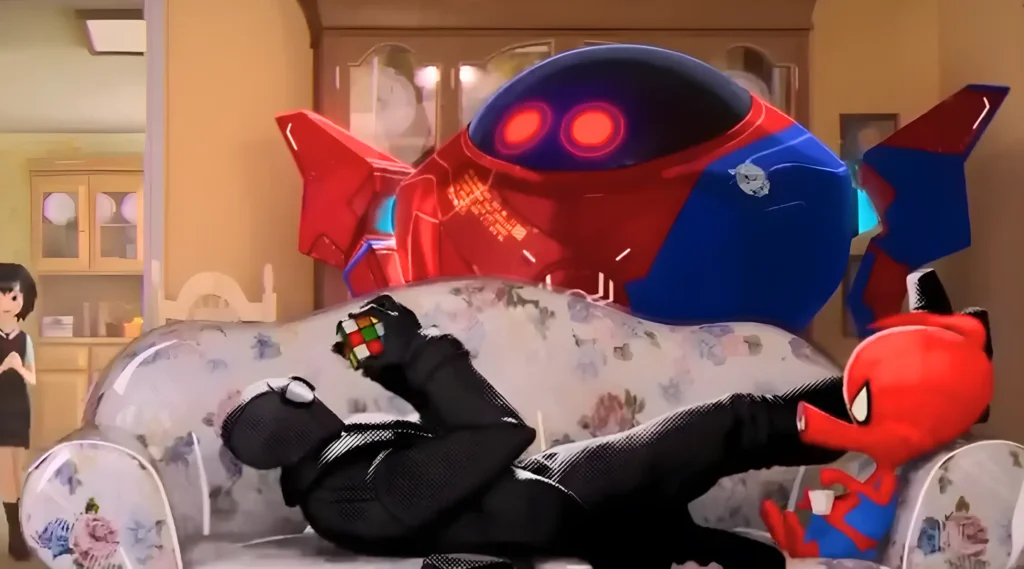
The version of Spider-Man Noir that most people know can’t figure out a Rubik’s Cube. He wanders around Miles Morales’ colorful, chaotic New York looking like he took a wrong turn out of a Raymond Chandler novel, delivers a few perfectly deadpan lines in Nicolas Cage’s best 1930s Transatlantic accent, and disappears back into his black-and-white universe. It’s a great bit. It’s also nowhere near the whole story.
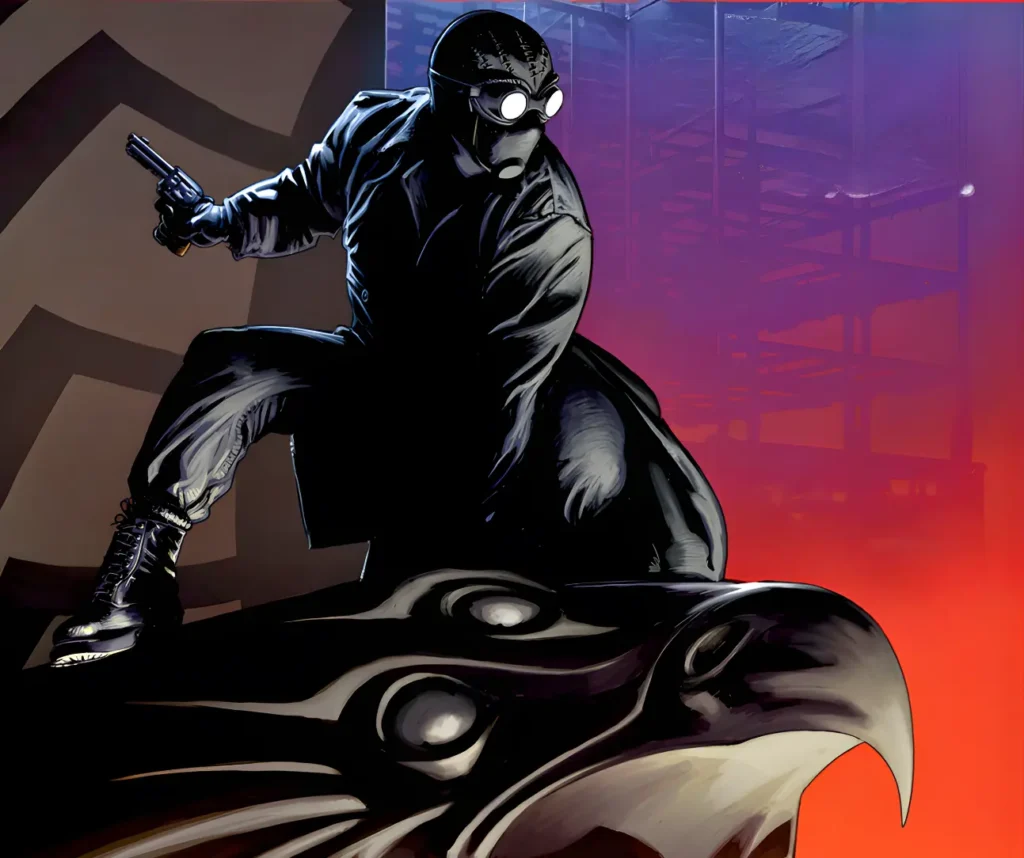
The Spider-Man Noir of the comics — the one David Hine and Fabrice Sapolsky created in Spider-Man Noir #1 back in February 2009 — carries a revolver. Uses it. His Uncle Ben wasn’t shot by a mugger. He was beaten half to death by Norman Osborn’s gang and then eaten alive by a cannibal called the Vulture. His mentor is a heroin addict. J. Jonah Jameson is a villain. The whole city is corrupt from the mayor’s office down to the sewer grates, and the only way to fight it is to get into the gutter yourself.
Spider-Man Noir is an alternate version of Peter Parker from Earth-90214 — Marvel’s designated noir universe — who operates as a violent, gun-carrying vigilante in 1930s New York during the Great Depression. Created in 2009 by David Hine and Fabrice Sapolsky with art by Carmine Di Giandomenico, he shares Spider-Man’s core powers but replaces the science-accident origin with a mystical spider-god bite, and replaces the “no killing” rule with the pragmatic logic of a man fighting a war that the courts can’t touch.
That’s who Nicolas Cage is actually playing when Spider-Noir drops on Prime Video on May 27, 2026 — all eight episodes, available globally, in your choice of black-and-white or full color. Not the charming cameo. The real one. Here’s everything you need to know about where he came from, what makes him genuinely different from every other Spider-Man, and why this particular show could be the most interesting Marvel project in years.
What “Noir” Actually Means (And Why It Changes Everything)
Before we get into spider bites and mob bosses, it’s worth understanding what the word “noir” is actually doing here — because most coverage treats it like a visual choice, a costume decision, a reason to make everything black and white. It’s not. It’s a complete philosophical reboot of what kind of story you’re allowed to tell.
Film noir emerged from 1940s and 50s Hollywood — Double Indemnity, The Maltese Falcon, Sunset Boulevard — and the genre didn’t have a lot of faith in humanity. Heroes were compromised. Institutions were corrupt. Endings were rarely happy, and when they were, they felt like consolation prizes. The visual language borrowed heavily from German Expressionism: deep shadows, harsh light cutting through darkness, architecture that felt oppressive. Raymond Chandler, who basically wrote the rulebook for hardboiled detective fiction, described it as a world where “down these mean streets a man must go who is not himself mean, who is neither tarnished nor afraid.” The operative word is must. Nobody goes willingly. Nobody comes out clean.
That’s what it means to set a superhero story in noir. It’s not just that the colors drain out. It’s that the genre’s core assumptions — about justice, about institutions, about whether doing the right thing actually produces right outcomes — are fundamentally different from the ones superhero stories usually run on. The classic Marvel and DC universes are, underneath all the carnage, optimistic. The Avengers fight. The system wobbles. But it holds. There are courts, and SHIELD, and Tony Stark building things in his garage, and somehow everything doesn’t completely collapse.
Noir doesn’t do that. Noir starts from the premise that the system has collapsed — or was never functional to begin with — and asks what one person does about it anyway. The hero isn’t a symbol of hope. He’s a stubborn holdout against despair.
Put Spider-Man in that world and you don’t just get a darker Spider-Man. You get a Spider-Man whose entire operating logic has to change. The responsibility is still there. The power is still there. But the framework that makes “with great power comes great responsibility” feel like an achievable covenant — that’s gone. What do you do when your responsibility points you somewhere the law won’t go and the press won’t cover and the people in charge have already been bought?
You find out what you’re actually made of.
The Origin — Spider-God, Not Science Lab
The pitch, as French comics journalist Fabrice Sapolsky later described it, started simply enough: what if Spider-Man had been created during the pulp era instead of the Silver Age? Sapolsky had been editing Comic Box, a French comics magazine, when he brought the concept to writer David Hine in December 2006. They developed it together, brought in Italian artist Carmine Di Giandomenico, and Marvel gave them a four-issue miniseries. Spider-Man Noir #1 hit shelves in February 2009, launching alongside X-Men Noir as the opening salvo of the broader Marvel Noir imprint.
The setting is Earth-90214. Winter, 1932. New York City during the Great Depression — not the romanticized Depression of sepia photographs, but the actual one: soup kitchens and police brutality and the gap between the very rich and the very desperate widening by the day. Rising in that gap, alongside the poverty, is something uglier: Nazi ideology filtering in from Europe, fascist sympathizers organizing in American cities, a political rot that the newspapers are either too afraid or too bought to cover honestly.
Peter Parker grows up in the middle of this. Raised by his Aunt May — a genuine social activist, not the gentle cookie-baking figure from the classic comics, but someone out in the streets organizing, speechmaking, putting her body in front of injustice — and his Uncle Ben, a World War I veteran who came back from the trenches with a particular clarity about power and those who abuse it. “If those in power can’t be trusted,” Uncle Ben tells Peter, “it’s the responsibility of the people to remove them.” It’s the same moral lesson. The stakes are just entirely different.
Then Norman Osborn’s enforcers arrive.
In this universe, Osborn isn’t a scientist who accidentally turns himself into a supervillain. He’s a crime boss — the Goblin, everyone calls him, and not affectionately — who has bought the mayor, the police chief, and enough of the press that he operates with near-total impunity. His muscle includes Kraven, a circus animal trainer who commands big cats with an ease that reads as something more than skill in this grimy context; the Chameleon, Kraven’s half-brother, who has worn other men’s faces for so long his own has become an afterthought; and the Vulture. Adrian Toomes. A circus freak and cannibal who earns his name in the most literal, grotesque way imaginable.
They make an example of Uncle Ben. Beat him nearly to death, then let the Vulture finish the job.
Peter witnesses none of this directly — but he pieces it together. What he does witness, shortly after, is the origin that puts this version of the character permanently in a different category from every other Spider-Man. Following a tip to a warehouse where Osborn’s men are smuggling stolen antiques, Peter hides in the rafters and watches them unload crates — including an ancient carved spider idol. The idol falls. Shatters. Releases a torrent of spiders into the room below, which swarm one of the henchmen and kill him. And one small spider climbs up to the rafters where Peter is hiding and bites him.
He passes out. In the vision that follows, something vast and ancient addresses him directly. My bite brings death only to those of evil intent, it tells him. I will bestow on you a greater torment — the curse of power.
He wakes hanging upside down from the rafters, encased in dark webbing, changed.
This is the crucial creative decision that separates Spider-Man Noir from every scientific accident, every radioactive spider in every other universe. The powers aren’t the byproduct of a lab mishap. They’re a gift from something with intent — something old and morally aware, something that chose him specifically. The spider-god doesn’t offer purpose, though. Just power, framed explicitly as a burden. What Peter does with it is entirely his problem.
Di Giandomenico’s artwork makes all of this land with genuine weight — angular, expressionistic, heavy with shadow in a way that owes as much to Weimar-era German cinema as it does to any superhero comic. The black organic webbing Peter produces isn’t clean and geometric like the classic version. It manifests in dark sprays and nets, something more biological than mechanical, something that belongs to the same category as the dark thing that gave it to him.
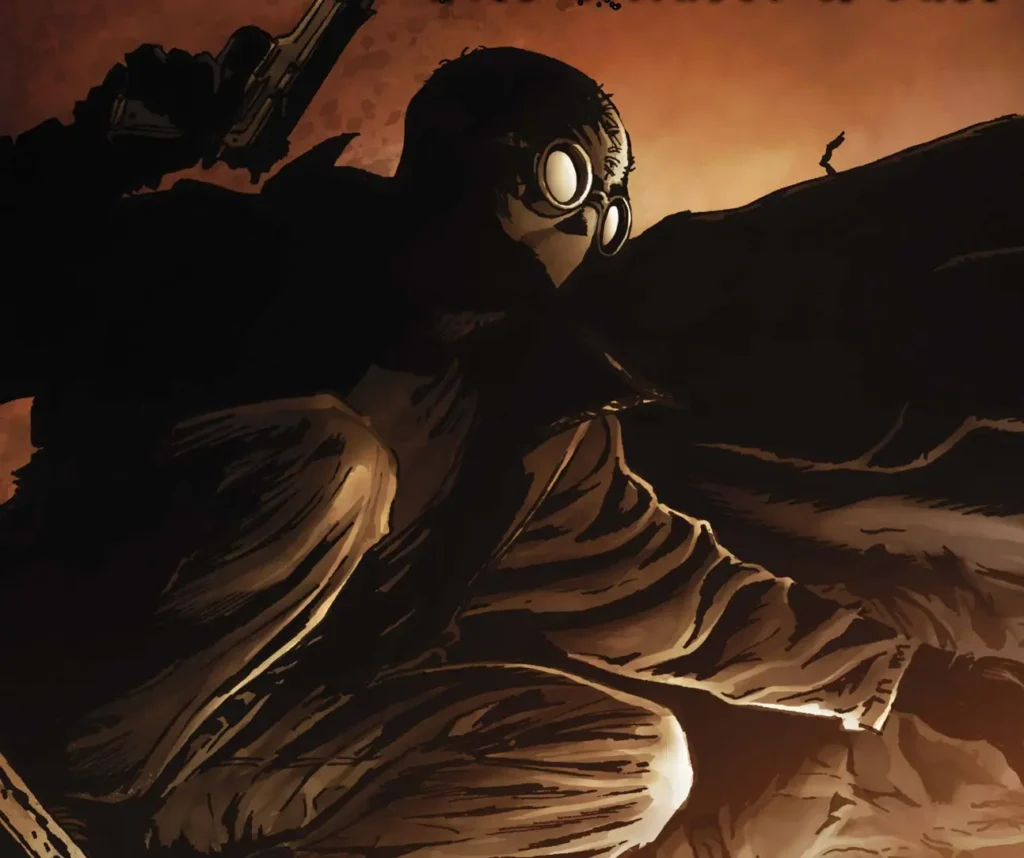
He builds his costume from his Uncle Ben’s WWI airman uniform. Adds a mask and goggles. Gets a revolver.
He’s not going to go to the police.
What Makes Him Different — Guns, Moral Greyness, and the Things He Does That Peter Parker Never Would
The revolver is the thing people always mention first, and fairly so. Spider-Man carrying a firearm is jarring enough that it tells you immediately you’re in different territory. But the gun is really just the most visible expression of something deeper — a fundamental difference in how this version of Peter Parker understands his relationship to violence, justice, and what heroism actually costs.
Classic Spider-Man doesn’t kill. Full stop. It’s one of the character’s defining commitments, the line he holds even when holding it is genuinely irrational, even when the villain is going to escape and hurt more people and the math clearly doesn’t work out. He holds it because the alternative — becoming someone who decides who deserves to die — is a line he won’t cross. That idealism is part of what makes him Spider-Man.
Spider-Man Noir crosses it. Not carelessly, not gleefully, but deliberately. In a city where the courts are bought and the police are on the payroll and the press is either silenced or compromised, nonviolence as a moral position isn’t noble — it’s a luxury that the people being ground up by the machine can’t afford. He uses lethal force because he’s made a different calculation about what the situation actually demands.
His Aunt May knows this. Hates it. One of the most quietly devastating moments in the original miniseries comes after Peter kills the Vulture — the creature directly responsible for Uncle Ben’s death, who was about to kill May herself. She survives. And then she turns on Peter. You could have stopped him with your powers, she tells him. Killing people makes you less of what makes you human. She’s not wrong, exactly. But she’s also not the one who watched what the Vulture did to Uncle Ben.
That moment is what this story is actually about. Not the powers, not the period setting, not the visual aesthetic. The question at the center of Spider-Man Noir — the one his world forces and ours mostly lets us avoid — is whether a moral code built for a functioning world means anything in one that isn’t. Aunt May says yes. Peter isn’t sure.
That tension — between her principled nonviolence and his brutal pragmatism — is the moral engine of the character. He doesn’t enjoy what he does. Later runs, particularly Margaret Stohl and Juan Ferreyra’s Twilight in Babylon (2020), show a Peter who’s increasingly haunted by his own methods, who questions whether the vigilante path creates as much damage as it prevents. He’s an anti-hero in the actual sense: someone doing necessary things through means we’re not supposed to entirely endorse.
His powers reflect this grittier register. The wall-crawling is there, but in the original comics he largely avoids it — parkour and free-running through Depression-era architecture, staying mobile without the conspicuous spider-theatrics. The webbing is organic, black, and not particularly elegant. It sprays in dark nets and tangles rather than the precise geometric lines of the classic version. After his resurrection in the 2020 comics, his control improves and he starts producing actual web-lines — but the early version is rawer, more instinctive, less superhero and more something older.
The costume — Uncle Ben’s WWI airman uniform, repurposed with a mask and aviator goggles — is designed for function, not symbolism. No spider insignia on the chest. No bright colors broadcasting his presence. It’s the outfit of a man who understands that in his city, visibility is a liability and heroes who announce themselves tend not to last long.
The Comics History — From 2009 Experiment to Multiverse Essential
Most coverage of Spider-Man Noir treats his publishing history as trivia — a list of issue numbers to prove you’ve done the homework. It isn’t. It’s the story of how a genuinely unusual character slowly earned the platform that was always big enough to contain him.
The original Spider-Man Noir four-issue run sold well enough for a follow-up. Spider-Man Noir: Eyes Without a Face arrived in late 2009, written again by Hine and Sapolsky with Di Giandomenico’s art carrying through. The sequel jumps forward roughly eight months — Norman Osborn is gone, Franklin D. Roosevelt has just won the 1932 election, and New York is cautiously exhaling. Peter is still operating as Spider-Man, but the political landscape is shifting in ways the first series didn’t have room to explore: eugenics, race science, the ideological currents flowing in from Europe that will eventually become something far worse. It’s a darker, more ambitious book in some ways than the original, even if it didn’t reach the same audience.
Then came a long quiet stretch. The Marvel Noir imprint produced its other titles — Daredevil Noir, Wolverine Noir, Punisher Noir, Luke Cage Noir, X-Men Noir: Mark of Cain, Iron Man Noir — and mostly wound down by 2010. Spider-Man Noir became one of those characters who existed in the database, appeared in video games like Spider-Man: Shattered Dimensions (2010), and showed up in fan conversations without much new material to fuel them.
Edge of Spider-Verse #1 changed everything. Published in September 2014, it returned to Earth-90214 — but jumped the timeline forward to August 1939. Six years have passed since the origin. Peter is older, more settled into the vigilante role, and now has a girlfriend in Mary Jane Watson, who spent three years fighting with the Abraham Lincoln International Brigade in Spain. The world has changed. The Nazis are actually in power now, not just a looming threat. And then the Superior Spider-Man shows up and recruits Peter into the Spider-Army — a multiverse-spanning coalition fighting the Inheritors, a vampiric family led by Morlun that hunts spider-totems across realities.
The Spider-Verse event (2014–2015), written by Dan Slott, threw Spider-Man Noir into the chaotic company of dozens of Spider-variants: Spider-Gwen, Spider-Ham, the Superior Spider-Man, Silk, Mayday Parker. The culture clash between his hardboiled 1930s worldview and the kaleidoscopic multiverse around him generated some of the event’s best moments. He survived. Became a founding member of the Web Warriors. Fought in Spider-Geddon in 2018 — and died there, or seemed to.
What dying and returning from the dead actually did to Peter is something the comics handle carefully. The spider-god’s terms were explicit: this resurrection wasn’t mercy, it was an extension of service. No special treatment. No promise of another one. He woke in a web-cocoon on his native Earth-90214 knowing that the next time he fell, he’d stay fallen. That knowledge changes a person. It changed him — made him more deliberate, more aware of what he was spending himself on, and more honest about the cost.
Spider-Verse vol. 3 #5 (2020), written by Christos Gage with art by Juan Ferreyra, handled the resurrection. It set up Spider-Man Noir: Twilight in Babylon (2020), Stohl and Ferreyra’s five-issue limited series, which found Peter operating as a private investigator — weathered, introspective, navigating both street-level crime and the encroaching shadow of World War II. It’s the most character-study-oriented of his solo runs, and the one that most clearly pointed toward what a long-form television adaptation could look like.
Marvel’s current Spider-Man Noir: The Gwen Stacy Affair (October 2025–2026), written by Erik Larsen with art by Andrea Broccardo, is a deliberate synchronization move — new comics material timed to the Amazon show’s May 2026 premiere window. The strategy is transparent and entirely reasonable. New readers discovering the character through the show need somewhere to go. The Larsen series gives them an entry point with updated antagonists in a story that doesn’t require any prior comics knowledge.
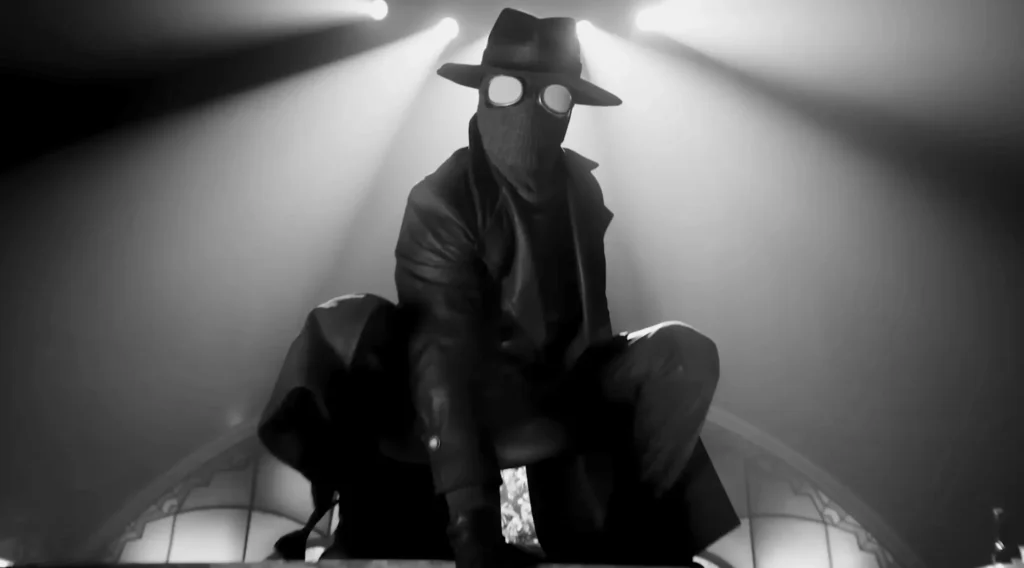
That platform arrived on February 12, 2026, in the form of a trailer.
Nicolas Cage, Spider-Verse, and Why the Cameo Wasn’t the Whole Story
Here’s something that gets lost in the Into the Spider-Verse conversation: Nicolas Cage didn’t just voice Spider-Man Noir in that film. He built a complete performance philosophy around a character most of the audience had never heard of, based on an interpretation of 1930s cinema that most animated superhero films wouldn’t go anywhere near.
Cage has talked about basing the voice on a composite of Humphrey Bogart, James Cagney, and Edward G. Robinson — the canonical voices of classic crime cinema, the ones that defined how morally complicated men sound when they’re trying to hold themselves together. The result is the Transatlantic dialect that made the character an immediate fan favorite: clipped, dry, every syllable deliberate, a man who speaks like he’s being recorded for posterity even when he’s panicking about a Rubik’s Cube. The joke works because the voice is so specifically committed. It’s not a parody. It’s a real performance wearing a parody’s clothing.
What the film couldn’t do — what its format structurally prevented — was give him a story. Into the Spider-Verse is Miles Morales’ movie, as it should be, and the other Spider-variants function as an ensemble that illuminates Miles’ journey rather than pursuing their own. Spider-Man Noir gets his moments. The black-and-white universe gag. The Rubik’s Cube. A few lines that land perfectly. But the film’s 117 minutes belong to Miles, and there’s simply no room to explore what actually makes this character interesting — the moral complexity, the brutal world, the weight of what he’s already been through before the multiverse ever found him.
He makes a brief non-speaking cameo in Spider-Man: Across the Spider-Verse (2023), and Cage is confirmed to reprise the role in Beyond the Spider-Verse whenever that arrives. The animated versions will always be a part of his identity now. But they were never going to be enough. A character this specific, this rooted in a particular historical moment and moral register, needs space that a multiverse ensemble can’t provide.
Eight episodes is space.
Spider-Noir — The Amazon Series, Explained
The first thing to understand about Spider-Noir is what it isn’t. It’s not an MCU project. Not a Disney+ series. Not connected to Tom Holland’s Spider-Man or the events of No Way Home or anything in the current Marvel Studios pipeline. This is a Sony Pictures Television production in partnership with Amazon MGM Studios, operating in its own lane — the same way the Venom films do, the same way Sony has been building its own corner of Spider-Man’s world for years. The multiverse door isn’t closed, exactly, but don’t walk into this expecting crossover teases.
The second thing to understand is the name change. Nicolas Cage is playing Ben Reilly, not Peter Parker — and that decision operates on two levels simultaneously. The stated creative reason, from co-showrunner Oren Uziel, is straightforward: Peter Parker is synonymous with a high school kid. That name carries decades of established expectation, and this show is about an aging Spider-Man — a down-on-his-luck private investigator in his middle years, forced back into a mask he thought he’d retired. Ben Reilly feels lived-in in a way Peter Parker doesn’t.
The legal dimension is equally real, even if nobody says it directly. Live-action use of the Peter Parker name outside the MCU framework involves a complicated arrangement between Sony and Disney that makes it genuinely easier to sidestep the issue entirely. The irony is rich: Ben Reilly is himself a significant Spider-Man character in the comics — the Scarlet Spider, Peter Parker’s clone, a figure with his own decades of complicated history. The show almost certainly isn’t engaging with any of that continuity. It’s borrowing the name for its associations (Ben, as in Uncle Ben; Reilly, as in working-class Irish-American New York) without the baggage.
The creative team assembled around Cage is where the show’s ambitions become clearest. Co-showrunners Uziel (22 Jump Street, The Lost City) and Steve Lightfoot — whose previous Marvel work was The Punisher on Netflix, a show that understood darkness without being empty about it — developed the series alongside Phil Lord, Christopher Miller, and Amy Pascal. Lord and Miller built the animated Spider-Verse from scratch and understand better than almost anyone what makes alternate Spider-People work as characters rather than novelties. Their presence as executive producers suggests the show has genuine creative guardrails, not just a famous face in a period costume.
Then there’s Harry Bradbeer directing the first two episodes. This is the choice that makes me genuinely excited rather than cautiously optimistic. Bradbeer directed Fleabag — all of it, every episode of both series — and Killing Eve. His specialty is interiority: characters who perform a version of themselves for the world while something more complicated and more painful operates underneath. He’s extraordinary at finding the specific physical and verbal tics that betray a person’s inner state, the way a laugh can be a deflection and a silence can be an admission. An aging ex-superhero turned private investigator who walked away from something he can’t stop thinking about is exactly the kind of character Bradbeer knows how to crack open. No one else working in this space would have been a more precise fit.
The cast fills in the world around Cage with real texture. Lamorne Morris as Robbie Robertson brings sharp, skeptical energy to a character who functions here as both moral anchor and information source. Brendan Gleeson as Silvermane is the casting decision that makes everything click — a Depression-era crime lord who needs to project grandfatherly warmth and cold menace simultaneously, and Gleeson is one of the few actors alive who can do both in the same breath without either feeling false. Li Jun Li as Cat Hardy and Jack Huston as Flint Marko complete a cast built around specificity rather than spectacle.
The dual-format release deserves more attention than it’s getting. Spider-Noir will be available in two distinct versions: “Authentic Black & White” and “True-Hue Full Color” — filmed digitally then processed separately through different post-production pipelines. The production coined “True-Hue” to describe a deliberately supersaturated color process, something Cage compared to Edward Hopper’s Nighthawks (1942). Anthony Breznican, writing for Esquire, put it well: the color version edges toward the lighthearted visual language of Dick Tracy, while the black and white reaches toward Raymond Chandler’s moral abyss. Genuinely different viewing experiences. Not a filter switch.
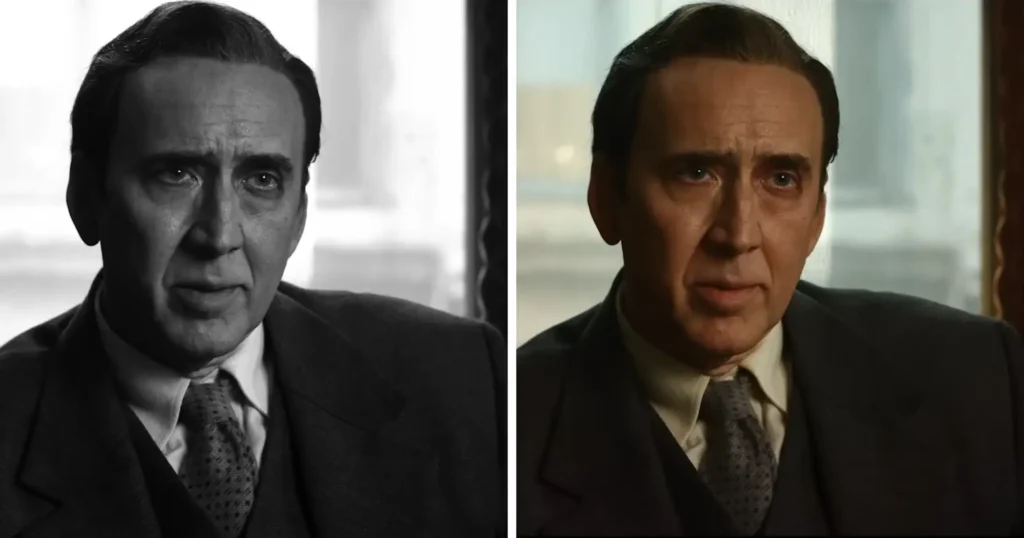
This is a bold creative commitment that studios rarely make, and it signals something important about how Amazon and Sony are positioning the show. They’re not treating this as a Marvel product with noir dressing. They’re treating it as a noir film that happens to feature a man who can crawl up walls and swing on black organic webbing — which is exactly the right approach, and exactly what the source material has always deserved.
Spider-Noir premieres May 25, 2026 on MGM+ in the United States. All eight episodes drop globally on Prime Video on May 27.
Why Spider-Man Noir Finally Gets the Story He Deserved
Spider-Man Noir was always built on a contradiction: the most optimistic character in superhero comics, transplanted into the genre least willing to reward optimism. Peter Parker’s core belief — that power obligates you to act, that showing up matters even when the math doesn’t work — turns out to be just as true in a world where it can get you killed as it is in one where it makes you a hero. Maybe more true. It’s easy to be responsible when responsibility is celebrated. It’s something else entirely when it just makes you a target.
Seventeen years after David Hine and Fabrice Sapolsky put a revolver in Peter Parker’s hand and dared readers to follow him anyway, that contradiction finally has the space it always deserved. Eight episodes. A director who understands what it costs a person to keep going. Nicolas Cage, who understood this character the first time and hasn’t stopped understanding him since.
The Rubik’s Cube bit was never the point. This is the point.