
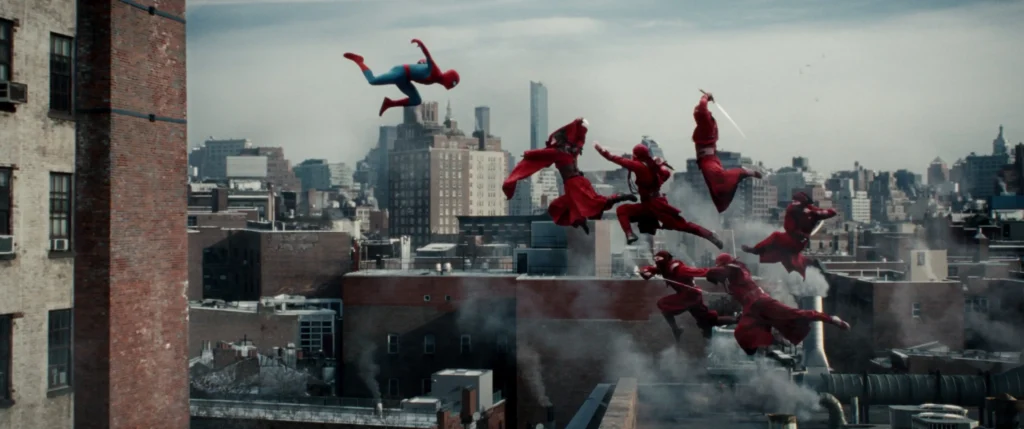
The red ninjas in the Brand New Day trailer aren’t a random villain choice. They’re a signal.
Frank Miller invented The Hand in 1981 to do something no superhero villain had really done before — not just threaten the hero’s life, but threaten the hero’s soul. The Hand doesn’t kill you and go home. They kill you, bring you back, and send you against everyone you loved. Wolverine spent a 12-issue arc fighting his way back from what they did to him. Daredevil built a fortress on top of Hell’s Kitchen and started murdering people from inside it. Even Elektra — one of the most dangerous fighters in the Marvel Universe — spent years as their weapon before clawing her way out.
Now Spider-Man’s fighting them. Alongside the Punisher. With a Daredevil-shaped hole in the Brand New Day trailer that Marvel’s visual effects team seems very, very eager to keep filled.
That’s not coincidence. That lineup has a name. It’s the Omega Effect — and if you know that 2012 crossover, you already know more about Brand New Day‘s structure than most of the internet does right now.
The Hand is a demonic ninja cult in Marvel Comics, created by Frank Miller in Daredevil #174 in 1981. They’re ancient assassins powered by a demon called the Beast, who grants them the ability to resurrect their dead as servants. In Spider-Man: Brand New Day, they appear as red-clad warriors — and their presence links the MCU’s street-level world to a much bigger mythology.
Here’s everything you need to know about The Hand — where they came from, what makes them genuinely terrifying, and why their MCU return might be the most important thing to happen to Marvel’s street-level universe in years.
Frank Miller Created Them — And They Were Never Just Ninjas
Most people date The Hand from the Netflix shows. That’s the wrong starting point by about forty years.
Frank Miller introduced The Hand in Daredevil #174, published in September 1981, and what he was building wasn’t just a recurring villain faction. In a span of roughly four years on that title, Miller created or codified almost every major piece of Daredevil mythology that’s still in use today — Elektra, Stick, The Chaste, the first Daredevil vs. Punisher confrontation, and The Hand as the organisation threading all of it together. You don’t understand The Hand without understanding Miller’s run, because the ninjas were never really the point. They were the mechanism through which Miller explored what happens when a hero gets close enough to evil to start resembling it.
The Hand’s origin goes back to 1588, when a samurai named Kagenobu Yoshioka founded a secret society of Japanese nationalist warriors — a genuine resistance organisation built to protect the common people against the country’s ruling class. Noble founding. Short-lived. Yoshioka was assassinated, and control of the organisation passed to the Snakeroot Clan, a demon-worshipping cabal that remade the Hand in service of a primordial entity called the Beast — known formally as Krahllak — whose existence Miller first named in Elektra: Assassin #1 (1986), illustrated by Bill Sienkiewicz. The Beast is the source of everything that makes The Hand genuinely dangerous: the black magic, the dark arts, and most critically, the resurrection power that lets them raise their dead as obedient servants. You can read The Hand’s full comics publication history on the Marvel Database.
That last ability is what separates them from every other Marvel ninja faction. An organisation that can replenish its ranks indefinitely and convert its enemies into assets isn’t an army. It’s a self-perpetuating machine.
One more detail worth knowing: the Foot Clan in Teenage Mutant Ninja Turtles was created in 1984 as a direct parody of The Hand. Kevin Eastman and Peter Laird were explicitly riffing on Miller’s Daredevil. Which means the most iconic ninja villains in pop culture — the ones most Western audiences encountered first — were built as a joke about these guys. The original is considerably less funny.
What Makes The Hand So Dangerous — The Resurrection Problem
Here’s the thing most Hand explainers get wrong: the ninjas aren’t the threat. The ninjas are the symptom.
Send a hundred Hand assassins after Wolverine and he’ll kill all of them before breakfast. Send them after Daredevil and Matt Murdock will work his way through the pile with compound fractures and a broken billy club. The rank-and-file members of The Hand are dangerous the way a tide is dangerous — relentless, replaceable, wearing you down rather than overpowering you. What makes The Hand genuinely terrifying operates at a completely different level.
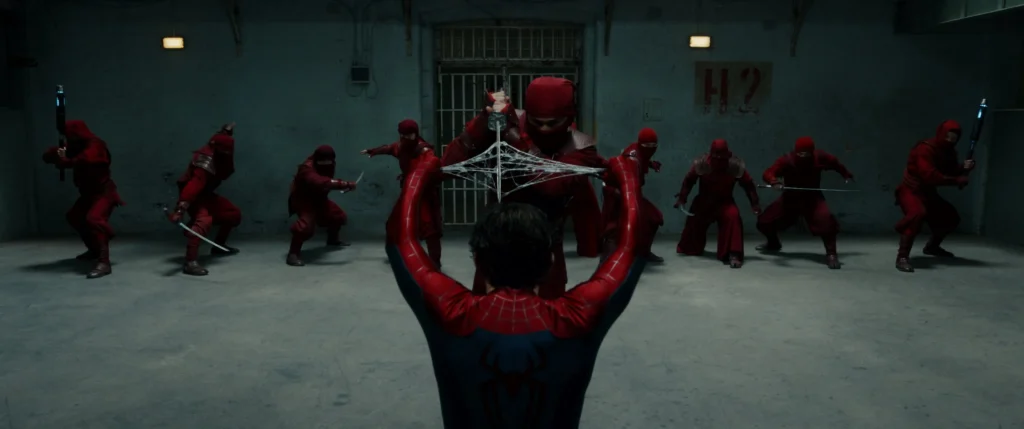
The resurrection power is where it starts. When a Hand ninja dies in battle, the organisation can bring them back — not as a ghost or an echo, but as a functional, obedient weapon, stripped of whatever autonomy they had in life. That’s unsettling on its own. But The Hand’s real weapon isn’t resurrecting their own dead. It’s resurrecting yours.
Elektra Natchios — one of the most lethal human fighters in the Marvel universe, a woman trained by both Stick of The Chaste and the Hand themselves — was killed by Bullseye in Daredevil #181 (April 1982), still one of the most gut-punch deaths in comics history. The Hand immediately moved to resurrect her as their weapon. Daredevil and Stone of The Chaste intervened in time, but the damage was done: the person Matt Murdock loved most had been turned into an asset the organisation tried to claim.
That pattern — identify the hero’s emotional core, then threaten to convert it — runs through every major Hand story in the comics. And the conversions don’t stop at supporting characters.
Mark Millar and John Romita Jr. ran Wolverine #20–31 from 2004 to 2005 in what became known as “Enemy of the State.” The Hand and Hydra captured Logan, killed him, brought him back through their resurrection ritual, and sent him — brainwashed and fully weaponised — against the X-Men, S.H.I.E.L.D., the Fantastic Four, and everyone else who got in the way. Wolverine’s healing factor and adamantium skeleton made him the perfect converted asset: nearly impossible to stop, completely under their control. It took the entire Marvel superhero community operating at full alert to bring him in, and even after S.H.I.E.L.D. deprogrammed him, the psychological damage lingered for years across subsequent runs.
That’s still not the worst thing The Hand ever did.
In Andy Diggle and Billy Tan’s Shadowland (2010), Daredevil — who had become the Hand’s leader in an attempt to reform the organisation from within — was slowly, methodically possessed by the Beast itself. By the time the possession was complete, Matt Murdock had murdered Bullseye, was running a brutal private justice regime from a fortress he’d constructed over Hell’s Kitchen, and had turned the Hand into an occupying army terrorising the neighbourhood he’d spent his entire career protecting. It took Iron Fist channelling his chi directly into Murdock’s soul to burn the Beast out. The man who emerged from that experience wasn’t the same person who walked into it.
That’s the pattern. Every hero who fights The Hand long enough, gets close enough, tries to control them from the inside — the organisation doesn’t just resist them. It bends them. Converts them. Uses their own strengths as the mechanism of corruption.
Now think about what Peter Parker looks like walking into Brand New Day. No mentor. No Tony Stark. No identity. A kid running on pure instinct, isolated from every emotional anchor, fighting an organisation specifically designed to exploit exactly that kind of psychological vulnerability.
“The Hand has never faced a more perfect target.”
Their Biggest Comic Stories Before Brand New Day
Forty-four years of Hand appearances across Marvel Comics is a lot of ground. But there are five runs that actually matter — the ones that built the mythology, defined the stakes, and set up everything Brand New Day is reaching for.
Frank Miller’s Daredevil Run (1981–1983)
This is where it all starts. Miller’s Hand appearances across Daredevil #174–#190 established the organisation’s core DNA: the resurrection power, the connection to Elektra, the rivalry with The Chaste, and the way The Hand operates not as a conventional villain faction but as a corrupting force that reshapes everyone it touches. If you’ve never read it, the Daredevil: The Frank Miller Companion omnibus collects the essential run. What strikes you reading it now is how little the core mechanics have aged — the Hand’s threat in 1981 is structurally identical to the Hand’s threat in Brand New Day forty-four years later. Miller got it right the first time. Marvel’s own history of Daredevil and the Hand tracks every major turn in that relationship from 1981 through the present day.
Elektra: Assassin #1–8 (1986)
Miller returned to the Hand mythology with artist Bill Sienkiewicz to formally name and define the Beast — the demonic entity whose power underpins everything the organisation does. This eight-issue prestige miniseries is stranger and more experimental than Miller’s Daredevil work, but it’s where the Hand transforms from a very dangerous ninja faction into a genuinely occult threat with cosmic ambitions. Most of what later writers built on — including the Netflix showrunners — traces back here.
Wolverine: Enemy of the State (Wolverine #20–31, 2004–2005)
Mark Millar and John Romita Jr. took the Hand’s greatest capability — converting heroes into weapons — and stress-tested it against Marvel’s most indestructible character. The result is twelve issues of controlled chaos: Wolverine slicing through the X-Men, the Fantastic Four, and S.H.I.E.L.D. while Hydra and the Hand watch their investment perform. What makes it more than a great action story is what it says about the Hand’s strategic patience. They didn’t just want Wolverine dead. They wanted to use him. That distinction is everything.
Shadowland (2010)
Andy Diggle and Billy Tan’s Shadowland event remains the most ambitious Hand story ever told — and the darkest Daredevil has ever been written. Matt Murdock becoming the Beast’s vessel while trying to lead the Hand toward something better is a tragedy structured like a Greek myth: the hero’s greatest virtue, his refusal to give up on people, becomes the exact mechanism of his destruction. Every street-level hero in New York — Spider-Man, Luke Cage, Iron Fist, Moon Knight, Shang-Chi, Ghost Rider — had to team up to stop him. It’s essential reading before Brand New Day.
The Omega Effect (2012)
Here’s where it gets genuinely interesting. Writer Mark Waid on Daredevil and writer Greg Rucka on Punisher co-plotted a crossover that ran through Daredevil #10–11, Punisher Vol. 9 #10, and Amazing Spider-Man #685–686 in 2012. The story brought together Daredevil, Spider-Man, Punisher, and a new character named Rachel Cole — a woman who’d lost her entire family to organised crime and was walking the same path as Frank Castle — against a coalition of the world’s biggest criminal organisations, with The Hand as the primary operative threat.
The MacGuffin is an Omega Drive: a data device containing compromising information on every major crime cartel, built from unstable molecules, practically indestructible. Daredevil has it. Every criminal organisation on Earth wants it. The only way out is a coordinated blitz — Spider-Man’s ingenuity, Punisher’s firepower, Daredevil’s intimate knowledge of the Hand — executed simultaneously across a single night.
Sound familiar? It should. Brand New Day has confirmed Spider-Man and the Punisher. It features The Hand as a major threat. And there’s a conspicuously altered sequence in the official Brand New Day trailer — figures appear to have been digitally removed from the Hand fight scene using the same technique Marvel employed in No Way Home to hide Tobey Maguire and Andrew Garfield — where Daredevil almost certainly belongs.
Mark Waid and Greg Rucka built that crossover in 2012 without knowing they were writing the blueprint for a $200 million Spider-Man film. Marvel is about to prove they weren’t wrong about the lineup.
The Omega Effect Is Already Brand New Day’s Blueprint
Let me tell you what Marvel hasn’t officially confirmed yet — and why I’m confident enough to say it anyway.
The Omega Effect crossover from 2012 assembles three characters to fight The Hand across a single chaotic New York night: Spider-Man, the Punisher, and Daredevil. Spider-Man: Brand New Day has confirmed Spider-Man and the Punisher fighting The Hand across what appears to be a single chaotic New York sequence. Daredevil is the character most defined by his history with the Hand in the entire Marvel universe. Charlie Cox has been doing his best Andrew Garfield impression — “If I were in the movie I would also say no, to be clear, but I’m not in the movie” — which is exactly what Garfield said about No Way Home for two years before walking through a portal.
That’s not a coincidence. That’s a blueprint.
The structural parallel runs deeper than just the lineup. In the Omega Effect, the story isn’t really about the Hand at all — the ninjas are a pressure mechanism. The actual story is about three people with fundamentally different moral codes being forced to work together, each convinced their method is right, none of them entirely wrong. Peter Parker argues for zero fatalities. Frank Castle argues that some people need to die. Matt Murdock argues that the information in that drive is more useful as a deterrent than a weapon. The Hand provides the crisis that makes all three positions impossible to hold simultaneously. What’s left when the fighting stops is a question about what kind of city New York gets to be — and who gets to decide.
Now look at Brand New Day‘s setup. Peter Parker is running on nothing: no Stark tech, no mentor, no memory in the world that connects him to anyone. He’s wearing a hand-stitched suit and apparently developing organic webbing as his body mutates into something more spider than man. Jon Bernthal’s Punisher is confirmed as a significant presence — not a cameo, not a background player. The Hand are attacking in force, in red, set approximately one year after Daredevil: Born Again Season 2.
That last detail matters more than it sounds. Born Again Season 2 premieres on Disney+ on March 24, 2026 — four months before Brand New Day opens. Marvel has confirmed that showrunner Dario Scardapane intends Season 2 to end the Mayor Fisk storyline and return the series to what he called “the large, mythological genre stuff” from the Frank Miller comics. The Hand are the large, mythological genre stuff of Frank Miller’s Daredevil. Which means by the time Brand New Day opens in July, the MCU Hand will have been reestablished, re-contextualised in the film-canon universe, and handed directly to a movie that puts Spider-Man and the Punisher against them.
The trailer’s digitally altered Hand fight sequence is the clearest tell. Eagle-eyed fans on Reddit clocked it within hours of the trailer dropping. The specific framing — Peter in what appears to be a coordinated fight formation rather than a solo brawl — suggests he’s not fighting alone. Someone is standing where the camera doesn’t want you to look.
There’s one more Omega Effect connection worth sitting with. In Waid and Rucka’s story, the emotional core isn’t the action — it’s a conversation. Daredevil talks Rachel Cole down from the edge of Frank Castle’s path by telling her that her grief doesn’t make her special. That the most dangerous thing she can do is believe her personal loss grants her a different moral framework than everyone else. “Your story is every story of everybody who’s ever struggled or had something taken from them,” he tells her. It’s the sharpest thing Matt Murdock says in the entire crossover, and it’s directed at someone who’s been running on pure pain ever since her world ended.
Peter Parker, post-No Way Home, is running on pure pain. He erased himself from everyone’s memory to save the multiverse. He lost MJ, Ned, Aunt May — everything that anchored him — and he did it voluntarily, because that’s who he is. If Brand New Day follows the Omega Effect’s emotional logic even loosely, the Hand aren’t just Peter’s physical opponents. They’re the pressure that forces him to figure out what kind of hero he wants to be when there’s no one left watching.
That’s not a recycled Netflix villain arc. That’s the best possible use of forty-four years of Hand mythology.
What The Hand’s MCU Return Actually Means
Putting The Hand in a theatrical Spider-Man film is a different kind of statement than putting them in a Netflix miniseries. The stakes are different. The budget is different. The audience reach is different. And most importantly — the permanence is different. A villain faction introduced at theatrical scale doesn’t get quietly wound down when a streaming show gets cancelled. They become franchise infrastructure.
That’s the upgrade Brand New Day delivers. The Hand aren’t Hell’s Kitchen’s problem anymore.
What’s significant about that upgrade is what it represents structurally. For nine years — from Daredevil Season 2 in 2016 through the end of Netflix’s Marvel run — The Hand existed exclusively on the small screen, in stories that the film side of the MCU consistently treated as peripheral. Crossover references were minimal. The Hand never threatened anyone the Avengers noticed. They were Hell’s Kitchen’s problem, and Hell’s Kitchen was considered a neighbourhood story. But that calculus is shifting fast, and the street-level universe may play a bigger role than anyone expects in determining which MCU characters are locked in through Secret Wars.
Elodie Yung’s Elektra has been widely rumoured for Born Again Season 3, and her unresolved fate — last seen buried under the Midland Circle rubble at the end of The Defenders — is the most dangling thread left in the Hand’s MCU history. If Brand New Day reactivates the Hand as a major force, her return becomes almost structurally necessary. Elektra without the Hand is just an assassin. Elektra within the Hand’s orbit is one of the most complicated and compelling characters the street-level MCU has produced.
There’s also the Iron Fist question. Danny Rand is the Hand’s sworn enemy — the warriors of K’un-Lun were specifically trained to oppose them, and the concept of chi as a counter to the Beast’s dark magic runs through the entire mythology. Marvel has been quietly rebuilding toward a full Defenders assembly for some time, and introducing The Hand at theatrical scale gives them a villain powerful enough to justify the reunion — and you can see how deep Marvel’s supernatural street-level bench actually runs in our breakdown of what’s coming.
But the most immediate implication isn’t about future storylines. It’s about Peter Parker right now.
The Hand specialises in one thing above everything else: finding the person a hero can’t afford to lose and using them. For Matt Murdock, it was Elektra. For Wolverine, it was his own body. For Daredevil-as-leader, it was his belief that he could fix them from the inside. Every conversion the Hand has ever engineered started by identifying the precise emotional pressure point that made the hero vulnerable — and then pressing it, methodically, until something broke.
Peter Parker in Brand New Day has no one left to lose. No family that remembers him. No mentor alive to guide him. No relationship intact. He’s operating with the psychological profile of someone the Hand would consider an ideal candidate — isolated, grief-saturated, defined entirely by a moral code with no community to reinforce it.
The red ninjas in the trailer aren’t the threat. The question they’re asking is.
Who is Peter Parker when there’s nothing left to protect him from becoming something else?
Brand New Day opens July 31, 2026. We’re about to find out. For everything confirmed about the full cast and villain roster, our complete Brand New Day villain breakdown has it all in one place.
Here’s my honest take after forty-plus years of Hand appearances across comics, film, and television: the Netflix version never quite got them right. The five-fingers immortality structure, the dragon bones, the Black Sky — it was a competent adaptation that flattened a genuinely complex mythology into a procedural villain arc. The Hand were scary because they were numerous, not because of what they represented.
Brand New Day has a chance to fix that. The Omega Effect lineup, the street-level stakes, a Spider-Man running on psychological fumes — that’s the combination of elements the Hand mythology was built for. If Cretton and his writers go back to Miller’s source material rather than the Netflix version, this could be the best on-screen Hand story ever told.
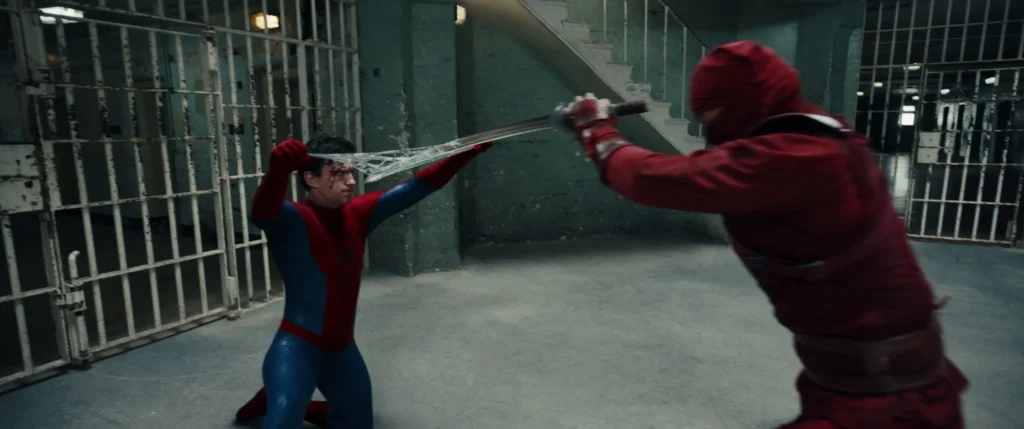
If they don’t, we’ll have red ninjas in a prison yard and nothing more. I don’t think that’s what this film is.
But I’ve been wrong before.
Frequently Asked Questions
Who are The Hand in Spider-Man: Brand New Day?
The Hand are an ancient demonic ninja cult appearing in the Spider-Man: Brand New Day trailer as red-clad warriors attacking Peter Parker. Created by Frank Miller in Daredevil #174 (1981), they’re a criminal organisation powered by a demon called the Beast who grants them resurrection abilities. Their presence in Brand New Day connects the film to the MCU’s Daredevil mythology and the street-level universe built across Netflix’s Marvel shows.
What is The Chaste and how does it relate to The Hand?
The Chaste is The Hand’s primary rival organisation — a group of elite warriors dedicated to opposing the Hand’s demonic influence. Founded by Master Izo, The Chaste trained Stick, who in turn trained both Daredevil and Elektra. Where The Hand serves the Beast and uses resurrection as a weapon of corruption, The Chaste exists specifically to counter that power. The two organisations have been at war for centuries in Marvel Comics continuity.
Did The Hand appear in the Netflix Marvel shows?
Yes — The Hand served as the central villain across Daredevil Season 2 (2016), Iron Fist (2017), and the crossover miniseries The Defenders (2017). The Netflix version reimagined their origin around five immortal leaders and dragon bone resurrection technology, diverging significantly from the comics’ Beast-worshipping mythology. Their story ended with the Midland Circle building collapse in The Defenders, leaving several characters’ fates unresolved.
What is the Omega Effect comic storyline?
The Omega Effect is a 2012 crossover written by Mark Waid and Greg Rucka, running through Daredevil #10–11, Punisher Vol. 9 #10, and Amazing Spider-Man #685–686. It teams Spider-Man, Daredevil, and the Punisher against The Hand and a coalition of criminal organisations, with an indestructible data drive as the MacGuffin. The storyline is notable for its exploration of three heroes with fundamentally different moral codes being forced to cooperate — making it the most direct comics template for Spider-Man: Brand New Day‘s confirmed lineup.
Will Daredevil appear in Spider-Man: Brand New Day?
Charlie Cox has denied appearing in Brand New Day, but his denials mirror exactly what Andrew Garfield said about Spider-Man: No Way Home before his confirmed appearance. The trailer’s Hand fight sequence shows signs of digital alteration — figures appear removed from the frame using the same VFX technique Marvel used in No Way Home to hide Garfield and Tobey Maguire. Given The Hand’s deep connection to Daredevil’s mythology and the Omega Effect’s three-hero lineup, Cox’s involvement remains strongly suspected by fans and analysts.