

Here’s a question that’s divided Marvel fans for six decades: is the Thing actually as powerful as the comics suggest, or has he always been the Fantastic Four’s underdog — the guy who fights above his weight class and occasionally wins?
The answer, once you dig into the source material, is more interesting than either camp admits. Ben Grimm isn’t just powerful. He’s operating at a level that most fans dramatically underestimate — and the gap between his official stats and what he’s actually demonstrated in the comics is bigger than almost any character in Marvel history.
The Thing can officially lift nearly 100 tons, placing him among Marvel’s elite physical powerhouses — second only to the Hulk by Marvel’s own assessment. His strength has grown from an initial Class 5 rating at his 1961 debut to Class 100 today, driven by decades of training, further mutation, and breakthroughs past psychological limits that were quietly holding him back the whole time. In raw, consistent physical might, no non-cosmic Marvel hero reliably matches him.
How Much Can the Thing Lift? The Official Stats
Marvel’s own biography says it plainly: “The Thing stands as one of the most powerful individuals on the planet, perhaps second only to the Hulk. His unique physique enables him to lift nearly one-hundred tons.”
That’s the floor. The actual ceiling is considerably higher.
When Ben Grimm first transformed in Fantastic Four #1 (1961), Reed Richards’ initial tests put his strength at a Class 5 — meaning he could lift roughly five tons. That’s still superhuman by any reasonable standard, but it’s a far cry from the powerhouse he’d become. What’s remarkable is how deliberately Marvel has tracked his growth over 64 years.
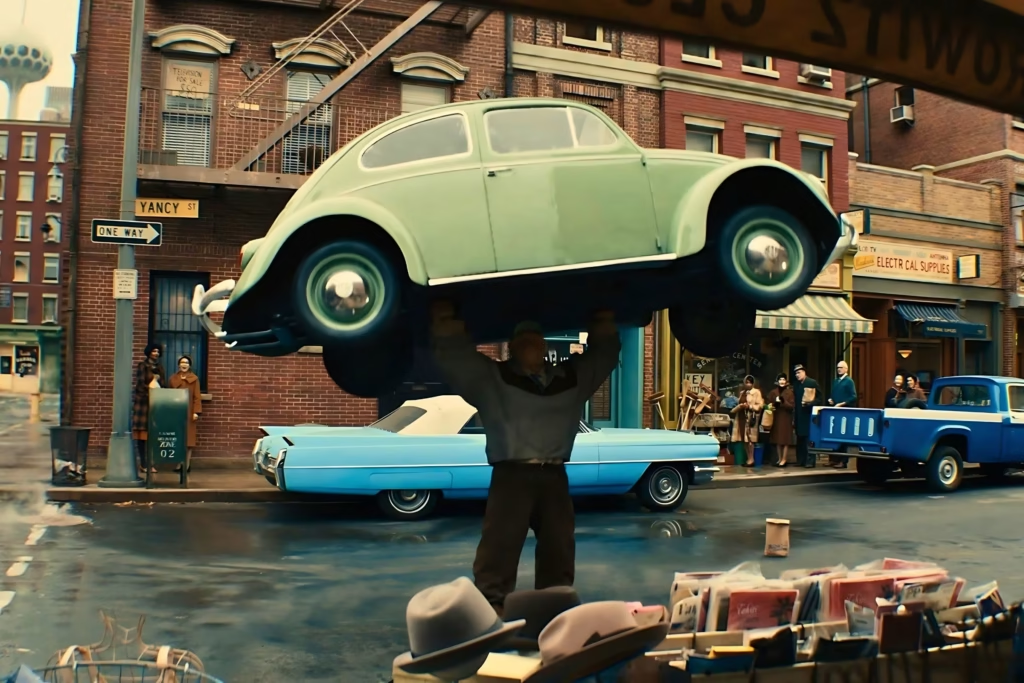
By the mid-1980s, through a combination of intense training on Reed Richards’ specialized equipment and a second exposure to cosmic rays that triggered further mutation, the Thing had climbed to a Class 85 rating. His current classification is Class 100 — the threshold Marvel uses for characters whose strength is measured in hundreds of tons rather than tens.
Here’s where it gets interesting: Class 100 in Marvel’s system doesn’t mean “can lift exactly 100 tons.” It means the character has passed into a tier where strength becomes difficult to quantify with precision. Ben’s demonstrated feats put his actual ceiling well above the official figure — he’s held together main cables of suspension bridges, which bear loads of approximately 10,000 tons, and has overpowered a Skrull hydraulic press described as capable of pushing through a planet. The 100-ton figure is what Marvel officially states. What he’s actually done in the comics suggests the real number is significantly higher when he stops holding back.
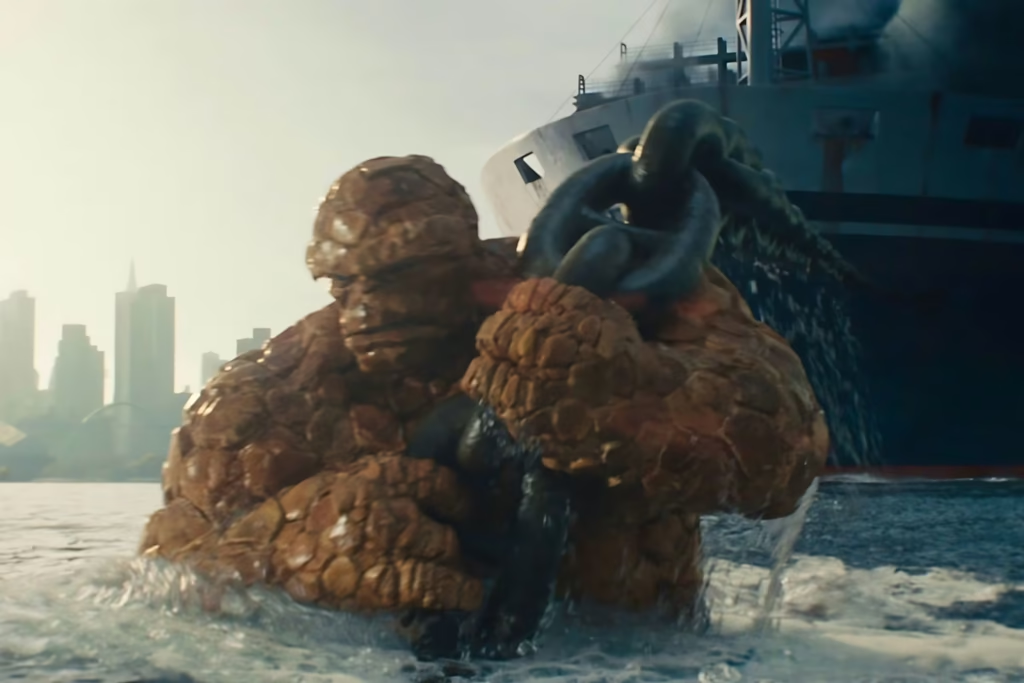
Physically, the Thing stands at an officially listed 6 feet tall and 500 pounds — though artists have rarely agreed on this. He’s consistently drawn taller than the 6’1″ Mister Fantastic, and a 2021 solo series by Walter Mosley updated his measurements to 6’6″ and 432 pounds. The discrepancy matters less than the principle: he’s dense, heavy, and built in a way that conventional measurement struggles to capture.
One detail that rarely gets discussed: Ben Grimm consistently underperforms his theoretical maximum. Stan Lee said it directly — the Thing’s deepest fear is losing control, really hitting someone with everything he has. That psychological restraint has functioned as a literal power limiter throughout his history. Reed Richards identified this early, noting that Ben’s subconscious blocks prevent him from accessing his full strength in most situations. The Class 100 rating, in other words, may itself be a conservative estimate.
The Thing’s Most Impressive Strength Feats
Talking about the Thing’s official stat is one thing. Watching what he actually does in the comics is another conversation entirely.
The Champion of the Universe (Marvel Two-In-One Annual #7, 1982)
This is the definitive Thing strength benchmark, and it’s the one most casual fans have never read.
The Champion of the Universe — Tryco Slatterus — is an Elder of the Universe who has spent millions of years mastering physical combat. He arrives on Earth carrying the Power Gem, seeking worthy opponents for a formal boxing match. He works through Marvel’s heavy hitters methodically: Thor, Colossus, Wonder Man, Sasquatch, Namor, Doc Samson. One by one, he disqualifies or defeats them all. Most aren’t worthy of finishing the fight.
The Thing is the last one standing.
Writer Tom DeFalco and artist Ron Wilson gave Ben Grimm one of his finest hours in this issue. The Champion is stronger. Objectively, measurably, undeniably stronger — and the Thing knows it from the opening bell. He gets knocked down repeatedly. He gets hurt in ways that would end most heroes. Every round, he gets back up.
The Champion doesn’t win by knockout. He wins by disqualification — stopping the fight himself because Ben Grimm refuses to stay down, and continuing would mean killing him. The Elder of the Universe, a being of near-cosmic power, ends the fight out of respect. He’s traveled the galaxy looking for a worthy opponent, and the Thing — outmatched on pure strength — is the only one who gives him one.
That fight established something no feat of raw power could: Ben Grimm’s ceiling isn’t just physical. His endurance under sustained punishment from a Power Gem-wielding cosmic entity tells you more about his true power level than any tonnage figure.
Knocking Out Galactus (Fantastic Four #243, 1982)
The Galactus incident from John Byrne’s run remains one of the most visually audacious Thing moments in comics history, and it holds up precisely because it’s honest about how it happened.
Galactus has come to devour New York. Several of Earth’s heroes converge — Thor, Spider-Man, Captain America, the Fantastic Four — but the scale of the problem is immediately obvious. Nobody is touching Galactus in a straight fight.
Doctor Strange provides the opening. Using the Images of Ikonn spell, Strange reaches into the darkest corners of Galactus’s mind and confronts him with the collective weight of every world he’s consumed — every life, every civilization, every ghost. The psychological assault leaves the Devourer of Worlds momentarily disoriented, his guard dropped.
Reed Richards transforms himself into a slingshot. The projectile is Ben Grimm.
The impact knocks Galactus — a being measured in hundreds of feet — unconscious. He crashes to the ground.
Two things make this feat legitimately impressive rather than just a fun story moment. First, Strange’s spell affected Galactus psychologically, not physically — the physical force required to actually topple a being of that mass still had to come from somewhere. Second, Ben absorbed the impact of hitting Galactus without losing consciousness himself. Whatever force is required to knock out a cosmic entity translates back onto the object doing the hitting. His durability in that moment is arguably more remarkable than his strength.
Punching Terrax Through Skyscrapers (Fantastic Four #242, 1982)
The Galactus issue gets the attention, but the issue immediately preceding it contains a feat that’s arguably more impressive for what it implies about Ben’s casual power output.
Terrax the Tamer is one of Galactus’s heralds. He wields a portion of the Power Cosmic and a cosmically-enhanced axe, and he’s one of the genuinely dangerous beings in the galaxy. He’s not a street-level threat. He’s not even a typical superhero-level threat.
Ben Grimm walks up behind him, taps him on the shoulder, and delivers a single punch.
Terrax goes through multiple New York skyscrapers. Reinforced concrete. Steel frames. Multiple buildings, two panels. The casualness of it — the shoulder tap before the punch — is the point. John Byrne wasn’t just drawing a powerful moment; he was making a statement about where the Thing operates on the power scale. A being carrying the Power Cosmic, sent flying through architecture like it isn’t there, from one punch delivered without apparent effort.
That’s how strong Ben Grimm is when he’s not holding back.
Is the Thing Stronger Than the Hulk?
No. And also: that’s the wrong question.
Ben Grimm said it himself — people always ask who’s stronger between him and the Hulk, and the answer is clearly the Hulk. The better question is who would win in a fight. That distinction matters because it’s the difference between a stat comparison and a combat record, and the Thing’s combat record against multiple Hulk incarnations is considerably more complicated than the simple power ranking suggests.
The Hulk’s strength scales with rage — theoretically without limit. The Thing’s strength is consistent. In a prolonged battle where Banner loses control completely, the gap eventually becomes insurmountable. But “eventually” is doing a lot of work in that sentence, and the Thing has spent 64 years finding ways to win before “eventually” arrives.
The Immortal Hulk (Fantastic Four #13, 2018)
The Thing’s most significant Hulk victory, and the one that best captures what makes Ben Grimm genuinely dangerous, came in Dan Slott and Sean Izaakse’s Fantastic Four #13.
The setup is almost cruelly ironic. Ben has just proposed to Alicia Masters. They’re on their honeymoon. Then the Puppet Master — Alicia’s own stepfather — mind-controls the Hulk and sends him directly at Ben with no warning and no restraint. This version of Banner is the Immortal Hulk, one of the most powerful and psychologically volatile incarnations in the character’s history. He doesn’t just hit hard. He’s driven by something deeper and darker than rage.
Ben tries diplomacy first. He openly acknowledges that the Hulk is the strongest one there is, tells him there’s nothing to prove here, tries to de-escalate. It doesn’t work. When it becomes clear the fight is unavoidable, he commits to it completely — with less than 90 minutes left before his transformation timer runs out and he reverts to human form.
What follows is one of the more honest Hulk fights in recent comics history. Ben doesn’t win through superior strength. He doesn’t find a clever exploit. Alicia, blind but somehow the clearest-eyed person in the fight, tells him through the chaos that this isn’t about brains or brawn. It’s about heart. And Ben Grimm has more heart than anyone.
In the final seconds, with his transformation countdown nearly expired, Ben throws everything he has into one punch. The impact is so violent that the rocky plating along his entire arm shatters on contact. But it connects. The Immortal Hulk goes down — and the feedback from the punch destroys the Puppet Master’s control doll simultaneously, severing Banner’s mental domination through sheer force.
One punch. Shattered his own arm doing it. Still won.
That’s the Thing.
Joe Fixit (Fantastic Four #320, 1988)
The Gray Hulk fight doesn’t carry the same dramatic weight as the Immortal Hulk battle, but it’s important for a different reason: it shows what the Thing looks like when he’s genuinely operating above his opponent rather than punching up.
At this point in continuity, Ben had just undergone his second cosmic ray exposure, mutating into the spikier, more physically imposing form that would define his look through the late 1980s. The Gray Hulk — Joe Fixit — was running Las Vegas as an enforcer. More cunning than his green counterpart. Significantly less powerful.
The Thing never looked like he was in real danger. The fight moved from rooftops to sewers to streets, with Ben maintaining the upper hand throughout. Joe Fixit, who was intelligent enough to recognize when a situation had turned against him, quietly acknowledged defeat before Doctor Doom’s intervention with a robotic Hulk prevented the finishing blow.
The match matters for power-scaling purposes because it demonstrates that the Thing’s strength can exceed certain Hulk incarnations without a dramatic circumstantial advantage. He didn’t need Alicia’s encouragement here, didn’t need a countdown, didn’t need to sacrifice anything. He was simply stronger than this version of Banner, and the fight reflected it.
Where the Hulk Actually Wins
The classic Savage Hulk fights tell the other half of the story, and they’re worth being honest about.
In their early encounters, Ben consistently outmaneuvered Banner — more agile, more tactical, landing the first strikes, using the environment cleverly. He’d wrap the Hulk in suspension cables, use terrain, create angles. The strategy was sound. For a while, it worked.
It stopped working once Banner got angry enough.
The Hulk’s rage-fueled strength increase is the variable that eventually overwhelms the Thing’s tactical advantages. Ben’s ceiling is high and consistent. The Hulk’s ceiling, when he’s truly enraged, is somewhere above that. Their prolonged battle on the George Washington Bridge is the clearest illustration: the Thing fought intelligently for as long as anyone could, and the Hulk still found his way through.
World War Hulk settled the question for anyone still debating it. The version of Banner who came back from Sakaar — enhanced by a breached warp core, carrying grief like a weapon, the most physically formidable Hulk the comics had ever produced — didn’t fight the Thing. He walked through him. Three members of the Fantastic Four went down in the same engagement. There’s no tactical adjustment for that. There’s no heart-over-strength moment waiting at the end of that fight. Sometimes the gap is just the gap.
The honest summary: the Thing can defeat several Hulk incarnations and has done so in the comics. Against a fully enraged, peak-power Savage or World War Hulk, he loses — not for lack of trying, but because the math eventually stops working in his favor. The psychological restraint cuts both ways here: Ben pulls his punches even against the Hulk. Banner, fully gone, does not.
How the Thing’s Strength Has Grown Over 64 Years
Marvel has tracked the Thing’s strength growth more consistently than almost any powerhouse character in their roster — and the gap between where Ben Grimm started and where he is now is wider than most fans realize. He debuted lifting five tons. He now has a documented feat record that implies capacity in the thousands. That progression didn’t happen by accident, and it didn’t happen overnight.

Class 5 (1961): Reed Richards’ first tests after the cosmic ray exposure put Ben’s strength at roughly five tons. Superhuman by any standard, but modest compared to what was coming. The early Hulk fights from this era reflect the gap accurately — Ben holds his own through tactics more than power, because the power wasn’t there yet.
Class 85 (mid-1980s): The combination of sustained training on Reed’s specialized equipment and a second exposure to cosmic rays pushed Ben into genuinely elite territory. This is the spiky-form era — the mutation that produced the more jagged, visually distinct Thing of the late 1980s. It’s also the era of the Champion of the Universe fight, which serves as the clearest real-world benchmark for where his strength had arrived. The fact that he could sustain that fight against a Power Gem-wielding Elder of the Universe — even losing — tells you more about his Class 85 ceiling than any tonnage figure.
Class 100 (current): Through continued training, further psychological breakthroughs, and the accumulated effect of decades of pushing his limits, Ben has reached the threshold Marvel reserves for its most physically powerful characters. Class 100 doesn’t mean exactly 100 tons — it means the character has entered a tier where strength becomes difficult to quantify precisely. His bridge cable feat implies capacity in the thousands of tons. His planetary press feat implies something higher still.
The psychological element is worth returning to here, because it’s genuinely unusual in Marvel power discussions. Most strength-based characters either have a fixed ceiling or one that scales with emotion. The Thing has something stranger: a ceiling that’s probably higher than anyone has measured, artificially suppressed by his own subconscious fear of what he might do if he stopped restraining himself. Stan Lee identified this as far back as the character’s early years. Reed Richards knew it. The Champion of the Universe effectively proved it by pushing Ben past what he thought his limits were and watching him keep going anyway.
The real number, for a Ben Grimm who has genuinely stopped holding back, remains untested. What makes that ceiling credible isn’t just the strength — it’s everything else underneath it. Because power at Ben’s level only stays standing when the rest of the system can support it.
The Thing’s Powers and Abilities Beyond Strength
Strength gets all the attention. What it sometimes obscures is that Ben Grimm is harder to stop than his power level alone explains — because the Thing’s full capability is a system, not a single stat. Durability, stamina, a healing factor that’s more significant than it’s usually credited, and an ability set that compounds his physical advantages in ways that only become visible when you look at the complete picture.
Durability
The Thing’s rock-like skin isn’t decorative. It’s a genuinely formidable defensive system that has withstood Hulk-level punishment, point-blank bazooka fire, extreme temperatures ranging from -75°F to 800°F, and the physical feedback of hitting Galactus. He can also generate a Thunderclap — clapping both hands together hard enough to produce a shockwave capable of stunning opponents at the level of Magneto, a tactical capability that rarely gets credit in power discussions. Marvel officially describes his hide as penetrable only by extraterrestrial weaponry or sorcery in most circumstances.

The notable exception is adamantium. Wolverine’s claws have breached the Thing’s skin and drawn blood — one of the few documented cases of conventional physical attack getting through. His defense isn’t absolute, but the list of things that can reliably damage him is genuinely short. Is the Thing bulletproof? Effectively yes against conventional firearms — bazooka shells fired point-blank don’t breach his hide. High-caliber rounds from standard weapons aren’t a concern. The edge cases are extraterrestrial tech, sorcerous attacks, and adamantium. Everything else either bounces off or fails to penetrate deep enough to matter.
Stamina
Ben can sustain maximum physical effort for approximately an hour before fatigue becomes a factor. That’s not unlimited, but in the context of superhero combat — where most fights are decided in minutes — it’s functionally irrelevant as a limitation. Against the Champion of the Universe, he fought through rounds of punishment from a cosmic-level opponent, got knocked down repeatedly, and kept going. The stamina underlies the heart.
Regeneration and Aging
The Thing ages — just not on anyone else’s schedule. He ages only once per year, specifically during the brief periods when he reverts to human form. Since that reversion happens rarely, Ben Grimm ages at a dramatically reduced rate compared to baseline humans. It doesn’t make him immortal in the traditional sense, but practically speaking, he’s going to outlive most of the people around him.
His healing factor is less dramatic than Wolverine’s but more significant than often credited. His rock-like composition means conventional wounds that would incapacitate a human often don’t register at all. More serious damage — like the shattered arm plating from the Immortal Hulk punch — does occur and does require recovery time. He regenerates, but he’s not indestructible.
The Fantastic Four Power Synergism
One underappreciated aspect of the Thing’s power set: it’s partially tethered to his teammates. The original Fantastic Four members share a cosmic connection — a power synergism tied to their shared origin. When they’re separated across universes for extended periods, their powers gradually weaken. Ben and Johnny Storm experienced this directly after the events of Secret Wars, when Reed and Sue departed to rebuild the multiverse. Ben noticed his strength declining before anyone understood why.
It’s not a limitation that comes up often in normal operations. But it’s worth knowing: the Thing at full power is, in part, a function of the Fantastic Four remaining the Fantastic Four.
Where the Thing Ranks Among Marvel’s Strongest Characters
Marvel’s own framing is the clearest place to start: “perhaps second only to the Hulk.” That’s not hyperbole from a fan site. That’s the publisher’s official positioning of Ben Grimm within their own universe’s power hierarchy.
What that means in practice is that the Thing occupies a specific and well-defined tier — one that separates him from virtually every other physically strong hero while acknowledging that one character exists above him.
At the top sits a small group of characters whose strength is effectively without ceiling: the Hulk, the Sentry, Galactus, the Celestials. These are beings whose power scales with external variables — rage, cosmic energy, sheer cosmic scale — in ways that place them outside normal measurement. They’re not a fixed point on the scale. They’re the point where the scale stops being useful.
Below that tier, the Thing is the first among equals. His demonstrated feats — the bridge cables, the planetary press, the Galactus incident, surviving sustained punishment from the Champion of the Universe — place him ahead of every other physically strong character in this category. Colossus, despite his steel form, operates well below the Thing’s ceiling. Namor is formidable and competitive, particularly in water, but Ben has held his own against the Sub-Mariner repeatedly without it being a genuine crisis. Wonder Man and Hercules operate at comparable levels in certain eras, but neither has the sustained feat record Ben has accumulated over six decades. Juggernaut is the most interesting comparison — momentum-based strength that scales differently than raw power — but even there, the Thing’s durability gives him an edge that pure strength comparisons miss.
Lay it out plainly and the hierarchy becomes clear:
Uncapped tier: Savage/World War Hulk, Sentry, cosmic entities — strength without a fixed ceiling
Thing’s tier: Ben Grimm — the strongest consistent, physically-based hero in Marvel
Comparable tier: Hercules (mythological strength, similar ceiling), Wonder Man (ionic energy-based, era-dependent), Namor (water-enhanced, genuinely competitive), Juggernaut (momentum-based, scales differently)
Below: Colossus, Luke Cage, She-Hulk (depending on era)
Thor is worth addressing specifically because the comparison comes up constantly. The Thunder God’s strength varies considerably depending on Odinforce access, worthiness, and creative era — but at comparable power levels, it’s genuinely close. What separates the Thing in most analyses is durability and consistency. Thor’s power can fluctuate. Ben’s doesn’t.
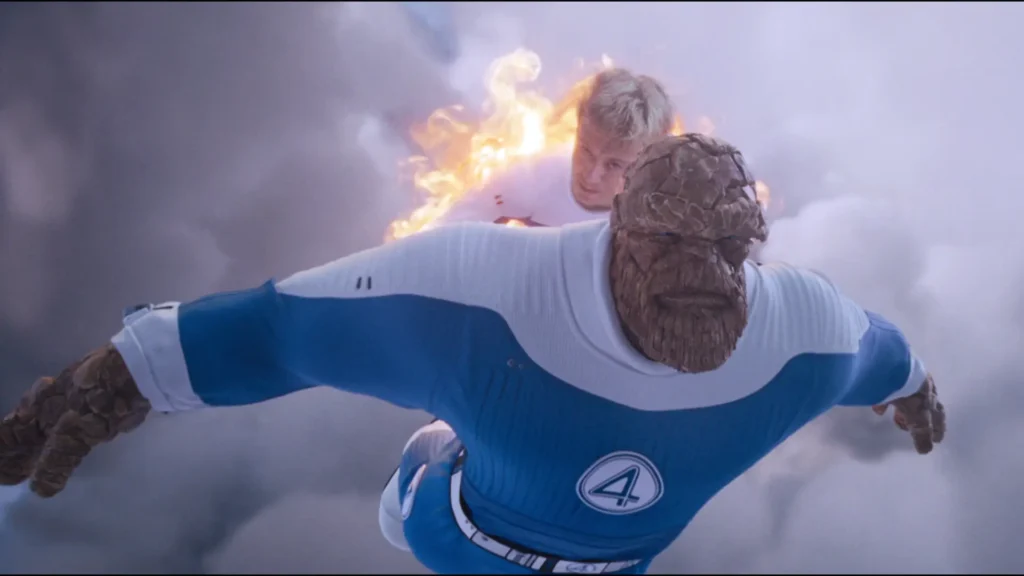
With The Fantastic Four: First Steps now in the MCU canon and Ebon Moss-Bachrach confirmed to reprise the role in Avengers: Doomsday (2026), the question isn’t whether the MCU will use the Thing — it’s whether they’ll have the courage to show what Ben Grimm can actually do when he stops holding back. Based on 64 years of source material, the answer to that question is going to be impressive.
The Bottom Line on How Strong the Thing Really Is
The number Marvel gives — nearly 100 tons — is accurate as a starting point and misleading as a conclusion.
It’s accurate because that’s the officially documented minimum: what Reed Richards’ tests confirm, what the handbooks record, what the power grid reflects. It’s misleading because Ben Grimm has spent six decades quietly demonstrating that the real ceiling is somewhere above whatever number gets written down. Bridge cables bearing 10,000 tons. A planetary hydraulic press. The Galactus incident. Rounds against the Champion of the Universe that should have ended him and didn’t.
The psychological restraint is real, and it matters. Ben Grimm is afraid of what he might do if he completely let go — and that fear has functioned as a governor on his power for his entire career. What he’s accomplished while holding back is extraordinary. What the fully unrestrained version would look like remains, after 64 years, genuinely unknown.
What is known: he’s knocked out the Immortal Hulk. He’s sent a Power Cosmic-wielding herald through multiple skyscrapers with a single punch. He’s absorbed the impact of hitting Galactus and stayed conscious. He’s lasted rounds against a cosmic entity carrying the Power Gem while being, by his own admission, clearly outmatched — and he made the Elder of the Universe respect him for it.
Ben Grimm isn’t the strongest Marvel character. He’ll tell you that himself. But he fights like he is, he lasts like he is, and when the situation genuinely demands everything he has, he finds more than anyone — including him — thought was there.
That’s how strong the Thing is. And it’s about time the rest of the Marvel Universe caught up to what comics fans have known since 1961.
Frequently Asked Questions About the Thing’s Strength and Powers
How much can the Thing lift?
Marvel officially states the Thing can lift nearly 100 tons, placing him in the Class 100 tier alongside the Hulk and Thor. His demonstrated feats suggest the real number is considerably higher — he’s held suspension bridge cables bearing approximately 10,000 tons and overpowered a hydraulic press described as capable of pushing through a planet. The 100-ton figure is the documented floor, not the confirmed ceiling.
Is the Thing stronger than the Hulk?
No — and the Thing himself acknowledges it. Bruce Banner’s strength scales with rage, theoretically without limit, which gives the Hulk a ceiling Ben Grimm can’t match in a prolonged fight. That said, the Thing has defeated multiple Hulk incarnations in the comics, including the Immortal Hulk in Fantastic Four #13 (2018) and Joe Fixit in Fantastic Four #320 (1988). Raw strength comparison favors the Hulk; combat record is more complicated.
Can the Thing regenerate?
Yes, though his healing factor is less dramatic than characters like Wolverine. The Thing’s rock-like hide means most conventional damage doesn’t penetrate deeply enough to require healing. More serious injury — like the shattered arm plating from his Immortal Hulk fight — does require recovery time. He also ages at a dramatically reduced rate, aging only once per year during brief periods of human reversion, making him effectively long-lived without being traditionally immortal.
Is the Thing bulletproof?
Effectively yes against conventional weaponry. Point-blank bazooka fire and high-caliber firearms don’t breach his rock-like hide under normal circumstances. The documented exceptions are Wolverine’s adamantium claws, extraterrestrial weaponry, and sorcerous attacks — all of which have drawn blood. Standard ballistic weapons, explosives, and extreme temperatures within the -75°F to 800°F range don’t constitute a meaningful threat.
What is the Thing’s weakness?
The Thing’s primary physical vulnerabilities are adamantium, extraterrestrial weapons technology, and magic-based attacks. Beyond physical limits, his most significant weakness is psychological — a deep-seated fear of losing control that functions as a subconscious power limiter, preventing him from accessing his full strength in most situations. The Fantastic Four power synergism also means extended separation from his teammates across dimensional barriers gradually reduces his power level.