

There’s a moment in Daredevil comics lore that tells you everything about Bullseye. He’s pitching a no-hitter in a sold-out Major League game — perfect control, perfect aim, the crowd watching every throw. He gets bored. He asks his coach to pull him. The coach refuses. And so, with complete calm, Bullseye throws the ball directly at the batter’s head, kills him instantly, and says one word as the ball connects: “Bullseye.” The crowd screams. He smiles. That’s not a superpower. That’s a personality.
Frank Miller — the writer who transformed Bullseye from a campy gimmick villain into one of the most psychologically complex figures in Marvel’s history — said something in a CBR interview that nobody seems to quote anymore. He called Bullseye “a doppelgänger — the identical opposite of Daredevil in that Daredevil is responsibility, law and order, and Bullseye is complete wild malice.” Not a hired killer. Not a hired gun with great aim. The precise, deliberate, mirror-image inversion of the man he obsesses over.
That framing changes everything. Because once you see it, you realise the paperclip and the toothpick are almost beside the point. The real target was never the body. It was always the person standing next to the hero — and Bullseye has been proving that for fifty years.
He’s back now. Daredevil: Born Again Season 2 is streaming on Disney+, and what Bullseye does in the season premiere is the most psychologically interesting move this character has ever made on screen. But it only makes sense if you understand everything that came before it.
Quick Answer
Bullseye is a Marvel supervillain and master assassin who first appeared in Daredevil #131 in 1976, created by Marv Wolfman and John Romita Sr. Capable of turning any object into a lethal projectile with perfect accuracy, he is Daredevil’s most personal enemy — responsible for the deaths of Elektra and Karen Page. In the MCU, Wilson Bethel plays Benjamin Poindexter across Netflix’s Daredevil Season 3 and Daredevil: Born Again, now streaming on Disney+.
The Villain Nobody Can Quite Place
Bullseye first appeared in Daredevil #131 in 1976, created by writer Marv Wolfman and artist John Romita Sr. — and Wolfman himself, years later, admitted he never quite cracked the character. “I never found the thing that made him mine,” he said in an interview with fan site ManWithoutFear.com, “the way Frank Miller did a year or two later.” That’s a remarkable thing for a creator to say about his own invention. And it tells you something important: Bullseye, as we understand him today, is less a singular creation than a character who had to be discovered.
What Wolfman did establish is the core concept that’s defined every version since. Bullseye is designed as a counter to Daredevil’s radar sense — where Daredevil excels at reading close-quarters combat, a villain who can kill from any distance with any object poses a categorically different threat. The concept is elegant. What Wolfman couldn’t fully deliver was the psychology behind it.
Then there’s the origin problem — and it’s a feature, not a bug.
Bullseye has told several versions of his own backstory, and in at least one instance, he’s mocked his interrogators for believing him. In one account, his brother set fire to their family home to kill their abusive father. In another account, it was Bullseye himself. In one version of his childhood, he painted a bullseye on his drunk father’s forehead and shot him. These stories don’t reconcile. They contradict each other on purpose. Bullseye’s origin is as much a weapon as his aim — he offers versions of himself that let people think they understand him, and then takes that comfort away.
The only things we know for certain: he can do things with a thrown object that most humans cannot do with a firearm, and he enjoys it.
The Abusive House, the Baseball Diamond, and the Moment He Named Himself
The most widely accepted version of Bullseye’s early life goes like this.
He grew up in a house with an abusive, alcoholic father and a brother named Nate who coped by obsessively shooting at things from the roof. Nate could never quite hit the targets. Bullseye never missed. The bad days, when the beatings got particularly brutal, drove them both toward a decision that had to be made: their father had to die. And then one afternoon, Lester — the name he’s given in exactly one issue before it might also be a lie — came home from school to find the house on fire. His brother screaming from above. His mother dead inside. His father pulling Nate back into the flames.
Whether that’s what actually happened is genuinely unclear. What followed is less disputed.
Foster family to foster family, until he ended up with the Wilkersons — people who gave him stability and a path he’d never had. He played baseball. He was extraordinary at it. His pitching was described by those around him as something approaching impossible: the control, the accuracy, the velocity. Three games into his professional career, he was called up to a sold-out Major League game. He pitched a no-hitter. And as the ninth inning wore on and nobody could touch him, he got bored.
He asked his coach to pull him. The coach refused. The opposing batter mocked him. So Bullseye threw the ball at the batter’s head, killed him instantly, and said one word as it connected: “Bullseye.” He was smiling. That’s the moment he named himself — not in a back alley, not on a battlefield, but in a stadium full of witnesses, doing something so brutal and so unnecessary that it could only have one explanation: he wanted to see if he could.
The National Security Agency apparently found that impressive. He was recruited, trained, deployed to Nicaragua to work with Contra rebels, decided almost immediately he’d rather be running his own criminal operation, carved out a drug trafficking hub from a Colombian airstrip — and ran directly into the Punisher, who he fought to a brutal standstill before the DEA intervened. Then New York. Then a new identity. Then a very specific business model: extortion letters sent to wealthy targets, “Pay me $100,000 or I will kill you. Signed, Bullseye,” with bodies delivered as proof of concept when payments didn’t arrive.
He was having the time of his life. Nobody in New York could stop him. Nobody, that is, until Daredevil.
He still resents that.
Frank Miller Made Him Terrifying — Here’s How
By the late 1970s, Bullseye had appeared enough times to have a reputation as a recurring threat — dangerous, memorable, reliably capable of putting Daredevil through a fight. What he didn’t have was depth. Different writers used him as a high-calibre hired gun, a gimmick with a target painted on his forehead, someone who showed up, created problems, got defeated, and left. The character worked. He just didn’t mean anything.
That changed when editor Denny O’Neil handed Frank Miller full writing control of Daredevil beginning with issue #168 (January 1981). Miller had already been drawing the book, already been developing his film noir sensibility on the title — the rain-slicked streets, the shadows, the moral ambiguity that felt nothing like the rest of Marvel’s output at the time. When he started writing, one of his first decisions was to figure out what Bullseye was actually for.
His answer was the doppelgänger.
“Bullseye is what we call a doppelgänger — the identical opposite of Daredevil in that Daredevil is responsibility, law and order, and Bullseye is complete wild malice.”
— Frank Miller
That’s not a writing note. That’s a complete theory of the character. Daredevil without conscience is Bullseye. Bullseye without psychosis is Daredevil. They are the same set of capabilities pointed in opposite directions — and once you see the frame, the entire history of their rivalry snaps into focus.
Miller tested the theory immediately with Daredevil #169: Bullseye, suffering from a malignant brain tumour, begins hallucinating everyone around him as Daredevil. He moves through New York killing anyone who crosses his path — the death toll reaches approximately a hundred people on Christmas Eve before Daredevil stops him in a subway tunnel. And here’s the critical moment: Matt Murdock nearly lets the train do it. He stands there and considers letting Bullseye die, the way any person — any human person — might consider it after a hundred murders and years of torment. He shows mercy instead. He saves the man who’ll make him regret it for decades.
The authorities tell him plainly: the next time Bullseye kills someone, the blood is on Daredevil’s hands. Matt accepts that. Files it away. Tries to believe it was the right thing.
It was. But it cost him everything that came next.
The Kills That Changed Everything
Every rivalry in comics has its defining moment. Spider-Man and the Green Goblin have Gwen Stacy falling from the bridge. Batman and the Joker have Barbara Gordon in a wheelchair. Daredevil and Bullseye have Daredevil #181 — and the reason it still lands fifty years later has nothing to do with the violence. It has everything to do with what Frank Miller understood about what Bullseye was actually doing.
When Bullseye breaks out of prison in DD #181 (April 1982), he isn’t going after Matt Murdock. He’s going after Elektra Natchios — Daredevil’s former lover, and the woman who had taken his place as Kingpin’s primary assassin. The professional grievance is real: Bullseye’s reputation had been built on being the best, and Kingpin’s preference for Elektra was a humiliation he couldn’t absorb. But read it again and the logic underneath the logic becomes clear. He doesn’t go after Kingpin. He doesn’t go after Daredevil directly. He goes after the thing Daredevil loves.
He kills Elektra with her own sai. Then he waits.
Daredevil finds him. What follows is a rooftop chase that ends with Matt Murdock making a decision he’ll spend years rationalising: he lets Bullseye fall. Three stories. Spine shattered. Paralysed. Matt watches him hit the ground and doesn’t reach for him the way he reached for everyone else. The police tell him afterward that if Bullseye ever escapes and kills again, the blood is on Daredevil’s hands. Matt knows they’re right. He carries that.
On the death of Elektra
“When he killed Elektra in the comics, you realised — ‘Oh, this is a hero-killer.’ That’s a very rare commodity.”
— Jeph Loeb, former Marvel Television head
He wasn’t wrong. The death of Elektra wasn’t just shocking because she was important. It was shocking because Bullseye did it to prove something — to Kingpin, to Daredevil, to anyone paying attention. I can reach what you love. Any time I want.
What followed — after Bullseye’s spine was surgically reinforced with adamantium by a Japanese crime lord named Lord Dark Wind, restoring his mobility and making him functionally impossible to break — is Frank Miller’s most underrated issue. Daredevil #191. The Russian Roulette issue. Matt breaks into Bullseye’s hospital room and plays a two-man variation with a secretly unloaded gun — pulling the trigger against Bullseye’s head again and again until the message lands: I could. I choose not to. Don’t make me reconsider.
But the issue isn’t really about the gun. It’s about Chucky. A boy who worshipped Daredevil, who replayed the “Circus of Death” tapes over and over to watch his hero beat impossible odds. Whose father turned out to be a criminal. Who saw Daredevil defeat his father and couldn’t reconcile it. Who concluded, with a child’s devastating logic, that if he wasn’t like Daredevil then he must be like Bullseye — and shot a classmate to prove it.
Miller is asking the only question that matters in a story about a man who inspires people by fighting crime: what happens when the shadow you cast is the same shape as the villain? Daredevil and Bullseye are two sides of the same coin. The mercy Matt shows is real. The damage Bullseye causes is real. And neither man can exist without the other as a reference point.
Karen Page comes seventeen years later. Kevin Smith writes Daredevil vol. 2 #5 (1999) — Karen, Matt’s great love, killed in front of him by Bullseye. Not because she’s a target. Because she matters to Matt. The same logic. The same message. Always the same message.
By that point, it didn’t need to be said out loud.
Beyond Daredevil — The Full Curriculum of a Career Sadist
After his adamantium skeleton restored his mobility, Bullseye resumed his career with the Kingpin and spent years alternating between imprisonment and employment — defeated by Daredevil regularly enough that his reputation in New York’s criminal underworld started taking serious damage. People were calling him a has-been. That apparently bothered him more than the broken spine had.
The Dark Reign era (2008–2009) gave him the most disturbing sandbox he’d ever had. Norman Osborn, freshly appointed as the head of SHIELD after the Skrull invasion, assembled a team of villains dressed as heroes — his Dark Avengers. Bullseye was handed Hawkeye’s identity. Clint Barton’s costume, Clint Barton’s name, Clint Barton’s public-facing heroism. He wore it the way he wore everything: as a tool for killing people with plausible deniability. Under Osborn’s orders he bombed a building and killed 107 people inside. On his own initiative he murdered the Sentry’s wife — a moment that remains one of the most deliberately horrifying in the Dark Reign storyline, built around the terrible gap between when you realise what’s about to happen and when you can do anything to stop it.
When the Dark Avengers collapsed and Osborn’s empire unravelled, Bullseye went to Shadowland — the fortress Daredevil had built over Hell’s Kitchen after taking control of the Hand. He arrived with one intention: kill the man who’d made his career hell for thirty years. He got close. Closer than anyone expected. And then, in Shadowland #1, a demonically possessed Daredevil killed him.
Briefly.
This is comics. Nothing stays dead, and Bullseye has too much unfinished business to stay in the ground. The Hand attempted a resurrection ritual. Heroes interrupted it before completion, leaving Bullseye technically alive but two-thirds dead — kept functioning in a high-tech life-sustaining sarcophagus, running schemes through proxies, still orchestrating misery from inside a machine. Even immobile, he managed to make Daredevil’s life measurably worse.
There’s a character who exists entirely because of what it means to witness Bullseye work. As a child, she was a victim of human trafficking, about to be sold, when the men holding her were killed by a hired assassin. She and Bullseye shared a single glance — he didn’t speak to her, didn’t acknowledge her beyond the fact of her existence — and then he was gone. She dedicated her life to becoming him. Lady Bullseye. Not a protégé, not a follower — someone so completely reshaped by one moment of proximity that she built an entire identity around it. It’s the most disturbing compliment the character has ever received, and it proves the argument better than any kill does: Bullseye doesn’t just destroy the people he targets. He leaves a mark on everyone in the room.
There’s one more story worth knowing. Jason Aaron’s Punisher MAX — a separate continuity, grounded and brutal in the way only MAX imprint stories can be — gives us the definitive Bullseye vs. Frank Castle. An aging Punisher, a New York crime landscape restructuring itself around the new Kingpin, and Bullseye hired to do what nobody else can: end Frank Castle. He studies Frank the way Frank studies targets. He eats what Castle eats. He sleeps where Castle slept. He kidnaps four families and subjects them to the same violence that was inflicted on Frank’s family on the day in Central Park that made him what he is — so he can understand, from the inside, what Frank actually felt. Then, when he finally faces him, he whispers into the Punisher’s ear the last words Frank ever said to his wife before they died: that he didn’t love them anymore. That he wanted a divorce. That he’d made his peace with leaving.
It destroys Frank completely. Not because Bullseye is stronger. Because Bullseye did the homework.
The closing line of a later Bullseye miniseries is the cleanest summary of everything he is: “I did it because I’m me and sometimes I like to see people suffer.” There’s no ideology underneath. No childhood wound being expressed symbolically. Just the purest possible statement of preference from a man who has never once confused what he wants to do with what he should do.
Wilson Bethel and the MCU Version — From FBI Agent to Full Villain
The Netflix adaptation of Bullseye made one significant creative decision that changed everything downstream: it gave him a name.
In the comics, Bullseye’s real name remains officially unknown — he’s given the first name Lester in one issue, Benjamin Poindexter as an alias in another, and the whole question is wrapped in deliberate uncertainty. The MCU version, introduced in Netflix’s Daredevil Season 3 (October 2018), committed. Benjamin “Dex” Poindexter. FBI agent. A man with a profound psychological need for a moral compass he simply doesn’t possess innately — someone who latches onto external structures (the law, a therapist, an obsession) to function, because left to his own devices, the things he’d do without a framework are the things he eventually does anyway.
Wilson Fisk understood that need immediately and exploited it with surgical precision. In Season 3, Kingpin doesn’t just hire Bullseye. He shapes him — feeds him a constructed identity as Daredevil’s replacement, gives his violence a cause and a costume, and then discards him the moment the usefulness expires. It’s the most interesting version of the Fisk/Bullseye dynamic the character has ever had on screen, because it makes the inevitable betrayal feel like tragedy rather than plot.
Wilson Bethel elevated the character from compelling concept to genuine fan favourite. He plays Dex as someone trying, visibly and desperately, to hold himself together — and failing in ways that are sometimes almost sympathetic before they become terrifying. Charlie Cox, speaking to MovieWeb about Bullseye’s Born Again Season 2 role, said he had to recalibrate his entire approach to the character mid-shoot. “It suddenly dawned on me,” Cox said, “I’m thinking of this person as a rational human being and he’s not. I have to talk to him like he’s a six-year-old, like he’s a delusional, crazy, tantruming child.” That recalibration shows in every scene they share. Matt Murdock handles Bullseye the way you handle something dangerous that you can’t quite predict — carefully, with a very specific kind of exhausted wariness that comes from having already paid the price of underestimating him.
The cogmium skeleton — the MCU’s version of the adamantium reinforcement from the comics — arrived after Daredevil threw Bullseye off a rooftop at the end of Born Again Season 1. Dr. Kenji Oyama performed the procedure, reinforcing his spine and making him structurally harder to damage. His vision was also enhanced as part of the procedure. In the Born Again Season 1 arc, Bullseye had been hired by Vanessa Fisk to kill Benny Cafaro and Foggy Nelson. He killed Foggy. He was arrested, convicted on eleven counts of first-degree murder, sentenced to life, moved by Mayor Fisk from protective custody into general population — a quiet death sentence — and escaped using a broken tooth. Then he went directly after Wilson and Vanessa Fisk. He nearly reached them. Matt Murdock stepped in front of the bullet.
He’s been off the grid since, with unfinished business in every direction.
“You’re Welcome” — What Bullseye Saving Daredevil Actually Means
Daredevil: Born Again Season 2 premiered on Disney+ on March 24, 2026, and its opening episode ends with a moment that reframes everything this character has done across fifty years of comics and multiple screen adaptations.
The Anti-Vigilante Task Force — Mayor Fisk’s enforcement arm, the machinery of a city that has officially made Daredevil illegal — corners Matt Murdock inside Cherry’s apartment. Unmasked. His identity exposed. Cherry suffers a heart attack mid-fight, splitting Matt’s attention at the worst possible moment, and the Task Force pins him. There is no obvious way out. Then the agents start dropping — taken out one by one by precise, lethal shots fired from outside the building, the trajectory and placement of each one suggesting a shooter with reflexes and accuracy that exist nowhere in the normal human range.
A knife ricochets into the room. It slides to a stop in front of Matt Murdock. Two words are engraved on the blade: You’re welcome. Alongside them, Bullseye’s crosshair symbol.
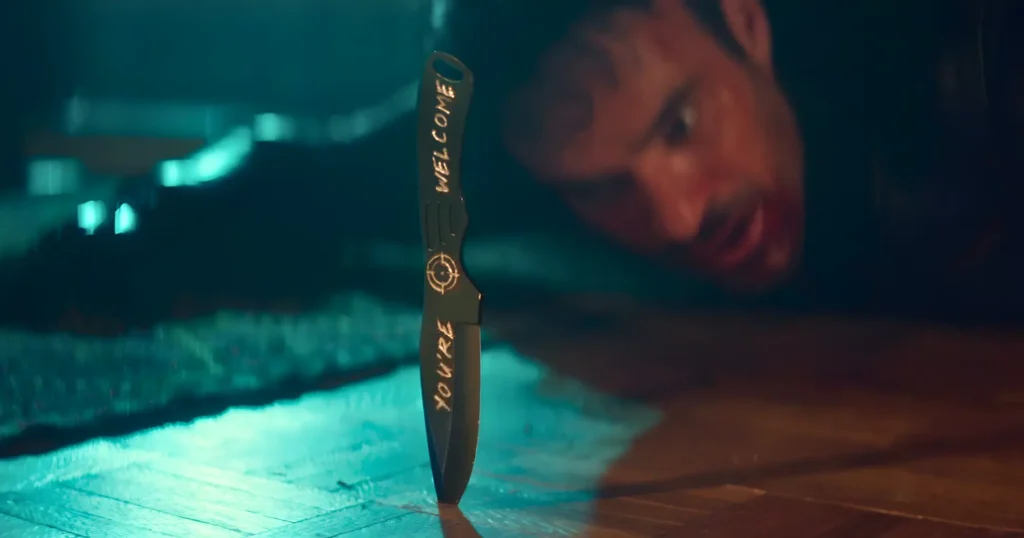
The man who killed Foggy Nelson just saved Daredevil’s life. The man Matt threw off a rooftop just pulled Matt’s people off a roof. And he announced it with the specific contempt of someone who doesn’t need gratitude — who did it not out of goodness but out of something far more interesting and far more dangerous: a private, operating logic that nobody else has access to.
Wilson Bethel addressed his character’s motivations in the official Season 2 press notes, describing Poindexter as entering this season with what he called “a renewed sense of purpose” — a personal idea of what redemption looks like, even if, Bethel acknowledged, he’s “a little misguided in his idea of what redemption looks like.” Showrunner Dario Scardapane framed it more broadly: every character in Season 2 reaches a point where they have to choose a side, and every choice comes with a price. For Bullseye, that choice is happening for the first time entirely on his own terms.
That’s what makes it so compelling. Every previous version of Bullseye’s MCU arc involved external shaping: Fisk recruited him, Vanessa hired him, the FBI trained him. He has never once operated without someone else’s architecture underneath him. And then Fisk moved him into general population in prison — a quiet attempt to get rid of him without getting his hands dirty — and something shifted. The man who cannot function without a moral compass had his compass taken away by the person who gave it to him. What’s left is purely Bullseye. Unmediated. Making choices that serve no one’s agenda but his own.
Set photos from the production — shot in New York between February and July 2025 — showed Bethel in upgraded combat armour standing alongside Cox’s Daredevil, neither fighting the other. The Season 2 teaser showed Daredevil reaching a hand down toward a bloodied Bullseye, apparently helping him up. These images are not from a standard villain storyline. They’re from something messier and more interesting than that.
Born Again Season 2
He didn’t save Daredevil.
He saved the rivalry.
Fisk’s AVTF killing Matt Murdock would hand Kingpin a victory, and that’s the one outcome Bullseye has never been able to tolerate. Daredevil is the only opponent who has ever taken him seriously. The only rivalry that has ever mattered. Letting Fisk take it would be the final discard — not just the manipulation in prison, but the erasure of the only meaningful context his violence has ever existed within.
“There are whole new avenues of Dex’s interesting, messed-up psyche that we get to explore,” Bethel said at New York Comic Con 2025, “and there’s some really, really fun stuff on the way.” Season 3 of Born Again is already in development. Whatever Bullseye’s arc across this season resolves to — alliance, betrayal, something genuinely new — the Born Again team has made it clear they’re not done with him yet.
They shouldn’t be. Neither should we. If you want to understand where this character goes from here, you have to understand what’s driving him. And what’s driving him, fifty years in, is the same thing that’s always driven him. Not money. Not ideology. Not even hate, exactly.
Just the purest possible need to be the most dangerous thing in any room he walks into. And right now, the most dangerous move available to him is the one nobody saw coming.
Frank Miller said it best, and he said it forty years ago: Bullseye is the doppelgänger. The identical opposite. Daredevil without the responsibility, without the law, without the faith that restraint means something.
What’s remarkable is how consistent that has remained across fifty years of comics, three screen adaptations, and more resurrections than any character probably deserves. Strip away the specific kills — Elektra, Karen, Foggy — and what you’re left with is the same shape every time: a man whose entire identity is constructed around the one opponent who takes him seriously. Without Daredevil as a reference point, Bullseye is just a very precise killer for hire. With Daredevil, he becomes something much harder to dismiss.
The “You’re welcome” knife in Born Again Season 2 is the purest expression of that dependency the character has ever had on screen. He didn’t save Matt Murdock. He protected the only relationship that gives his violence any meaning.
Whether Matt ever sees it that way is a different question entirely.
Essential Reading
Daredevil #131 (1976) — Wolfman & Brown. The first appearance. Campy but essential for context.
Daredevil #168–191 (1981–83) — Frank Miller’s defining run. Start here for the real character.
Daredevil vol. 2 #1–8 (1999) — Kevin Smith. Karen Page’s death. The emotional gut punch.
Punisher MAX (2010) — Jason Aaron — The definitive Bullseye vs. Frank Castle. One of Marvel’s best MAX stories.
Bullseye (2017) — Brisson & Siqueira — The “I did it because I’m me” miniseries. Five issues, pure character distillation.
Frequently Asked Questions
Who plays Bullseye in Daredevil: Born Again? +
Wilson Bethel plays Benjamin “Dex” Poindexter, also known as Bullseye, in the MCU. He debuted in Netflix’s Daredevil Season 3 in 2018 and reprises the role across both seasons of Daredevil: Born Again on Disney+. Bethel’s portrayal made Bullseye an instant fan favourite and remains one of the most praised performances in Marvel’s street-level corner.
Why did Bullseye save Daredevil in Born Again Season 2? +
Bullseye saved Daredevil in the Season 2 premiere not out of conscience, but out of calculated self-interest. Kingpin’s Anti-Vigilante Task Force killing Matt Murdock would hand Fisk a victory — and Fisk already manipulated and discarded Poindexter. Bullseye is operating on his own terms for the first time, and protecting the rivalry with Daredevil is more valuable to him than letting Fisk win it.
What are Bullseye’s powers and abilities? +
Bullseye can turn virtually any object into a lethal projectile with superhuman accuracy — playing cards, paperclips, toothpicks, and coins have all been used as weapons. He is also an elite hand-to-hand combatant. In the comics, his spine was reinforced with adamantium after being shattered. In the MCU, the equivalent procedure uses cogmium, performed by Dr. Kenji Oyama, which also enhanced his vision.
What did Bullseye do in Born Again Season 1? +
In Born Again Season 1, Bullseye was hired by Vanessa Fisk to assassinate Foggy Nelson, which he carried out. Daredevil threw him off a rooftop in response, and he was subsequently arrested and convicted on eleven counts of first-degree murder. Mayor Fisk later moved him to general population in prison — a quiet attempt to have him eliminated — but Bullseye escaped using a broken tooth and attempted to kill the Fisks before going into hiding.
Is Bullseye a villain or antihero in Born Again Season 2? +
Neither cleanly. In Season 2, Bullseye is operating independently for the first time — not hired by Fisk, not controlled by anyone. He saves Daredevil’s life in the premiere, suggesting a temporary alignment of interests against Kingpin. But Wilson Bethel has described the character as having “a little misguided” ideas about redemption. He’s not a hero, not a traditional villain. He’s Bullseye — which is more unpredictable than either.