
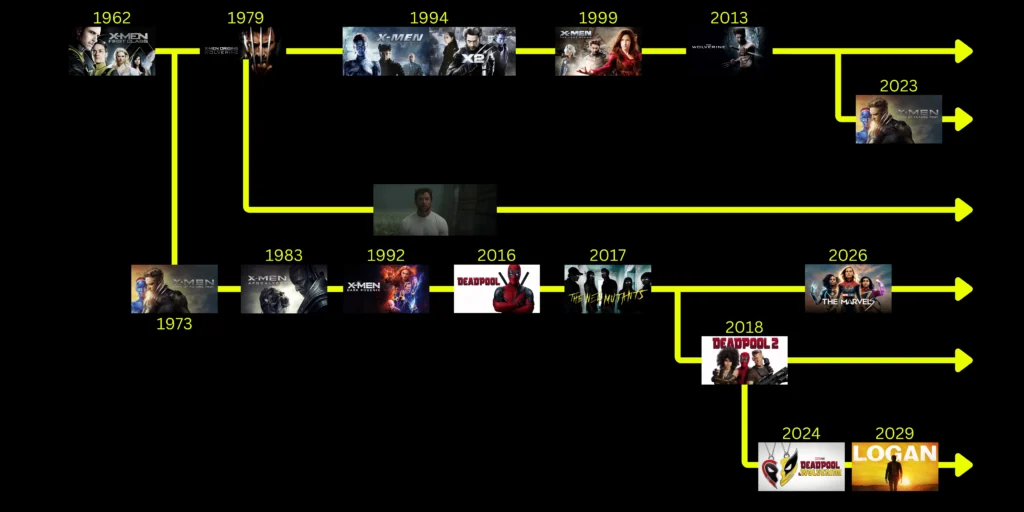
You want to rewatch the X-Men movies, but you have no idea where to start.
The X-Men timeline is notorious for being a mess. Characters age backwards. People who died are suddenly alive. Wolverine meets himself. Professor X walks in one scene despite being paralyzed in another. The internet loves to mock these “continuity errors,” creating elaborate charts trying to make sense of the chaos.
But here’s the secret: The X-Men timeline isn’t broken. It’s deliberately rebuilt. Multiple times.
Once you understand how the timelines work—how time travel didn’t just change events but rewrote reality itself—the entire franchise transforms from a confusing mess into something genuinely brilliant. The “mistakes” weren’t mistakes. They were the whole point.
Let’s fix your timeline confusion once and for all.
Understanding the Three Timelines
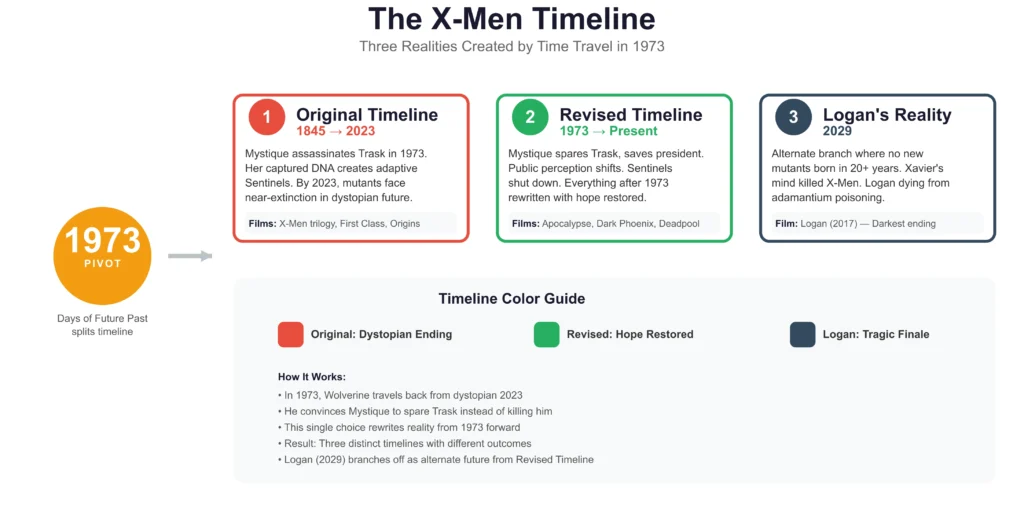
Not quite. Here’s the actual structure:
The X-Men franchise doesn’t have one timeline with a bunch of plot holes. It has three distinct timelines—and understanding the difference is crucial. These aren’t alternate universes running parallel to each other. These are reality rewrites, where the timeline gets edited and events unfold differently from a specific point forward.
Think of it like this: Time travel in the X-Men universe doesn’t create branches. It edits the source code.
Timeline 1: The Original Timeline (Earth-10005)
This is the version of events we see in the first X-Men trilogy (2000-2006), X-Men: First Class (2011), X-Men Origins: Wolverine (2009), The Wolverine (2013), and the dystopian future sequences in X-Men: Days of Future Past (2014).
This timeline runs from 1845 to 2023 and ends in disaster—a world where Sentinels have nearly wiped out all mutants.
Timeline 2: The Revised Timeline (Also Earth-10005, Post-1973)
In Days of Future Past, Wolverine’s consciousness travels back to 1973 and changes one crucial moment: Mystique’s choice. Instead of assassinating Bolivar Trask (the creator of the Sentinels), she spares him.
This single change rewrites everything from 1973 forward. The Original Timeline’s 2000s events (X-Men, X2, The Last Stand) are erased and replaced with new history. This Revised Timeline includes X-Men: Apocalypse (2016), Dark Phoenix (2019), and the Deadpool films (2016-2024).
Here’s the weird part: Events before 1973 remain identical in both timelines. First Class (1962) happened exactly the same way. But everything after the 1973 pivot point changes, sometimes drastically.
Simon Kinberg, writer of Days of Future Past, explained the franchise’s philosophy: “Time is like a river. You can splash it, throw rocks in it, even shatter it. But it eventually coalesces.” Certain events “find their way back” even in altered timelines—the universe has an immutability to it. Some things want to happen.
Timeline 3: Logan’s Alternate Reality (2029)
Logan (2017) is set in a bleak 2029 where no new mutants have been born in over 20 years. This is a separate branch that diverges from the Revised Timeline somewhere in the early 2000s. It’s the darkest possible endpoint—and the most emotionally resonant.
The Anchor Being Concept
Here’s where it gets even stranger. In Deadpool & Wolverine (2024), we learn that every reality has an “anchor being”—an individual whose existence is vital to holding that reality together. For Earth-10005 (the Fox X-Men universe), that anchor being is Wolverine.
When Logan dies in 2029, it doesn’t destroy the universe immediately. Instead, it starts a slow countdown to collapse—a decay that takes hundreds or thousands of years. The universe can survive without its anchor, but it’s living on borrowed time.
This explains why the timelines aren’t alternate realities but rewrites: Changing the past doesn’t create a new universe. It edits the existing one. There’s only one Earth-10005, but its history keeps getting rewritten because someone keeps going back and changing it.
Now let’s see how it all fell apart the first time.
The Original Timeline – How It All Began
This timeline spans from 1845 to 2023 and includes the first X-Men trilogy, X-Men: First Class, X-Men Origins: Wolverine, The Wolverine, and the dystopian future scenes in Days of Future Past.
Think of this as the foundation—the version of events that happens first, before time travel rewrites everything.
Ancient Prologue (3600 BC)
Long before any of this, there was En Sabah Nur—the world’s first mutant, who would become Apocalypse. In ancient Egypt, during an attempted consciousness transfer ritual, his followers betray him and bury him alive beneath a collapsing pyramid. He’ll stay there for millennia.
Origins Arc (1845-1962)
Canada, 1845. A young James Howlett discovers he has bone claws when he witnesses his father’s murder. He kills the murderer (who turns out to be his real father), and flees with his half-brother Victor Creed. They’re both nearly immortal, and over the next century they fight in every major American war together.
Flash forward to 1944. A young Eric Lensherr stands in Auschwitz as a Nazi scientist named Sebastian Shaw forces him to move a coin with his magnetic powers by threatening to kill his mother. When Eric can’t do it, Shaw murders her. The trauma unlocks Eric’s abilities fully—he’ll spend the rest of his life trying to prevent that kind of powerlessness.
Here’s where the groundwork gets laid for everything that breaks later.
A decade passes. In the 1950s, a young Charles Xavier meets a blue-skinned shapeshifter named Raven breaking into his family’s mansion to steal food. Instead of turning her away, he offers her a home. He becomes the first person to accept her for what she is.
The Cuban Missile Crisis, 1962. Charles and Eric, now friends and partners, recruit a team of young mutants to stop Sebastian Shaw from triggering World War III. They succeed, but it costs them everything.
Formation Era (1962-1973)
During that mission, Charles and Eric’s philosophical divide becomes permanent. Eric believes mutants must dominate to survive. Charles believes in peaceful coexistence. When Eric kills Shaw—by slowly forcing that same coin through his brain—Charles realizes his friend has become something he can’t follow.
And this is where the cracks start showing.
The final battle brings tragedy. A bullet meant for Eric ricochets off his magnetically-deflected helmet and hits Charles’s spine, paralyzing him for life. Mystique—Raven—chooses to leave with Eric, feeling rejected by Charles’s constant insistence that she hide her blue form and “pass” as human.
A year later, 1963: Magneto is imprisoned for allegedly assassinating President John F. Kennedy. The truth? He was trying to save him, because JFK was a mutant.
Then comes 1973 and the Weapon X program. Colonel William Stryker bonds adamantium to Logan’s skeleton, making his claws unbreakable and turning him into a living weapon. The process is agonizing and erases his memories.
Logan becomes Wolverine—a man with no past, only pain.
Modern Era (2000-2006)
By 2000, Charles has established his School for Gifted Youngsters. The dream lives on: training young mutants to control their powers and build a better world.
Logan, drifting and alone, encounters a teenage girl named Rogue whose power-draining touch has put her boyfriend in a coma. Magneto, now leading a Brotherhood of mutant supremacists, attempts to force world leaders to accept mutants by triggering their latent X-genes with a machine. The problem? The process kills them. The X-Men stop him, barely.
X2 escalates everything. Stryker returns, attacking Xavier’s school and nearly using Charles (via his son, a powerful illusionist) to kill every mutant on Earth through a weaponized version of Cerebro. Jean Grey sacrifices herself at Alkali Lake to save the team from a breaking dam, presumably drowning.
Then comes The Last Stand and the beginning of the end. A pharmaceutical company develops “the Cure”—a treatment that permanently suppresses the mutant gene. To some, it’s a choice. To others, it’s genocide with a friendly face. The mutant community fractures.
Meanwhile, Jean returns. But her psychic barriers have shattered, releasing the Phoenix—a primal force of psychic energy that knows no control. She kills Cyclops. She vaporizes Professor X. Magneto tries to use her as a weapon. Wolverine, the only one who can get close through her telekinetic storms, is forced to kill the woman he loves.
The dream is dying. And it’s about to get much worse.
Future Dystopia (2023)
This is where it all ends.
In 2023, the Sentinels—adaptive killing machines created using Mystique’s DNA from her assassination of Bolivar Trask in 1973—have nearly wiped out mutants. The few survivors are constantly on the run, using Kitty Pryde’s evolved phasing ability to send Bishop’s consciousness back a few days to warn the group of incoming attacks.
It’s not enough. They’re losing.
The only hope is to send someone back to 1973 to stop Mystique from killing Trask before the Sentinel program can get her shape-shifting DNA. The problem? Sending someone’s consciousness back decades would tear most minds apart. Only Wolverine’s healing factor can repair the damage as fast as the time-phasing creates it.
Logan volunteers. Kitty sends him back.
And the timeline breaks.
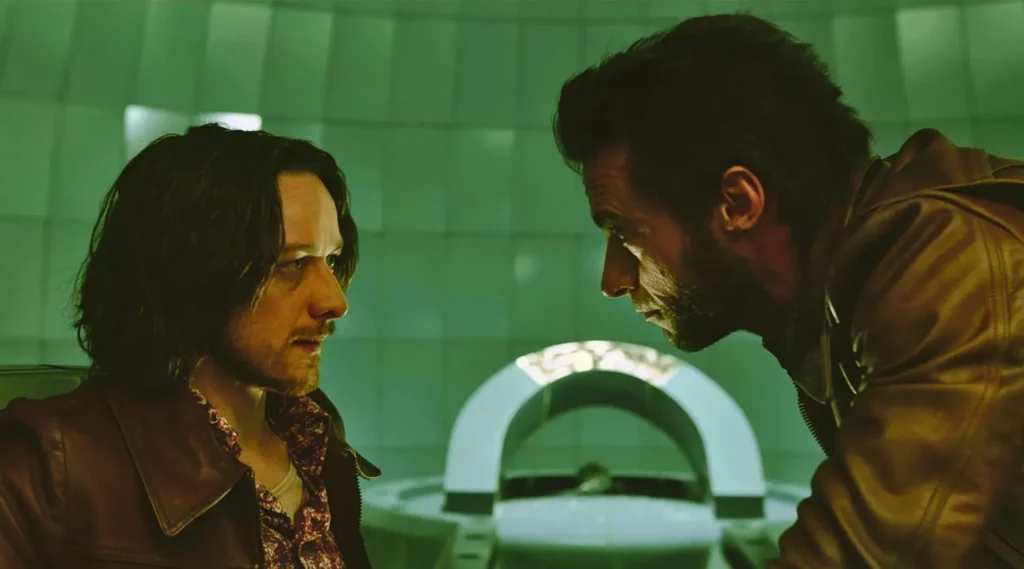
Days of Future Past – The Pivot Point
This is it. THE franchise hinge.
X-Men: Days of Future Past is the most important film in the entire franchise because it doesn’t just continue the story—it rewrites it. With a $205 million budget, Bryan Singer assembled both generations of X-Men actors and created something unprecedented: a film that explicitly acknowledged the franchise’s continuity problems and used them as the foundation for its plot.
Time Travel Mechanics
Kitty Pryde’s secondary mutation allows her to phase people’s consciousness through time into their younger bodies. For short jumps—days or weeks—most people can handle it. But decades? The neural strain would shatter minds.
Wolverine is the only viable candidate. His healing factor repairs the neural damage from time-phasing as fast as Kitty creates it. It’s constant, agonizing, but sustainable.
1973 Mission: Stop Mystique
The mission is specific: Stop Raven (Mystique) from assassinating Bolivar Trask at the Paris Peace Accords.
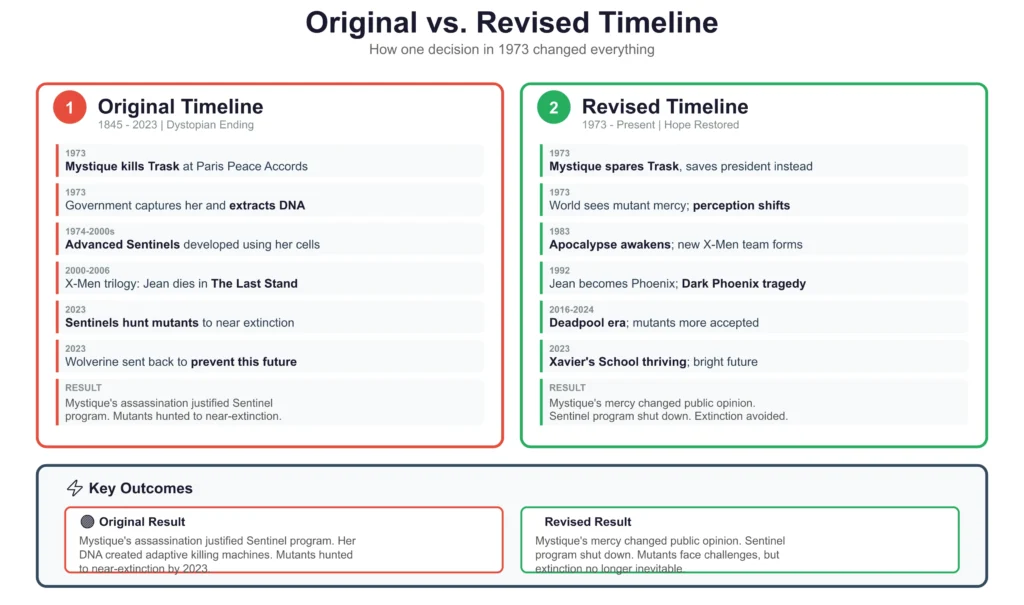
In the Original Timeline, Mystique killed Trask to stop his Sentinel program. But it backfired catastrophically. The government captured her, extracted her DNA, and used her shape-shifting cells—constantly rewriting their molecular structure—as the blueprint for adaptive Sentinels that could counter any mutant power.
Mystique’s assassination created mutant extinction.
But there’s a problem: The 1973 Charles Xavier is broken. He’s lost Raven, lost Eric, lost students to the Vietnam War. He takes a serum that lets him walk again but suppresses his telepathy—choosing physical mobility over his powers. He’s drowning in alcohol and regret, hiding in his decaying mansion.
Magneto’s Stadium Gambit
When Charles finally freezes Mystique mid-assassination, preventing the murder, Eric decides to take matters into his own hands. He lifts the entire RFK Stadium, surrounds the White House with it, reprograms prototype Sentinels, and turns them on humans.
If Mystique killing Trask proved mutants were dangerous, Eric attacking the president proves it tenfold. The Sentinel program would be justified either way.
Mystique’s Choice
The climax comes down to Raven with a gun pointed at Magneto. The cameras are rolling. The world is watching. This is the moment that defines everything.
Charles, connected telepathically, doesn’t force her to stop. He doesn’t override her will or control her mind. He just asks. He apologizes for trying to make her hide who she is. He tells her she can be better than her pain.
Mystique lowers the gun. She saves the president. She walks away.
The world sees a mutant choose mercy instead of violence. Public perception shifts. The Sentinel program is shut down.
And reality rewrites itself from that moment forward.
Reality Rewrite Rules
Bryan Singer and Simon Kinberg created specific rules for who would remember the timeline change and who wouldn’t. Most people have no memory of the Original Timeline—for them, the Revised Timeline is the only one that ever existed.
But Wolverine is the exception. Because his consciousness traveled through time, he remembers both versions. He wakes up in 2023 to a bright new world: Xavier’s School thriving, Jean Grey and Cyclops alive, Storm and Beast teaching. The dark future is gone.
Only Logan carries the bittersweet burden of remembering what was lost and what was saved.
What About the “Continuity Errors”?
The different character ages, the contradictory origins, Xavier walking when he should be paralyzed—these aren’t mistakes. They’re deliberate choices about how reality rewrites itself. Time didn’t just change events; it reorganized the universe’s structure.
Some fans call it sloppy. Others call it brilliant. Either way, it’s the franchise committing to its chaos instead of apologizing for it.
The Revised Timeline – A New History
Timeline 2.0: Same foundation (pre-1973), rebuilt everything after.
The Revised Timeline is what happens when you give history a second chance. Everything before 1973 remains identical—First Class still happened exactly as we saw it. But Mystique’s choice in Paris changes the trajectory of the next five decades.
It’s evolution in fast-forward.
1973 Divergence
Mystique isn’t captured after Paris, which means advanced Sentinels are never built, which means mutants aren’t hunted to near extinction. The world moves forward on a different path.
Here’s a crucial detail: When Mystique (disguised as Stryker) pulls Wolverine from the Potomac River in 1973, she changes when and how Weapon X happens. Logan still gets adamantium—time’s immutability at work—but the circumstances differ. It happens years later, under different conditions.
Here’s Where Things Get Genuinely Weird
Time rewrites don’t just change events—they reshape who exists when.
Scott Summers—Cyclops—was born before the 1970s in the Original Timeline (he’s an adult by the early 2000s). In the Revised Timeline? He’s a teenager in 1983’s Apocalypse. Jean Grey followed the same pattern: a child in the ’70s originally, now a teen in the ’80s. Angel’s the most baffling—appearing as both a teenager in 1983 (Apocalypse) and an adult in 2006 (The Last Stand, Original Timeline).
Same names. Completely different birth years. Impossible to reconcile.
Unless you accept what the franchise is actually saying: These aren’t the same people living different lives. They’re different iterations of the same archetypes. The universe course-corrects because it needs certain roles filled—an Angel, a Cyclops, a Jean Grey. Reality finds new ways to create the patterns it requires.
It’s bizarre. It’s also exactly what the X-Men have always been about: You can’t control how you’re born, only what you become.
But the Revised Timeline has one more tragedy to deliver.
1983: Apocalypse Awakens
Mystique’s 1973 heroism changed public perception of mutants. By the 1980s, mutants are known but not universally hunted—they’re out of the shadows, more accepted AND more vulnerable.
En Sabah Nur wakes up to a world he sees as weak and in need of cleansing. He recruits Four Horsemen—Storm, Psylocke, Angel, and a grief-stricken Magneto—amplifies their powers, and plans to transfer his consciousness into Xavier’s body for ultimate power and global mind control.
The film is, let’s call it troubled. Overstuffed, thin villain motivations, a dragging final battle. But thematically, it works: It forces a new generation of X-Men—Jean, Scott, Kurt, Jubilee—to unite as a team for the first time. Jean taps into the Phoenix Force and destroys Apocalypse. The X-Men are truly born in this timeline.
1992: Dark Phoenix
A decade later, the X-Men are celebrities. They rescue space shuttle astronauts as the world cheers. But Raven warns Charles that the glory is going to his head, that he’s pushing the team too hard to maintain his legacy.
She’s right.
During the rescue, Jean absorbs a cosmic force—the Phoenix. It tears down the psychic barriers Charles placed in her mind as a child, barriers meant to protect her (and everyone else) from power she couldn’t control. She discovers her father is alive, that Xavier lied about her parents’ death, that she killed her mother in a car accident as a child.
The Phoenix Force feeds on her rage and pain. Raven tries to reach Jean—Jean accidentally kills her.
The moment devastates everyone. Hank blames Jean. Magneto wants revenge. Charles finally realizes his paternalistic control led directly to this tragedy.
The film itself was troubled: reshoots, creative differences, the looming Disney merger casting a shadow over production. It should have been the triumphant conclusion to the prequel trilogy. Instead, it became a messy, melancholic finale.
But the core tragedy works. Jean, unable to reconcile her power with her pain, ultimately sacrifices herself—flying into space to destroy both an alien threat and the Phoenix Force consuming her.
Why Changes Matter
These aren’t just different events—they carry different emotional weights. In the Original Timeline, Jean Grey’s death in The Last Stand felt rushed and punitive, a character disposed of by a troubled production. In the Revised Timeline, her death in Dark Phoenix carries the weight of Xavier’s mistakes—a young woman who was never given the chance to be whole, a power that should have been embraced but was locked away until it exploded.
Mystique’s death means something deeper here too. Hank loses someone he loved but never fully appreciated. Magneto loses his closest ally. Charles loses the sister he had in all but blood.
These revised versions dig deeper into the franchise’s core themes: What happens when we try to control those we claim to protect? What’s the cost of hiding who you really are? Can redemption ever truly erase past sins?
The Deadpool Divergence & Multiverse
And then Deadpool showed up and made fun of all of this.
The Deadpool films occupy a unique space in the X-Men timeline—they’re simultaneously part of the Revised Timeline (taking place roughly 2016-2024) and completely aware that none of this makes any sense. Wade Wilson knows he’s in a movie. He knows the timeline is a mess. And he’s not afraid to say it out loud.
Breaking the Fourth Wall, Breaking the Timeline
In Deadpool 2, Cable travels back in time using technology completely different from the consciousness-shifting method in Days of Future Past. Does this contradict the established rules? Probably. Does Deadpool care? Absolutely not.
The franchise leans into its meta-awareness, with Deadpool literally shooting his earlier self from X-Men Origins: Wolverine in the head and calling it “cleaning up the timeline.” It’s a joke, sure, but it’s also an acknowledgment: These movies know their continuity is tangled, and they’re okay with it.
Cable can change the past by going back hours or days. Deadpool uses his time device to save Vanessa, save Peter, and murder Ryan Reynolds before he can make Green Lantern. None of this creates branching timelines or requires Kitty Pryde’s powers. It just… works. Because Deadpool movies play by different rules.
But Deadpool & Wolverine changed everything.
Earth-10005 and the Multiverse Connection
In 2024, Deadpool & Wolverine earned a staggering $1.338 billion worldwide, becoming the highest-grossing R-rated film of all time. More importantly, it gave the X-Men universe an official designation: Earth-10005.
The film opens with Wade using Cable’s time device to visit Earth-616—the MCU’s Sacred Timeline—where he meets Happy Hogan and asks to join the Avengers. Happy politely declines. Wade returns home, destroys the device, and goes back to selling cars.
Six years later, the TVA comes knocking.
Mr. Paradox, a rogue TVA agent, explains that Wade’s universe is dying. When Logan died in 2029, he didn’t just end his own story—he doomed the entire timeline, because Wolverine was Earth-10005’s “anchor being,” the entity holding reality together.
Without its anchor, the universe will fade over thousands of years. But Paradox has built a Time Ripper that can delete it instantly. He offers Wade a place on Earth-616, the Sacred Timeline, if he’ll let his friends die.
Wade, of course, says no. Instead, he decides to find a new Wolverine from another universe to replace the dead one, hoping to stabilize Earth-10005 and save everyone he loves.
The Variants and the Void
What follows is a multiversal road trip where Deadpool encounters different versions of Wolverine: a patch-wearing variant, an Age of Apocalypse variant, a comic-accurate short variant, even one played by Henry Cavill. Finally, he finds a broken Logan—one who failed his X-Men, watched them die, and has been drowning in guilt ever since.
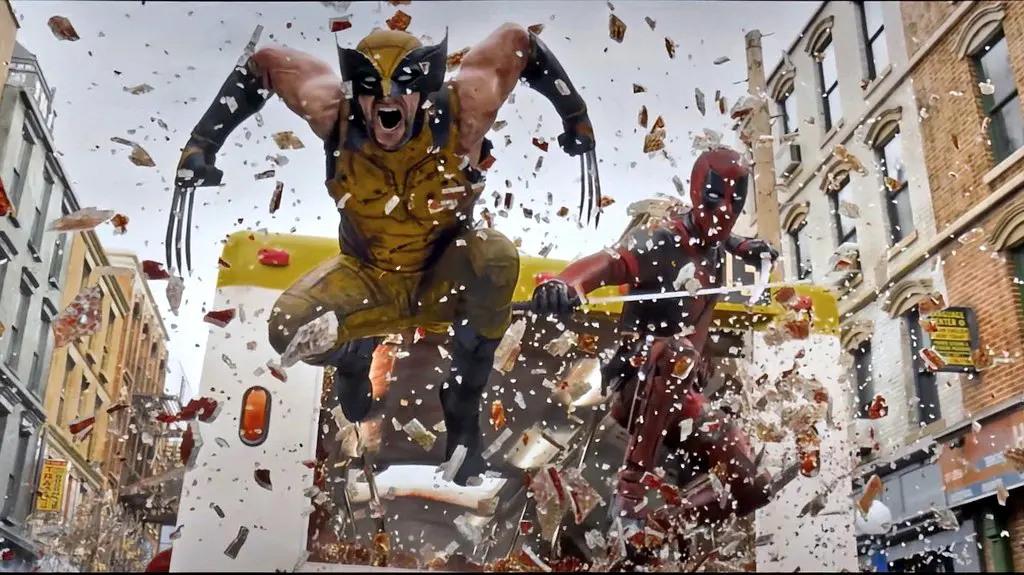
Together, they end up in the Void (the place at the end of time where the TVA dumps pruned variants), fight Cassandra Nova, and ultimately save Earth-10005 by stopping the Time Ripper. The new Wolverine stays in Wade’s universe, apparently stabilizing it as a replacement anchor being.
And suddenly, the Fox X-Men universe was officially part of the MCU multiverse.
What This Means for the Future
Kevin Feige has been clear about where this is heading: “The whole story of Secret Wars really leads us into a new age of mutants and of the X-Men. We finally have the X-Men back.”
After Avengers: Secret Wars, the MCU will undergo what Feige calls a “reset” (not a reboot), with new actors playing the X-Men. The new team will be younger, focused on mutants “who feel different, and who feel other, and who feel like they don’t belong”—returning to the franchise’s roots.
As for Deadpool himself? Ryan Reynolds is working on “various script treatments for an ensemble film centered on three or four X-Men characters alongside Deadpool,” though Marvel reportedly feels “no sense of urgency” about another Deadpool solo film despite the massive success.
Reynolds has been clear about his vision: “If Deadpool becomes an Avenger or an X-Man, we’re at the end. That’s wish fulfillment, and we can’t give him that.” Wade works best as the outsider, the supporting character who comments on everyone else’s drama while never quite fitting in himself.
Which brings us to the other outsider. The one who did get his ending.
The one who actually died.
Logan – The Endpoint
In 2029, an old man is dying.
His name is Logan. The adamantium coating his bones is poisoning him. His healing factor is failing. His hands shake. And the man who once couldn’t die is now counting down his final days.
Logan is the third timeline—a branch that splits off somewhere in the Revised Timeline’s future. It’s a world where no new mutants have been born in over 20 years, where Alkali-Transigen poisoned the food supply to suppress the mutant gene, where Charles Xavier’s deteriorating mind accidentally killed the X-Men in Westchester.
It’s the darkest possible future. And it’s the most honest.
The Death of the Dream
This isn’t a world of Sentinels or cosmic threats. It’s a world where mutants simply… faded. The dream Charles spent his life fighting for—peaceful coexistence, a better tomorrow—died not with a bang but with a whimper.
Charles himself is dying too, his powerful mind now a weapon he can’t control, prone to seizures that freeze everyone nearby. Logan keeps him sedated, hidden, and safe in an abandoned smelting plant in Mexico. It’s not the mansion. It’s not a school. It’s survival.
Then a little girl shows up. Laura. X-23. Logan’s daughter, created from his DNA by the same people who gave him his claws.
Don’t Be What They Made You
The film strips away everything superhero movies usually are. No costumes (except in Laura’s comic books). No grand speeches. No world-ending stakes—just a desperate sprint to get kids across the Canadian border before the bad guys catch them.
Logan doesn’t want to be a hero anymore. He’s too tired, too sick, too broken. But Laura needs him. And Charles, in his final lucid moments, reminds Logan of something he’d forgotten: being a hero isn’t about the mission. It’s about the person standing next to you.
When Charles dies—murdered by X-24, a mindless clone of Logan—it’s quiet. Painful. There’s no resurrection coming. The professor who brought mutants together, who believed in a better world, dies in a motel room in the woods.
But his dream doesn’t die with him.
The Cross Becomes an X
At the film’s end, Logan is impaled on a tree branch, dying from wounds even his weakened healing factor can’t fix. He’s saved Laura and the other children. They’re free. And he finally tells her the truth: “Don’t be what they made you.”
She calls him “Daddy.” He dies.
The children bury him. They mark his grave with a cross made from sticks. And then Laura, before leaving, turns it on its side. The cross becomes an X.

Why This Ending Matters
When Logan died saving Laura, he set a countdown on the entire universe—his death as anchor being meant Earth-10005 would eventually fade. But in that moment, none of that mattered. He wasn’t thinking about timelines or multiverses or reality itself.
He was thinking about his daughter.
Logan works because it’s not about the timeline. It’s about what happens when the fighting stops, when the healing fails, when all you have left is the choice to be something better than what they made you.
The X-Men died in Westchester. Charles died in the woods. Logan died protecting children who represent a future he’ll never see.
And somehow, that’s the perfect ending. Not because it’s happy—because it’s earned.
The anchor being fell. But the dream lived on.
How to Actually Watch These Movies
So you’re ready to dive in. The question is: where do you start?
The answer depends on what you want from the experience. Here are three approaches, each with its own advantages.
Option 1: Chronological Order (In-Universe Timeline)
If you want to experience events as they happened in the story:
- X-Men: First Class (1962)
- X-Men: Days of Future Past (1973 scenes + 2023 future)
- X-Men Origins: Wolverine (1845-1979)
- X-Men: Apocalypse (1983)
- Dark Phoenix (1992)
- X-Men (2000s)
- X2: X-Men United (2000s)
- X-Men: The Last Stand (2000s)
- The Wolverine (Post-Last Stand)
- Deadpool (2016)
- Deadpool 2 (2018)
- The New Mutants (2018, optional)
- Logan (2029)
- Deadpool & Wolverine (2024)
The problem? Watching chronologically means starting with prequels that reference events you haven’t seen yet. You’ll understand the timeline, but you’ll miss a lot of emotional weight.
Option 2: Release Order (The Intended Experience)
Watch them as audiences did:
X-Men (2000) → X2 (2003) → The Last Stand (2006) → Origins: Wolverine (2009) → First Class (2011) → The Wolverine (2013) → Days of Future Past (2014) → Deadpool (2016) → Apocalypse (2016) → Logan (2017) → Deadpool 2 (2018) → Dark Phoenix (2019) → The New Mutants (2020) → Deadpool & Wolverine (2024)
The advantage? You experience the timeline confusion and fixes exactly as they were intended. Days of Future Past hits harder when you’ve lived through the original trilogy.
Option 3: Best Understanding Order (Recommended)
This hybrid approach gives you the clearest narrative while maintaining emotional impact:
- X-Men: First Class – Foundation
- X-Men trilogy – Original timeline
- The Wolverine – Logan’s journey
- X-Men: Days of Future Past – THE PIVOT POINT
- X-Men: Apocalypse – New timeline begins
- Dark Phoenix – Revised timeline conclusion
- Deadpool films – Meta commentary
- Logan – Emotional finale
- Deadpool & Wolverine – Multiverse connection
Skip or save for later: Origins: Wolverine (contradicted by later films) and The New Mutants (disconnected side story, though perfectly fine if you’re curious).
This order lets you understand the timeline structure without getting bogged down in contradictions. You’ll see the Original Timeline, experience the rewrite, follow the Revised Timeline, and end with both the emotional conclusion (Logan) and the multiverse expansion (Deadpool & Wolverine).
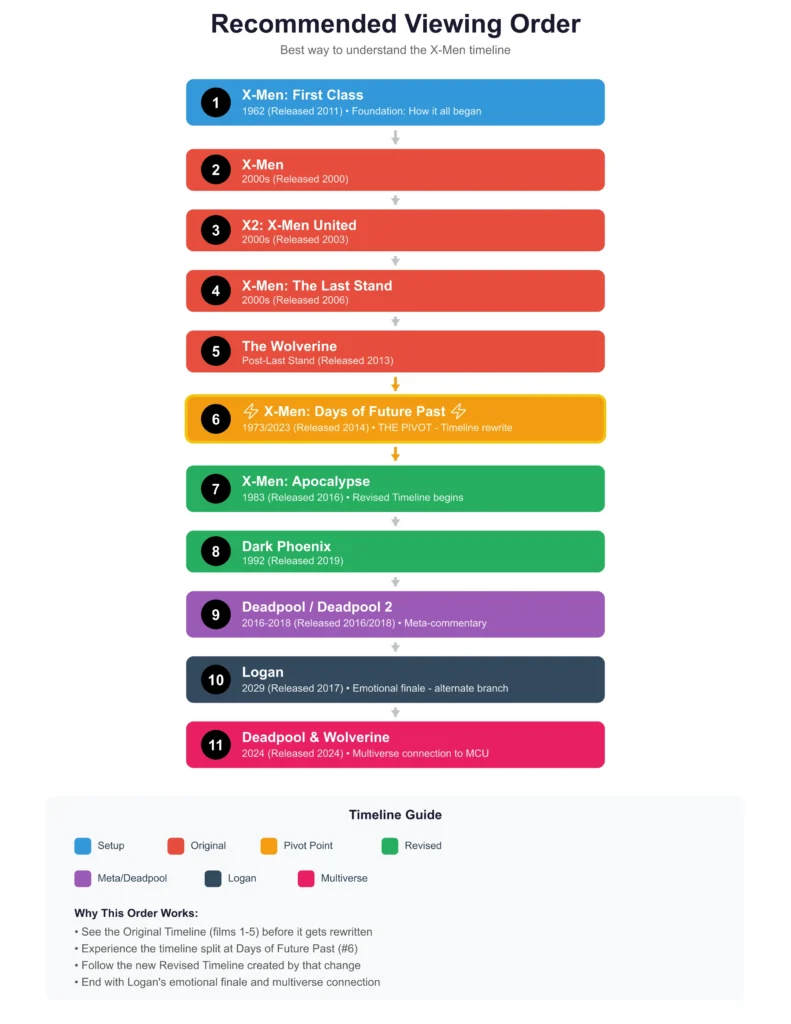
One final tip: However you watch, pay attention to Days of Future Past. It’s the Rosetta Stone for understanding everything else. Miss that one, and you’ll be lost.
Now go forth and enjoy 24 years of mutant mayhem—with total confidence. Your timeline confusion has been cured.
Frequently Asked Questions About the X-Men Timeline
Q: Do I need to watch the X-Men movies in chronological order?
A: Not necessarily. While chronological order helps you understand the timeline, release order gives you the intended experience. We recommend a hybrid approach: Start with First Class, watch the original trilogy, then Days of Future Past, followed by the revised timeline films.
Q: How does Deadpool & Wolverine fit into the X-Men timeline?
A: Deadpool & Wolverine takes place in 2024 on Earth-10005 (the Fox X-Men universe) and connects it to the MCU multiverse through the TVA and anchor being concept. It occurs 5 years before Logan’s 2029 setting in the timeline.
Q: What is an anchor being in the X-Men timeline?
A: An anchor being is an individual vital to their reality’s existence. In Earth-10005, Wolverine was the anchor being—when he died in Logan (2029), it started a countdown to that universe’s eventual destruction, though it would take thousands of years.
Q: Why does the X-Men timeline have so many contradictions?
A: Days of Future Past intentionally rewrote the timeline in 1973, creating the “Revised Timeline” where characters are born at different times and events unfold differently. This isn’t a mistake—it’s a deliberate narrative choice that mirrors the films’ themes about change and evolution.
Q: Will the Fox X-Men timeline continue in the MCU?
A: Kevin Feige has confirmed the MCU will introduce a new, younger X-Men team after Avengers: Secret Wars in what he calls the “Mutant Era.” However, the multiverse means Fox-era characters like Wolverine can still appear alongside the new team.
Why Timeline Chaos Makes It Better
Remember that problem we started with? You wanted to rewatch the X-Men movies but had no idea where to begin.
Now you know it’s not a problem at all. It’s the point.
The X-Men timeline isn’t broken—it’s about breaking. About change, evolution, and the impossibility of a perfect past. Just like the mutants themselves, the franchise refused to stay locked in one form. It evolved, adapted, and transformed into something new.
Think about what these films actually explore: Charles Xavier trying to control Jean’s power by locking it away until it explodes. Magneto believing the only way forward is to destroy the past. Wolverine living so long he forgets who he was. Mystique hiding her true form because the world isn’t ready to accept it.
Every major theme in the X-Men movies is about the tension between what you are and what you’re told you should be. About whether you hide your nature or embrace it. About whether the past defines you or you define yourself.
So of course the timeline is messy. How could it not be?
Days of Future Past didn’t fix continuity errors—it weaponized them. The franchise took its biggest weakness and made it the thematic spine of its most successful film. That’s not sloppy storytelling. That’s bold.
And now, with the MCU’s “Mutant Era” approaching, the X-Men get to evolve again. New actors, new stories, new timeline. Kevin Feige has promised a younger team dealing with feeling different, feeling other, feeling like they don’t belong—which is exactly what the X-Men have always been about.
The Fox era may be over, but its chaotic, contradictory, beautiful mess of a timeline proved something important: Perfection is overrated. Growth is messy. And sometimes the best stories come from embracing the chaos instead of fighting it.
So the next time someone complains about X-Men continuity, smile. Because you know the secret: The timeline was never the problem. It was always the solution.
Now go watch them. Any order you want. Because that’s the most mutant thing of all—choosing your own path.