
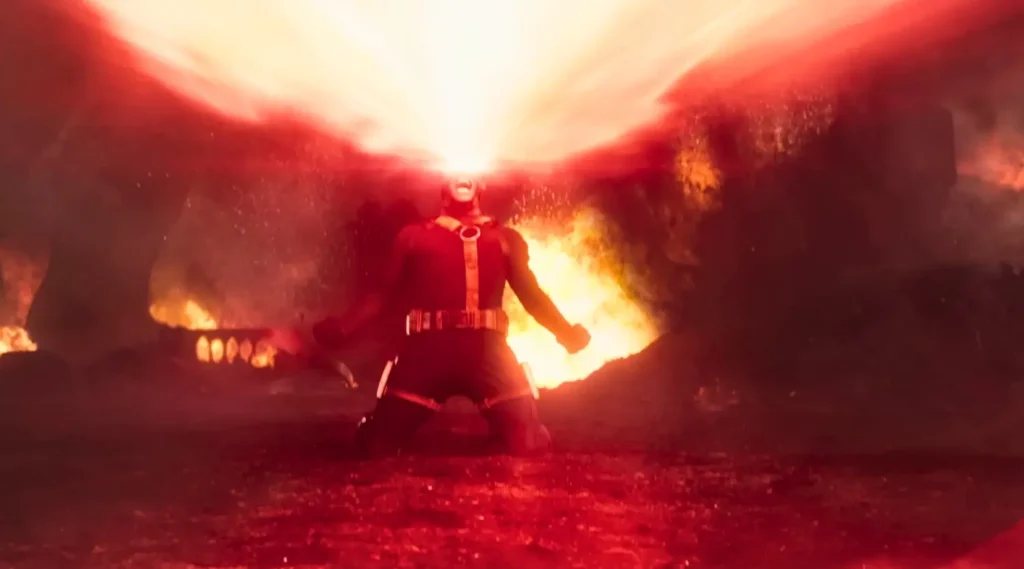
Three seconds. That’s all it took to remind us why Cyclops matters.
The new Avengers: Doomsday trailer drops, and there he is—James Marsden’s Scott Summers, older now, standing in a devastated X-Mansion. His hand moves to his visor. The camera holds. He removes it, deliberately. His eyes glow red. The scream builds. And then: devastation. Pure, unrestrained power tearing through what’s left of Xavier’s dream.
The internet erupted. “It’s finally his time,” one comment read, capturing the sentiment of millions who’d watched James Marsden’s Cyclops get sidelined across four X-Men films spanning two decades. After 26 years of false starts, diminished screen time, and off-screen deaths, Marvel was finally giving us the Cyclops moment we’d been waiting for.

But who is Scott Summers? How did a boy who survived a burning plane crash become the X-Men’s first member and tactical leader? What makes his origin story different from every other hero in the Marvel landscape?
The answer involves alien attacks, Victorian supervillains, nuclear plants, and a choice between two very different mentors. It’s a story about trauma, control, and what it means to be born with a weapon you can’t turn off.
This is the complete origin of Cyclops—updated with contemporary context from the Krakoa era through his December 2026 return in Avengers: Doomsday.
THE SUMMERS FAMILY: BEFORE THE FALL
Before the tragedy, before the powers, before the X-Men, there was just a family.
Christopher and Katherine Anne Summers seemed ordinary enough. A military test pilot and his wife, raising two sons—ten-year-old Scott and his younger brother Alex—in Anchorage, Alaska. They took family vacations. Had dinner together. Lived the kind of stable, middle-class American life that feels almost quaint in superhero origin stories.
Christopher occasionally flew them in his de Havilland Mosquito, a WWII-era wooden bomber he’d restored as a personal aircraft. On this particular flight—returning from what should have been a routine family trip—the four of them were buckled into that vintage plane, watching clouds pass beneath them, completely unaware they were about to become part of a cosmic conflict that would reshape Scott’s entire existence.
Scott was just a kid. He liked model planes and baseball. His biggest worry was probably homework. Normal ten-year-old concerns.
If you’ve ever lost someone suddenly, you understand that moment—when normal becomes impossible in a heartbeat.
Everything changed in the skies above the Pacific Northwest.
CATASTROPHE: THE SHI’AR ATTACK
The alien scout ship appeared without warning.
One moment, clear skies. The next, a massive vessel from the Shi’ar Empire—an interstellar civilization conducting reconnaissance on Earth—materialized overhead. Christopher’s training kicked in immediately. Evasive maneuvers. Drop altitude. But what can a wooden WWII bomber do against technology that crosses galaxies?
The Shi’ar ship opened fire.
Plasma bolts tore through the Mosquito’s hull. The impact came halfway between the cockpit and tail, and suddenly they were falling, the plane consumed in flames. Katherine Anne screamed for Christopher to do something—anything—but they both knew the truth. There was no outrunning this.
There was only one parachute.
“Get the boys strapped in!” Christopher shouted over the roar of wind and fire. Katherine Anne’s hands shook as she fastened the parachute to ten-year-old Scott’s back. Alex wrapped his arms around his older brother, terrified, not understanding why they were being pushed toward the door.
Scott protested—we can’t leave you—but Katherine Anne was already stuttering through reassurances she knew were lies. “We’ll be right behind you, sweetheart. We promise.”
She pushed them out of the burning plane.
Scott held his little brother as tightly as he could while they plummeted. The parachute deployed—and immediately caught fire from debris. They were still falling too fast. Scott did the only thing he could: he twisted his body at the last second, putting himself between Alex and the ground.
The impact was devastating.
Scott’s head struck something hard—a rock, debris, the ground itself—and the world went dark. Alex survived with minor injuries. Scott’s skull had absorbed the brunt of the trauma. When authorities found the boys hours later, Scott was unconscious, bleeding, and would remain in a coma for the next year.
In trauma psychology, there’s a term for what happens to a child’s brain during moments like this: developmental rupture. The instant everything safe becomes dangerous. Scott Summers was ten years old.
What about their parents?
| The Fate of Christopher and Katherine Summers Christopher and Katherine Anne weren’t killed in the crash—they were teleported aboard the Shi’ar vessel. On the throneworld of Chandilar, Katherine Anne was brought before mad Emperor D’Ken. When she refused his demands to join his harem, he killed her in front of Christopher’s eyes. Christopher was sent to the slave pits, where he eventually escaped with three other prisoners. Stealing a starship, they became the space pirate crew known as the Starjammers, with Christopher taking the name Corsair. For years, he believed his entire family had died in the crash. This backstory would be explored decades later in Uncanny X-Men #104 and subsequent Starjammers storylines. |
Meanwhile, back on Earth, Scott remained comatose. Alex was placed with adoptive parents who gave him a normal childhood. And when Scott finally woke up a year later—groggy, confused, unable to remember most of what had happened—he was told his parents had died in the crash.
He was alone. Orphaned. Brain-damaged in ways the doctors didn’t fully understand.
But the real nightmare was just beginning.
THE ORPHANAGE YEARS: SINISTER’S SHADOW
When Scott Summers woke from his year-long coma, the world had moved on without him.
His brother Alex had been adopted by another family—gone, just like their parents. Scott was alone, placed in the State Home for Foundlings in Omaha, Nebraska. To the outside world, it looked like any other orphanage. Clean hallways. Strict routines. A stern administrator named Mr. Pearson overseeing operations. A kind physician, Dr. Robyn Hanover, who seemed genuinely concerned about the children in her care.
But beneath the building, hidden in a high-tech underground laboratory, one of Marvel’s most terrifying villains was conducting experiments.
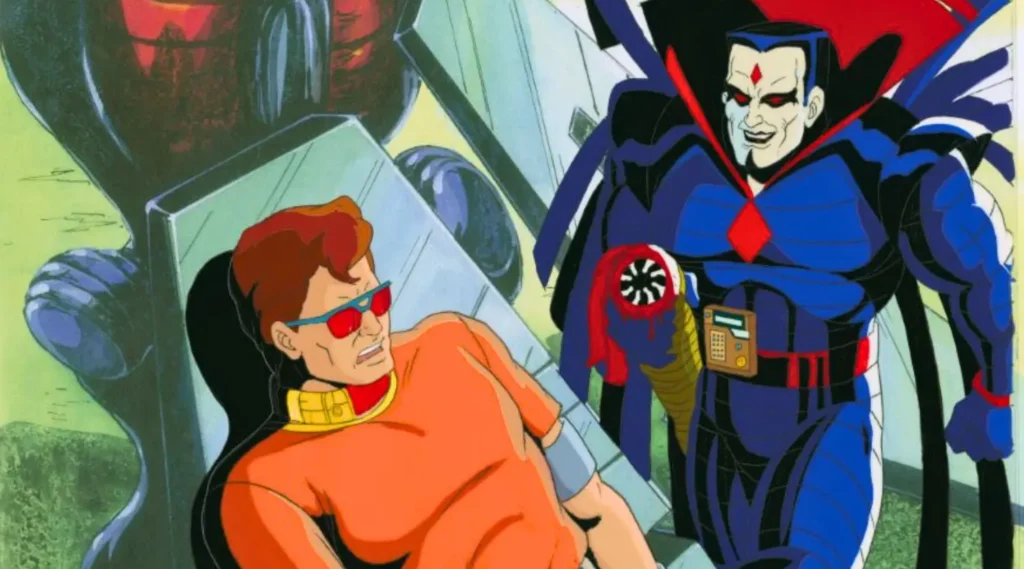
Mr. Sinister—the Victorian-era geneticist transformed into an immortal being by Apocalypse—had been tracking the Summers bloodline for over a century. When he learned about the plane crash and Scott’s survival, he immediately arranged for the boy to be placed in his facility.
What happened next was a masterclass in psychological manipulation:
Sinister’s Control Methods:
- Identity Shifting: Operated as “Mr. Milbury” (administrator), anonymous optometrist, and “Nate” (fellow orphan)
- Isolation Tactics: Had Alex adopted separately to make Scott emotionally vulnerable and dependent
- Covert Experimentation: Subjected Scott to batteries of tests during year-long coma and after
- Memory Erasure: Placed mental blocks to hide evidence of late-night laboratory sessions
- Ruby Quartz Discovery: Through trial and error, found the only substance that could block Scott’s optic energy
- False Medical Care: Provided glasses under pretense of treating “eyestrain and headaches”
The “Nate” identity was particularly insidious. This supposed roommate acted as Scott’s only friend—overly territorial, aggressively protective, isolating Scott from forming other relationships. When Scott tried to connect with other children, Nate would intervene. When Scott showed interest in activities, Nate would undermine his confidence.
Scott was living in a cage he couldn’t see.
Then came the moment that nearly broke him.
Dr. Hanover noticed Scott’s isolation and tried to help. She had friends—Richard and Tricia Bogart—a kind couple who expressed genuine interest in adopting the troubled teenager. Richard was a pilot, just like Scott’s father. They visited the orphanage. Spent time with Scott. Talked about flying, about Alaska, about family dinners and Saturday morning cartoons.
For the first time since the crash, Scott let himself hope.
The Bogarts got along well with Scott. The adoption paperwork was submitted. Scott packed his few belongings into a donated suitcase. Dr. Hanover told him he deserved this. That his life was about to change.
An hour before the Bogarts were scheduled to pick him up, they called and canceled.
No explanation. Just a polite message through Mr. Pearson: We’ve reconsidered. We don’t think we’re ready.
What Scott didn’t know: Sinister had initially considered having them killed. But murder would create trauma that might push Scott away permanently. Instead, Sinister used his telepathic abilities to plant doubts—anxieties about parenthood, fears about Scott’s “problems,” second thoughts about the commitment.
Scott was devastated. And exactly as Sinister planned, he became even more attached to “Nate.”
Imagine being told you’re finally getting a family—after years of isolation, after losing everything. Then having it ripped away an hour before it happens.
Through it all, Sinister’s obsession went beyond scientific curiosity. He’d encountered a time-traveling Scott Summers and Jean Grey in the 19th century and had become fascinated by their genetic potential. He believed the Summers and Grey bloodlines, when combined, would produce a mutant powerful enough to destroy Apocalypse—his former master and eventual enemy.
Scott Summers wasn’t just another test subject. He was a crucial piece in a genetic chess game spanning centuries.
But Sinister’s control had limits. When Scott’s powers finally manifested at age seventeen, the event was too public for Sinister to contain. And worse, another telepath—far more powerful—had also noticed.
At seventeen, everything Scott had been suppressing would explode into the open.
AWAKENING: WHEN POWER BECOMES A PRISON
Picture yourself at seventeen, unable to open your eyes without destroying everything you look at. Every morning is a choice: stay blind or risk catastrophe.
Scott’s mutant power manifested during a school trip to Washington D.C. He’d been experiencing headaches for weeks—pressure building behind his eyes, strange sensations he couldn’t explain. Then, while standing on a busy street watching construction, he looked up at a crane lifting steel beams.
His eyes burned. Something released.
The blast demolished a crane. The debris fell harmlessly away from the crowd below. Scott had just saved dozens of lives. But when he opened his eyes—still glowing red—all they saw was a threat.
‘He tried to kill us!’ someone shouted from the crowd.
‘Freak!’ another voice joined in. ‘Monster!’
The mob formed quickly. Angry faces. Pointed fingers. Someone picked up a chunk of concrete. Scott’s hands trembled—not from fear of them, but fear of himself. If he opened his eyes again, even accidentally, people would die. So he ran blind, stumbling through alleys, hands pressed against his closed eyelids, while the shouts echoed behind him.
Here’s what most people don’t understand about Scott’s power: it’s not laser vision. It’s a concussive force drawn from another dimension through his eyes. Think of his eyes as portals to a realm of pure kinetic energy. The damage isn’t from heat—it’s from impact. Like being hit by an invisible battering ram.
And Scott couldn’t control it. The head trauma from the plane crash had damaged the part of his brain that would regulate the power. Without ruby quartz glasses—which Sinister had provided under false pretenses—Scott’s eyes were loaded weapons with no safety.
This was 1983 in the Marvel Comics timeline—a period of rising anti-mutant hysteria. The public was already afraid. Senators were proposing registration acts. Religious leaders called mutants “abominations.” And here was a teenager who’d just destroyed a crane with his eyes.
Scott couldn’t return to the orphanage. Couldn’t explain what had happened. Couldn’t risk being around people. For days, he survived on the streets—eyes closed, stolen food, sleeping in alleys, terrified of what he’d become.
Someone had been watching.
TWO MENTORS: CHOICE AND DESTINY
The question isn’t whether Scott Summers would have become a hero—it’s whose vision of heroism would have claimed him first.
Two men were hunting for the teenage runaway with the devastating power. Both were mutants. Both had plans. Both believed they were offering salvation.
One wanted a weapon. The other wanted hope.
Jack Winters found him first.
Scott had been on the run for days after his public display of power—the crane, the crowd, the angry mob convinced he’d tried to kill them. Exhausted and terrified, stumbling through the woods outside the city, he felt a voice in his head. Not words exactly. More like a pull. A telepathic summons leading him to a small shack in a clearing.
The man inside introduced himself as Jack Winters, a mutant who understood what Scott was going through. He had telepathy. Teleportation. And hands that transformed into living diamond—flexible crystalline appendages that could slice through steel like paper.
Here’s what Winters didn’t mention: he was a criminal. A former nuclear plant worker who’d tried to steal radioactive isotopes, only to have them explode, covering his hands in radiation and granting him powers. Now he had a theory—if that small dose had given him this much power, imagine what more could do.
He wanted Scott to help him break into the nuclear plant. If Scott refused, Winters made the consequences clear. Physical ones.
Scott was seventeen, alone, and being manipulated by the first person who’d claimed to understand him.
We’ve all faced this choice in smaller ways—the person offering easy answers vs. the one asking us to do hard work. Scott’s stakes were just higher.
The Nuclear Plant Confrontation
Professor Charles Xavier—the powerful telepath operating from Westchester—had been tracking new mutants with a prototype device called Cyberno. When Scott’s power manifested publicly, Xavier detected both signatures immediately and understood what was happening.
If mutants were hunted by fearful humans, they’d be driven toward exactly the desperation that would confirm humanity’s worst fears. But if someone offered guidance? They could become something better.
When Winters teleported Scott to the nuclear plant, Xavier followed. Winters collapsed part of the ceiling with his strength, forming a barrier between himself and the professor, then pressed toward the reactor room. Scott slipped away in the chaos.
In the control room, Xavier found Scott holding off security guards, trying not to hurt anyone. The professor used his telepathy to end the conflict peacefully, then sensed Winters’ intentions—seconds before the criminal would succeed.
This was the moment Scott Summers chose who he would become.
Xavier’s voice filled his mind: You can use their own machinery against him. The vibrational inducer. Trust me.
Scott had every reason not to trust. Sinister had twisted his childhood. Winters had threatened him. Every adult in his life had used him for something.
But something in Xavier’s tone was different. Not commanding—inviting. Not controlling—empowering.
When Winters burst through the wall, his entire body now transformed into living diamond, Scott made his choice. He activated the vibrational inducer. The frequency locked Winters’ crystalline joints, making movement impossible.
Winters fought it. Struggled with such stubborn ferocity that his diamond body couldn’t withstand the pressure. The cracks spread. The structure shattered. Jack Winters—the man who’d tried to weaponize both radiation and a desperate teenager—was dead.
In the silence that followed, Scott realized something: he’d just killed someone. Even accidentally. Even in self-defense. The weight of that would never fully leave him.
Xavier approached carefully. Offered not just a home, but a purpose. Not exploitation, but education. A mansion in Westchester that doubled as a school. Training to master his abilities. A uniform and specialized visor to give him control.
And a dream—that mutants and humans could coexist peacefully. That the next stage of human evolution didn’t have to mean conflict. That young mutants, if given proper guidance, could become heroes rather than threats.
Scott looked at the shattered remains of what he might have become. Then at the professor offering a different path.
The choice was obvious.
This was the moment the X-Men were truly born.
BECOMING CYCLOPS: THE FIRST X-MAN
Training began immediately. Xavier worked with Scott to understand his powers, discovering that only ruby quartz could block the optic energy. Hank McCoy (Beast) designed specialized glasses and a tactical visor.
The first real test came in the Danger Room—Xavier’s high-tech training facility. Scott stood before a series of moving targets while Xavier’s voice echoed through speakers: ‘Control is not suppression. Control is precision.’ Scott had spent seventeen years afraid to open his eyes. Now he was learning to weaponize what he’d feared. The first target disintegrated. The second. By the twentieth, he could graze the edge without obliterating the center.
Xavier didn’t just provide technical training—he gave Scott purpose. The ruby quartz visor became more than protection; it was a symbol of control regained. The codename ‘Cyclops’—inspired by the mythological one-eyed giants—reframed his difference as strength rather than disability. And when Xavier designated him field leader, making him responsible for coordinating the team’s first missions against threats like Magneto’s Brotherhood, it completed Scott’s transformation from weapon to guardian.
This is what makes his story resonate: not the power itself, but the choice to use it for others when every instinct says protect yourself first.
By the time the full X-Men team assembled in 1963—Jean Grey (Marvel Girl), Bobby Drake (Iceman), Hank McCoy (Beast), and Warren Worthington III (Angel)—Scott Summers had already been training under Xavier for months. He wasn’t just a founding member. He was the founding member. Xavier’s first student. The template for what the X-Men could become.
That designation—first X-Man, field leader, Xavier’s right hand—would define Scott Summers for the next six decades. Through romance with Jean Grey, conflicts with Wolverine, leadership crises, deaths, resurrections, and the weight of impossible decisions, Cyclops remained the tactical anchor of the team.
That responsibility has defined him ever since—through countless battles, impossible losses, and the weight of decisions no one else wanted to make.
Which brings us full circle to that three-second moment in the Avengers: Doomsday trailer. James Marsden removing the visor. The scream building. The devastation unleashed in a ruined X-Mansion. After 26 years and four cinematic iterations, Hollywood is finally ready to show the Cyclops that comic readers have known all along: not just a boy scout with a laser beam, but a leader forged in trauma who chose heroism anyway.
But how did Hollywood get here? And why did it take so long?
BEYOND THE PAGE: CYCLOPS’ CINEMATIC JOURNEY
The question isn’t whether Hollywood understood Cyclops—it’s whether they ever gave themselves the chance to try.
James Marsden’s portrayal across the original Fox trilogy (2000-2006) had everything needed: the stoic leadership, the barely contained power, the complicated relationship with Jean Grey. In X-Men (2000), he established Scott as the team’s tactical anchor. His rivalry with Wolverine crackled with genuine tension.

But Fox made a choice: Wolverine was the main character.
By X2: X-Men United (2003), Cyclops’ screen time had shrunk. By X-Men: The Last Stand (2006), he was killed off-screen—reduced to floating glasses for Logan to discover. The culprit? Bryan Singer left to direct Superman Returns and took Marsden with him. The third X-Men film proceeded without its field leader.
What the Films Got Right (and Wrong)
WORKED:
- Marsden’s tactical precision captured comic accuracy
- Visual design (visor, optic blasts) translated effectively
- Team dynamics showed leadership potential
DIDN’T WORK:
- Positioned as “Jean’s boyfriend” rather than team leader
- Tactical brilliance stated but rarely shown
- Trauma-driven psychology mostly ignored
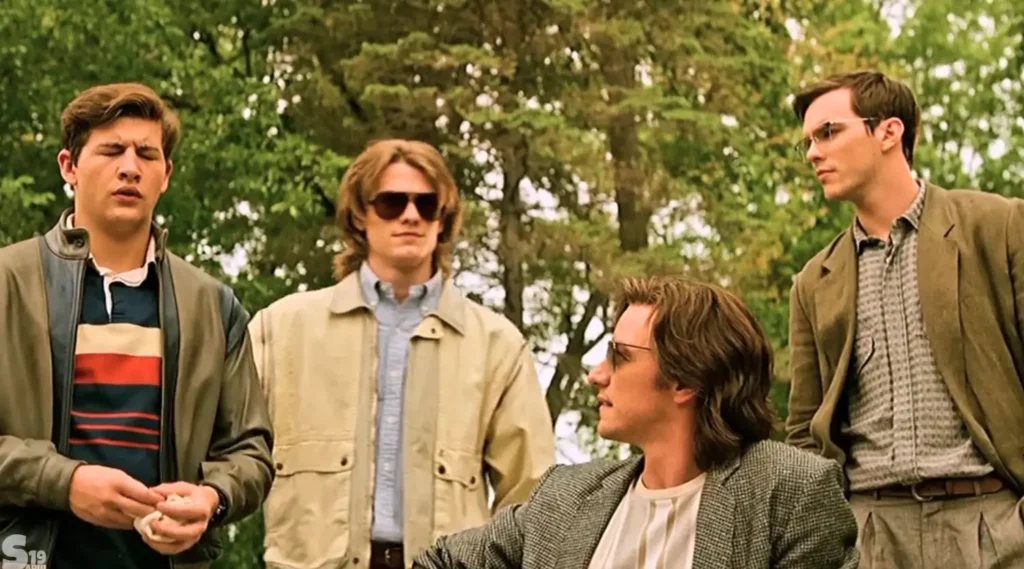
The prequel era tried to course-correct. Tye Sheridan’s young Scott in X-Men: Apocalypse (2016) and Dark Phoenix (2019) brought scrappier energy and actual origin story. But Professor X and Mystique still dominated screen time. Even when Dark Phoenix adapted Jean’s famous storyline, Scott remained secondary.
If you grew up watching these films, you know the frustration.
The animation difference: X-Men: The Animated Series (1992-1997) made Cyclops central. And in 2024, X-Men ’97 reminded everyone why Scott Summers matters, delivering action and character moments that had fans declaring: “Finally. This is the Cyclops we’ve been waiting for.”
Which brings us to December 2026. James Marsden returns in Avengers: Doomsday—wearing the comic-accurate blue-and-yellow costume, unleashing full power in a devastated X-Mansion. After 26 years, Hollywood might finally be ready to show us the Cyclops who’s been in the comics all along.
THE LASTING IMPACT: WHY CYCLOPS ENDURES
The Krakoa era (2019-2024) transformed mutant comics. The sentient island became a sovereign nation. Mutants achieved functional immortality. Cyclops led not as a superhero, but as a general—making impossible decisions, confronting world leaders, delivering his iconic speech: “My family has spent our entire lives hunted and hated. Did you honestly think we were going to sit around forever and take it?”
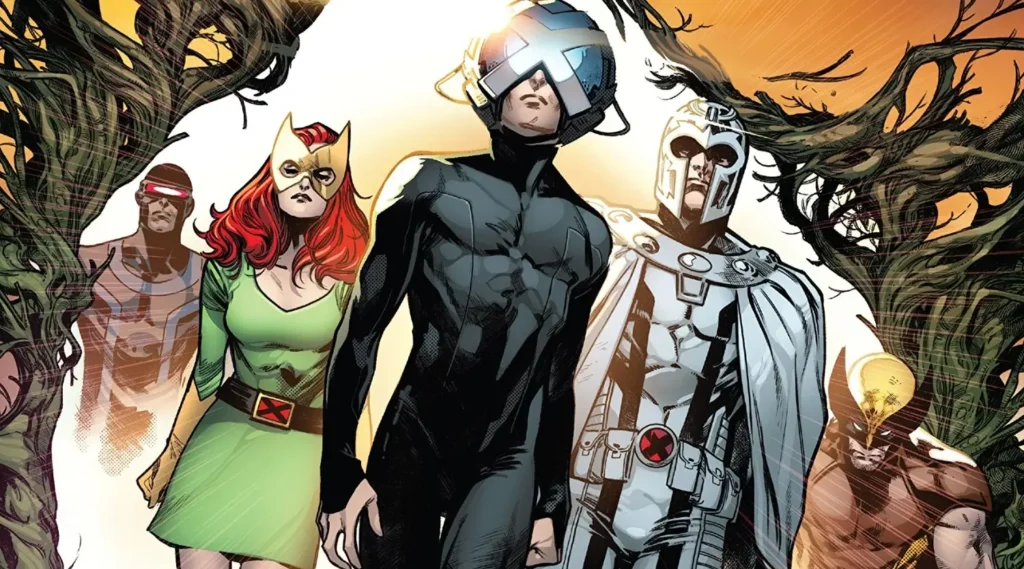
That era ended with Krakoa’s fall, but left Scott Summers fundamentally changed. He stood trial facing execution. Led his team through extinction-level threats. Made choices that would haunt any leader.
Now, post-Krakoa, Cyclops is rebuilding. Leading a new team from Alaska—Beast, Magneto, Psylocke, Kid Omega, Magik, Juggernaut, and Temper. Fighting remnants of anti-mutant forces. Training the next generation. Doing what he’s always done: enduring.
That’s the through-line. From burning plane to mutant nation to fallen paradise, Scott Summers keeps moving forward. The trauma never leaves—the uncontrollable power, the lost parents, the manipulation, the impossible choices. But he channels it into purpose. Into protection. Into leadership that costs him everything and asks for more.
Key Developments:
- Krakoa Transformation (2019-2024): From superhero to revolutionary leader
- Post-Krakoa Era (2024-present): Rebuilding after catastrophic loss
- MCU Integration (2026): Marsden’s return in Doomsday after 26 years
- Animated Success (2024): X-Men ’97 proves character’s enduring appeal
What This Means:
The origin story of Cyclops isn’t just about powers. It’s about what you do when you’re born with a weapon you can’t turn off. When trauma rewires your brain. When villains manipulate your childhood and you still choose heroism. When you lose everything and keep leading anyway.
Avengers: Doomsday represents more than nostalgia. Those three seconds in the trailer—Marsden removing his visor, the scream, the unleashed power in a ruined mansion—carry decades of weight. Every time Cyclops was sidelined. Every moment the films forgot he mattered. Every fan who defended the character knowing what he could be.
This is why the character endures—not despite the trauma, but because of how he transforms it. We all carry wounds. The question is what we build from them.
The themes resonate universally: Control. Learning to live with dangerous parts of yourself. Trauma. How childhood wounds shape adult identity. Responsibility. Being the person everyone depends on. Found family. Creating belonging when your original family was destroyed.
Scott Summers was Xavier’s first student because Xavier saw something essential: not just power, but the capacity to turn pain into purpose. To lead not despite trauma, but informed by it. To understand powerlessness and vow to protect others from that feeling.
The first X-Man. Not the strongest. Not the most popular. But the one who shows up, makes the hard calls, keeps the team together when everything’s falling apart. The one whose origin story is about survival, choice, and refusing to let trauma define you even when it never leaves.
In December 2026 and beyond, audiences will finally see what comic readers have known for 60 years: when written with respect, Cyclops isn’t just another X-Man.
He’s the heart of what they’re fighting for.