

The most honest thing about Spider-Man: Brand New Day‘s casting is the thing nobody wants to say directly: every mentor Peter Parker has had in the MCU — Tony Stark, Nick Fury, Doctor Strange — has lied to him. Not cruelly. Not maliciously. But they’ve all, at some point, told Peter that being a hero and being a person can coexist without cost. Frank Castle won’t do that.
The Punisher — real name Frank Castle — is a former Force Recon Marine turned lethal vigilante. After the mob murdered his wife and children in Central Park, Castle declared a one-man war on all criminals, with no limits and no mercy. In Spider-Man: Brand New Day, Jon Bernthal reprises the role for Frank’s first-ever MCU big-screen appearance.
The Punisher has been in Peter Parker’s world since 1974 — literally the first comic he appeared in was The Amazing Spider-Man #129, and he was sent there to kill Peter. That’s not a footnote. That’s the entire relationship in miniature: two New Yorkers, same streets, same enemy, completely incompatible answers to the same question. And right now, in Brand New Day, Peter is facing the most dangerous version of that question he’s ever encountered. After No Way Home, there’s no Peter Parker left — just Spider-Man wearing his face. Frank Castle knows exactly where that leads.
He’s not in this film by accident. He’s not there because Sony needed an MCU character for their deal with Marvel, though that’s also true. He’s there because he’s the only character in Peter Parker’s orbit who has already become what Peter is at risk of becoming — and survived it.
Who Is the Punisher? Frank Castle, From Marine to One-Man War
Frank Castle was born Francis Castiglione, the son of Italian-American immigrants, and spent his early adult life doing what his upbringing and his instincts pointed him toward: serving. He attended a Catholic seminary before deciding the Church’s theology of forgiveness didn’t match what he was seeing in the world, then enlisted in the United States Marine Corps and became one of its best. Force Recon. Multiple combat tours. The Bronze Star. The Silver Star. Four Purple Hearts. By the time Frank came home, he’d fought in some of the most dangerous operational environments the military could manufacture, and he was still standing.
Then came Central Park.
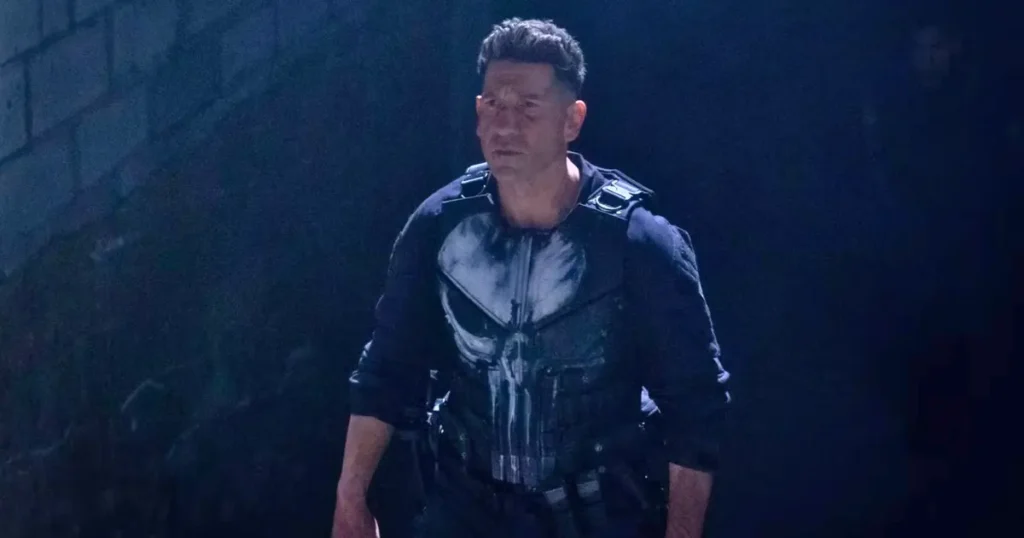
Frank took his wife Maria and their two children — daughter Lisa and son Frank Jr. — for a picnic. They stumbled onto a mob execution. The killers couldn’t leave witnesses, so they shot all four of them. Frank was the only one who survived. He identified the killers. He went to the police. And he watched as every one of them walked free, protected by paid alibis and a system too compromised to move against them.
That’s the moment Frank Castle died. Not physically. Psychologically. He looked at the law, at the institutions he’d served, at the idea of justice as a process — and he decided it was a lie. Then he put on a skull and declared a permanent war.
What makes Frank’s origin genuinely tragic — rather than just dark — is the clarity of the choice. He didn’t snap. He reasoned his way there. He concluded that the system couldn’t deliver what he needed, and he built a replacement. That cold deliberateness is what separates the Punisher from most revenge characters in comics. Frank isn’t grief-stricken. He’s operational.
The Punisher’s Powers and Abilities — What Makes Frank Castle Dangerous
Here’s what the Punisher doesn’t have: speed, strength, invulnerability, energy projection, enhanced healing, or any detectable superpower whatsoever. Nick Fury’s intelligence files once classified Frank Castle at threat level 6 or above — above the threshold reserved for enhanced individuals — not because of anything Frank was born with, but because of what he’d removed.
What Frank Castle doesn’t have is limits.
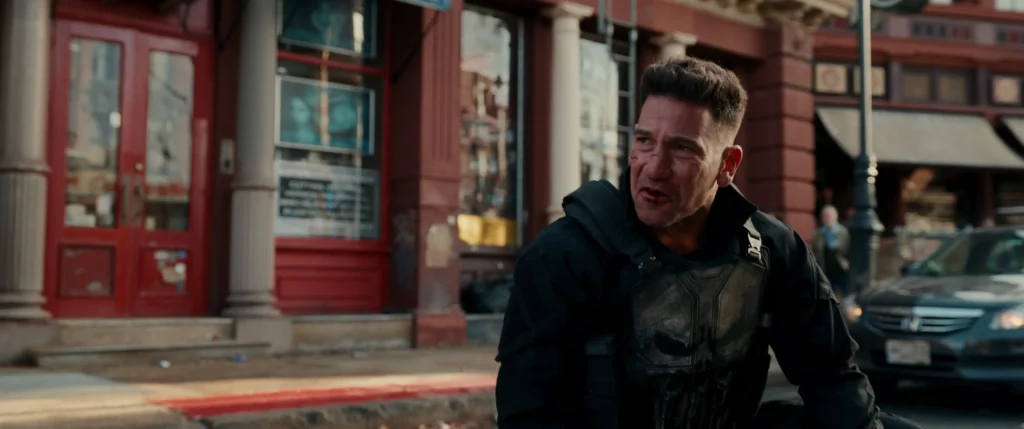
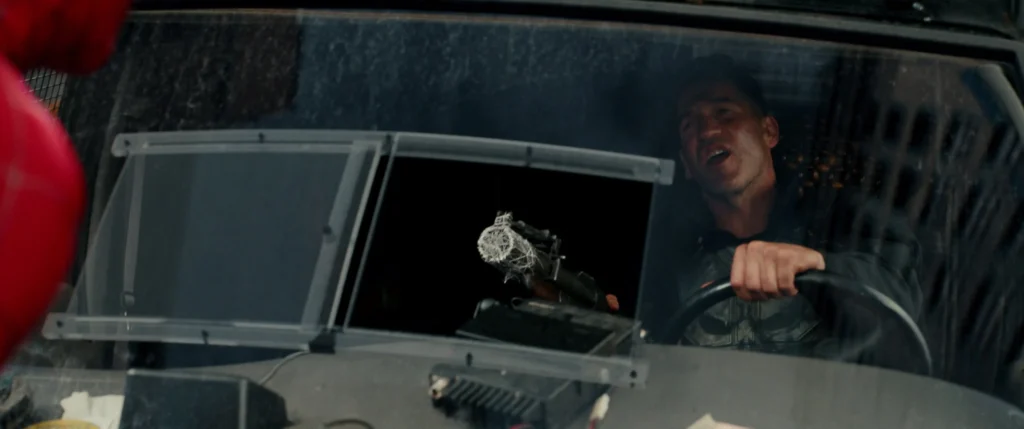
His base skillset starts with Force Recon Marine training — one of the highest-tier special operations combat programs in the US military — and builds from there. Expert marksmanship. Advanced hand-to-hand combat across multiple disciplines. Guerrilla warfare, urban tactics, survival expertise, demolitions, and the kind of strategic mind that can plan a multi-target operation solo with military precision. He maintains a state-of-the-art arsenal, most famously transported in the Battle Van — the heavily armored vehicle that makes its first live-action MCU appearance in Brand New Day — which functions as both mobile armory and command center.
But none of that is actually what makes him dangerous, and if you think it is, you’re missing the point. Daredevil is a better martial artist. Captain America is stronger, faster, and more durable. What neither of them has is Frank Castle’s willingness. He’ll do what they won’t. He’ll go where they stop. He’ll make the call they spend the rest of the story trying to avoid making. That’s the capability that has every hero in the Marvel universe deeply uncomfortable around him — not his skill level, but his answer to the question every street-level hero eventually faces: how far is too far?
Frank’s answer, arrived at in Central Park on the day his family died, is: there is no too far.
The skull on his chest was designed by his creator Gerry Conway to mean exactly that. It’s not intimidation. It’s a statement of philosophy. The Punisher doesn’t represent law and order — he represents their failure.
The Dark Mirror — Spider-Man and the Punisher Have Always Been Built This Way
Most people assume the Punisher ended up in Brand New Day because Marvel needed a street-level character with name recognition and Sony needed an MCU draw. Both true. And both beside the point — because anyone who’s read the comics already knows the Punisher was specifically designed as Spider-Man’s problem.
The Amazing Spider-Man #129, February 1974. Written by Gerry Conway, drawn by Ross Andru, cover by Gil Kane and John Romita Sr. That’s the issue that introduced Frank Castle to the world — and he was introduced as a villain. Not a misunderstood antihero. Not a grey-area figure the reader was meant to empathize with. An assassin, hired by the Jackal and pointed directly at Peter Parker, operating on a false belief that Spider-Man had murdered Norman Osborn. Conway has been direct about his design intention in the years since: the Punisher was created to be an “oppositional figure to superheroes.” Not a villain in the traditional sense — something more uncomfortable than that. A dark reflection of the hero’s logic taken to its endpoint.
Think about what that means. The hero takes the law into his own hands. Sets himself above the system. Decides he knows better than the institutions around him. The Punisher does the same thing — just without the restraint the hero pretends makes it different.
Frank Miller understood this when he used the Punisher as Daredevil’s philosophical foil in his landmark Daredevil run in the early ’80s — specifically issues #183 and #184 — pitting two men who operate outside the law against each other to ask which one had actually reasoned their way to the right answer. Same neighbourhood. Same enemy. Irreconcilable methods. Miller’s framing has been the structural template for every great Punisher/street-hero story since.
That’s the DNA Brand New Day is working with. Not two characters being thrown together for spectacle. Two characters whose entire philosophical architecture was designed to create friction with each other.
The question the film is actually asking isn’t whether Frank Castle and Spider-Man can work together. It’s whether Peter Parker can look at what Frank became — and choose differently.
Why the Punisher Belongs in Brand New Day — Peter Parker’s Identity Crisis
At the end of Spider-Man: No Way Home, Doctor Strange casts a spell that makes the entire world forget Peter Parker exists. Not Spider-Man. Peter Parker. The person underneath the mask — the kid from Queens with the dead uncle and the science scholarship and the friends who know his name — is gone. What remains is a twenty-something living alone in a bare apartment, no support system, no history anyone can verify, no one who loves him as a person rather than a symbol.
For the first time in his MCU life, the mask isn’t something Peter wears. It’s all he has.
That’s the most dangerous position Spider-Man has ever been in — not because of the villains, not because of the stakes, but because of what the vacuum invites. When there’s no Peter Parker left to protect, there’s no gravitational pull back to restraint. No MJ to come home to. No Ned to keep him grounded. No Aunt May voice in his head reminding him what the responsibility actually means. Just Spider-Man, operating in a city full of people who need saving, with no counterweight on the other side of the scale.
Frank Castle is what happens when that counterweight disappears permanently.
Frank didn’t lose his civilian identity by accident. He surrendered it deliberately, at the graveside of his family, and he has never once tried to get it back. There is no Frank Castle anymore — not really. There’s mission planning and tactical assessment and the occasional moment of something that might be grief if you catch it at the right angle. But the man who had a name before the skull? Gone. And Frank knows it. That self-awareness — that he chose this, eyes open, and that it cost him everything that made him a person rather than a weapon — is precisely what makes him the right character to stand in Peter Parker’s path right now.
We’ve seen this dynamic work before. In Daredevil: Born Again Season 1, Frank and Matt Murdock’s dynamic isn’t just two vigilantes tolerating each other — it’s a man who kept his soul in conversation with a man who traded his for a purpose. Matt holds onto his Catholicism, his law practice, his name, his capacity for hope, as a deliberate counterargument to what Frank became. Frank respects it, in his way. But he also knows Matt only gets to maintain it because someone else is doing the work Matt won’t do.
That’s the relationship the film is positioning for Peter. Not mentor and student in the conventional MCU sense — not the Tony Stark dynamic, not the Nick Fury dynamic, not Strange handing Peter a moral framework and a mission. Something rawer. Frank Castle pointing at himself and saying: this is the destination. Figure out if you still want to take the road.
Frank Castle is the first one who’ll show him what being only a hero actually costs.
Jon Bernthal’s Punisher in the MCU — From Netflix to the Big Screen
When Jon Bernthal played Frank Castle in Daredevil Season 2 in 2016, he did something none of his predecessors had managed: he delivered grief. Not action. Not spectacle. Grief. His Frank Castle wasn’t a one-man army who happened to have a tragic backstory — he was a traumatized veteran whose rage had metastasized into something that looked like purpose, and you felt the cost of it in every scene. Dolph Lundgren in 1989, Thomas Jane in 2004, Ray Stevenson in Punisher: War Zone in 2008 — all three gave you the skull and the guns. Bernthal gave you the man underneath, and the absence of the man he used to be.
The character earned his own Netflix series in 2017, ran for two seasons, and then went quiet when the Marvel Netflix deals complicated everything.
What happened next matters for understanding why Brand New Day exists the way it does. When Marvel began planning the post-Netflix MCU, Bernthal was reportedly approached to reprise the role under a softer mandate — a version of the Punisher that pulled back on the darkness to fit more comfortably within the broader MCU’s tonal range. He declined. Bernthal had been clear publicly about his position on the character: Frank Castle only works if the brutality is real, if the weight of what he does is never treated as spectacle. A defanged Punisher, in his view, wasn’t the Punisher at all.
Marvel’s decision to fully canonize the Netflix shows changed the equation. Once Daredevil: Born Again confirmed that everything in the Defenders Saga counted — that Bernthal’s Frank, Charlie Cox’s Matt, the entire street-level history of that era — was part of the same continuity as the Avengers films, the character could come back intact. Born Again Season 1 brought Frank in, established him as a fugitive operating in Fisk’s increasingly hostile New York, and ended with him breaking free of the Kingpin’s dungeon in the mid-credits scene. The Disney+ Punisher Special bridges the gap from there — Bernthal has described it as the most unfiltered version of the character he’s ever played.
Brand New Day lands after all of that. Bernthal filmed his scenes back-to-back with the Special, and he’s been explicit about what he, Tom Holland, and director Destin Daniel Cretton were building toward: a version of Frank that could walk off one set and onto the other without tonal contradiction. The Battle Van makes its first live-action appearance here — a detail that matters more than it sounds, because the Van is Frank’s whole operational infrastructure in the comics, the physical symbol of his war made mobile. Its debut on the big screen is a signal about how seriously this version of the character is being taken.
Worth acknowledging honestly: the Sony/Marvel deal is also a factor. Part of the agreement that keeps Spider-Man in the MCU requires MCU characters to appear in Sony’s Spider-Man films. We’ve seen it with Tony Stark in Homecoming, Nick Fury in Far From Home, and Doctor Strange in No Way Home. Hulk and Punisher in Brand New Day fit that pattern. But here’s the thing — corporate logic and narrative logic aren’t mutually exclusive. The deal created the opportunity. The character earned the placement. You can hold both of those things at once.
For readers who want to understand how Peter Parker’s identity situation and the Hulk angle intersect — specifically why Bruce Banner doesn’t remember who Peter is — that piece of the Brand New Day puzzle is broken down in detail in our piece on the Savage Hulk memory question. And for the full picture of who else is showing up in this film, our Brand New Day villain breakdown covers the rest of the cast.
Here’s the uncomfortable version of this argument: Frank Castle might be right.
Not about the killing. About the honesty. Every mentor Peter Parker has had in the MCU has, at some point, decided Peter couldn’t handle the full truth about what being a hero costs. Tony built him a suit and handed him a legacy without asking if Peter wanted the weight of it. Strange handed him a spell and watched it detonate. Frank Castle doesn’t do that. Frank has no legacy to protect, no reputation to manage, no reason to soften anything. He’ll tell Peter exactly what this road looks like.
Whether that makes him a better mentor than Tony Stark is the argument Brand New Day is positioned to have. I think it does. Prove me wrong in the comments.
Frequently Asked Questions
What is the Punisher’s origin story?
Frank Castle was a decorated Force Recon Marine who witnessed his wife Maria and their two children murdered by the mob in New York City’s Central Park after they accidentally observed a gangland execution. When the killers walked free despite his testimony, Castle abandoned his civilian identity entirely and declared a one-man war on all criminals. He took the name the Punisher and has never stopped.
What happened to Peter Parker after No Way Home?
At the end of Spider-Man: No Way Home, Doctor Strange cast a spell that erased all memory of Peter Parker’s existence from everyone on Earth. Peter now lives anonymously in New York with no friends, no support system, and no one who knows his name — only his identity as Spider-Man remains. Spider-Man: Brand New Day picks up four years after this moment.
How does Spider-Man: Brand New Day connect to Daredevil: Born Again?
The creative teams behind both projects were in constant communication to ensure continuity. Daredevil: Born Again Season 1 ended with the Punisher breaking free from Wilson Fisk’s prison — an event that feeds directly into his appearance in Brand New Day. A Punisher Disney+ Special bridges the gap between his escape and the film. Marvel head of television Brad Winderbaum has confirmed the projects exist in the same world with shared consequences.
Is the Punisher a hero or a villain in Marvel Comics?
Frank Castle is one of Marvel’s most enduring antiheroes — a character who operates outside the moral framework that defines both heroes and villains. He was introduced as a Spider-Man antagonist in Amazing Spider-Man #129 (1974) but became one of Marvel’s most popular and profitable characters through the 1980s and ’90s. His creator Gerry Conway described him as “an oppositional figure to superheroes” — the dark mirror of the hero’s logic without the hero’s restraints.
When does Spider-Man: Brand New Day release?
Spider-Man: Brand New Day releases in theaters on July 31, 2026. Directed by Destin Daniel Cretton and written by Chris McKenna and Erik Sommers, it stars Tom Holland as Peter Parker alongside Jon Bernthal, Mark Ruffalo, Zendaya, Sadie Sink, Jacob Batalon, Michael Mando, and Marvin Jones III.